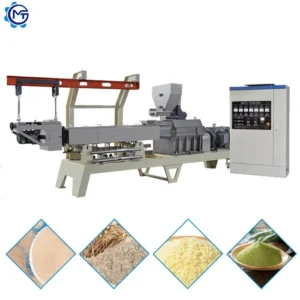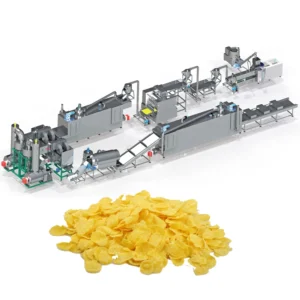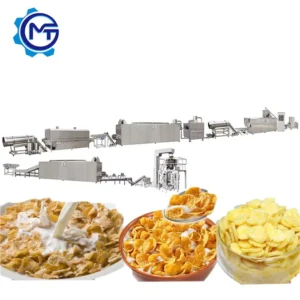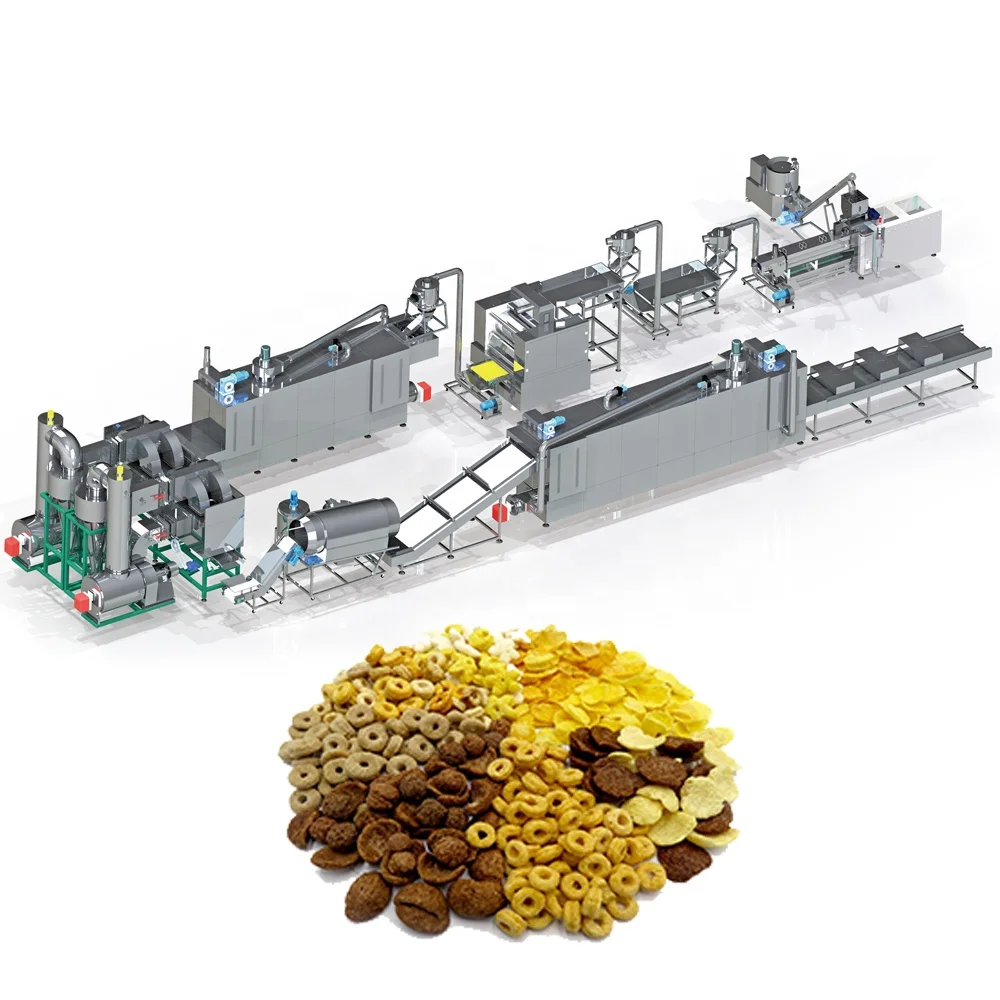
Co-rotating twin-screw design — sectional screw modules and matched die geometry are configured to your grain formulation, controlling starch gelatinisation and flake density rather than relying on a generic copied build.
Technical Specifications
| Parameter | Value |
|---|---|
| Model | MT-65 |
| Product Type | Twin Screw Extruder Corn Flakes Production Line |
| Screw Type | Co-rotating twin screw, sectional modules |
| Mixer Output | 10–30 kg per load |
| Mixer Power | 4 kW |
| Mixer Tank Size | φ600 × 500 mm |
| Mixer Dimension | 1000 × 800 × 1200 mm |
| Screw Conveyor Driving Power | 0.75 kW |
| Corn Flakes Press Machine Power | 16.12 kW |
| Corn Flakes Press Roller Size | 510 × 310 × 1050 mm |
| Corn Flakes Press Material | Stainless steel |
| Corn Flakes Press Features | Large roller with cooling system, adjustable roller gap for flake thickness |
| High-temperature Oven Size | 4.5 × 1.4 × 1.8 m |
| High-temperature Oven Power | 3.75 kW |
| Oven Heating Source | Gas-fired, both-side baking system |
| Sugar Spraying System Total Power | 28.75 kW |
| Sugar Spraying System Roller Size | Ø600 × 2700 mm |
| Sugar Spraying System Dimension | 4000 × 1900 × 1880 mm |
| Contact Material | Stainless steel, food-grade |
| Control System | Separate controller box for flaking unit; full line PLC/MCC configuration available on request |
| Voltage & Frequency | Configurable (e.g. 3ph 380V 50Hz, 3ph 415V 60Hz, 3ph 220V 60Hz — confirm target market at order) |
| Standards | CE |
Application Suitability
| Application | Material or Output |
|---|---|
| Breakfast cereal production | Corn flakes, rings, balls, stars, sticks from corn flour, rice flour, oat flour |
| Fortified breakfast cereal | Grain blends with added vitamins and nutritional ingredients |
| Coated snack products | Corn flakes and puffed snacks with sugar syrup or honey coating |
| Instant breakfast foods | Extruded cereal pieces consumed with milk |
Why the Raw Material Question Must Come Before the Screw Configuration
A screw profile designed for standard corn flour will produce broken, scorched flakes when your local grain carries higher fat content.
I saw this firsthand last year when a Southeast Asian customer ran a corn flake line with standard parameters. Their locally sourced corn flour had noticeably higher fat, and the flakes came off the press brittle and over-browned. Every temperature zone, every moisture setpoint had to be reworked from scratch. The cost was weeks of trial and wasted raw material — all because the corn flakes extrusion technology twin screw setup was copied from a generic reference instead of matched to the buyer’s actual flour profile [NEED_CITE: grain composition variability by growing region].
That incident changed how I approach every shipment. Before any line leaves the workshop, I insist on running the customer’s actual raw material through our testing facility. If the flakes do not meet the target density and bowl-life specification on your flour, the screw configuration gets reworked before the machines are packed.
How Barrel Temperature Zones Shape Flake Consistency
The MT-65 extruder barrel is divided into independently controlled heating zones. Each zone governs a different stage — hydration, gelatinisation, cooking and expansion — so the operator can adjust the profile without disrupting upstream or downstream stages. When corn flour moves through these zones, the co-rotating twin-screw action generates shear and thermal energy that drives starch gelatinisation evenly throughout the dough mass. Getting this profile right is the difference between a flake that holds its crunch in milk and one that turns to mush within seconds. The corn flakes extrusion technology twin screw process depends on this precise thermal staging to produce uniform, shelf-stable cereal.
Die Design and Its Role in Pellet Geometry
After extrusion, the cooked dough mass passes through a die that shapes the pellets before they enter the flaking press. The die orifice diameter and land length determine how much the pellet expands upon exit, which directly affects the thickness and diameter of the final flake after pressing. A die designed for ring-shaped cereal will behave differently than one for traditional flat flakes, and the screw elements must be matched to maintain consistent pressure at the die face. Without this coordination, pellets arrive at the flaking press with inconsistent moisture and density, producing a mixed bed of thick and thin flakes that cannot be uniformly toasted [NEED_CITE: die land length effect on extrudate expansion].
Reading the Specifications: What Each Parameter Means for Your Line
The co-rotating sectional screw design is the core of this system. Sectional modules allow the screw profile to be rearranged — adding or removing conveying, kneading and reverse elements — so the same extruder can handle different grain blends without replacing the entire screw assembly. For a buyer running both corn and oat formulations, this means changeover requires only a module swap rather than a full screw replacement.
The adjustable flaking press with its integrated cooling system addresses a specific failure mode: without roller cooling, the dough pellets stick and tear instead of flattening cleanly. The variable roller gap lets the operator dial in flake thickness to match the bowl-life and crispness specification your market expects.
The gas-fired high-temperature oven with dual-side baking ensures that flakes on the top and bottom of the conveyor receive equivalent heat exposure. Single-side baking creates a gradient — over-toasted surfaces with under-dried cores — which shortens shelf life and produces uneven colour in the retail package.
The sugar spraying system’s temperature-keeping roller maintains syrup viscosity throughout the coating run. Cold syrup thickens and clumps; overheated syrup crystallises. The Ø600 × 2700 mm roller provides enough surface contact time for even distribution before the flakes enter the final drying stage.
The Hidden Cost of Mismatched Line Stations
When the extruder output does not align with dryer capacity, the bottleneck shows up as damp flakes entering the sugar coating station. Coating then slides off instead of bonding, and the final product reaches the packaging line with uneven moisture. I have walked into workshops where operators were manually spreading flakes thinner on the conveyor to compensate — adding labour, slowing throughput, and introducing inconsistency that no amount of downstream adjustment could fix [NEED_CITE: throughput mismatch between extrusion and drying stations in cereal lines]. The same applies in reverse: an oversized dryer running half-empty wastes fuel and degrades flake colour through excessive dwell time.
What Distinguishes This Line from Assembled Alternatives
The entire line from flour mixer through cooling conveyor is configured as a single system, so throughput is matched at every station rather than assembled from independent vendors who each rate their equipment in isolation.
Screw configuration and die geometry are specified against your raw material sample and target flake density, not copied from a generic reference drawing.
The in-house testing workshop allows trial runs on your actual grain formulation before the line ships, so parameter adjustments happen in our facility rather than during your commissioning window.
Separate controller architecture for the flaking unit allows the press to be tuned independently while the extruder maintains its thermal profile, reducing the interaction between stations during changeover.
Food-grade stainless steel contact surfaces throughout the line meet hygiene requirements for breakfast cereal production without requiring aftermarket material upgrades.
Documentation & Verification
- Line layout drawing showing station throughput matching across mixer, extruder, press and dryer
- Screw and die configuration record matched to your grain formulation and target flake density
- Trial run report on your actual raw material conducted before shipment
- Electrical schematic with voltage and frequency confirmed for your facility
- Factory test record documenting run parameters and output sample inspection
- CE declaration of conformity for the complete production line
Installation, Commissioning & Support
- Dedicated power circuits required for the 28.75 kW sugar spraying system and 16.12 kW flaking press
- Modular station layout allows phased installation matching your facility readiness and floor space
- Gas supply connection and ventilation planning needed for the 4.5 m high-temperature oven
- First-run commissioning includes screw profile tuning and barrel zone calibration on your raw material
- Wear parts list covering screw modules, die inserts and press roller surfaces provided at handover
- Operator training on roller gap adjustment and temperature zone management for consistent flake quality
Before You Send an Inquiry
To configure a line that matches your production target, share your grain formulation details including flour type, fat content and any nutritional additives you plan to incorporate. Specify your target flake thickness, bowl-life expectation and retail packaging format. Confirm your facility voltage, frequency and preferred control language so the electrical package is built correctly before shipping. If you have existing upstream milling or downstream packing equipment, provide interface details so the line connects without modification.
Frequently Asked Questions
Q: How is screw configuration determined for different grain formulations?
A: We start with your raw material sample and target flake specification. The sectional screw modules are arranged to balance conveying, mixing, shearing and cooking zones for your specific flour composition. Higher fat or fibre content requires different kneading intensity and barrel temperature staging than standard corn flour. The configuration is documented and can be replicated or adjusted for future formulations.
Q: Can a trial run be performed on my raw material before shipment?
A: Yes. Our in-house testing workshop is equipped to run your actual grain formulation through the extruder and flaking press before the line is packed for dispatch. This allows us to verify flake density, thickness and crispness against your specification and adjust the screw profile or barrel temperatures if results fall outside tolerance.
Q: What barrel temperature profile is used for corn flakes versus other cereal formats?
A: Corn flakes require a gradual temperature ramp across barrel zones to achieve full starch gelatinisation without premature expansion at the die. Ring or ball shapes may use a higher final-zone temperature to drive controlled puffing. Each profile is set during the trial run and documented in the configuration record so operators can restore it after cleaning or product changeover.
Q: How is flake thickness controlled and what is the practical range?
A: The flaking press features an adjustable roller gap that the operator sets based on the target flake thickness for your market. The integrated cooling system prevents dough adhesion to the roller surface, which would otherwise cause tearing and inconsistent gauge. Roller gap is calibrated during commissioning and can be adjusted for different product formats on the same line.
Q: What voltage and control language options are available?
A: Voltage and frequency are configured to your facility standard at order — common configurations include 3ph 380V 50Hz, 3ph 415V 60Hz and 3ph 220V 60Hz among others. Control language for the operator interface is specified during the confirmation stage so documentation and HMI labels match your production team’s requirements before the equipment arrives on site.