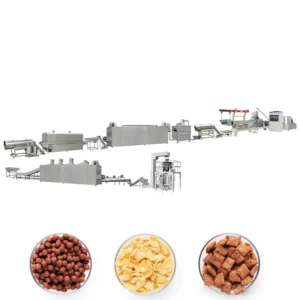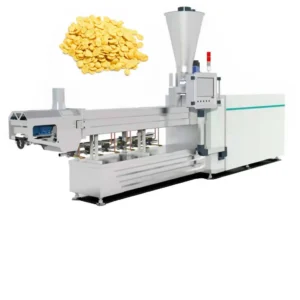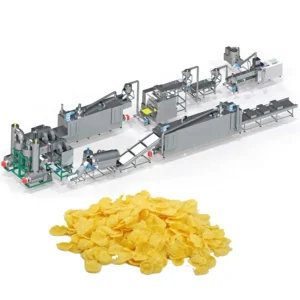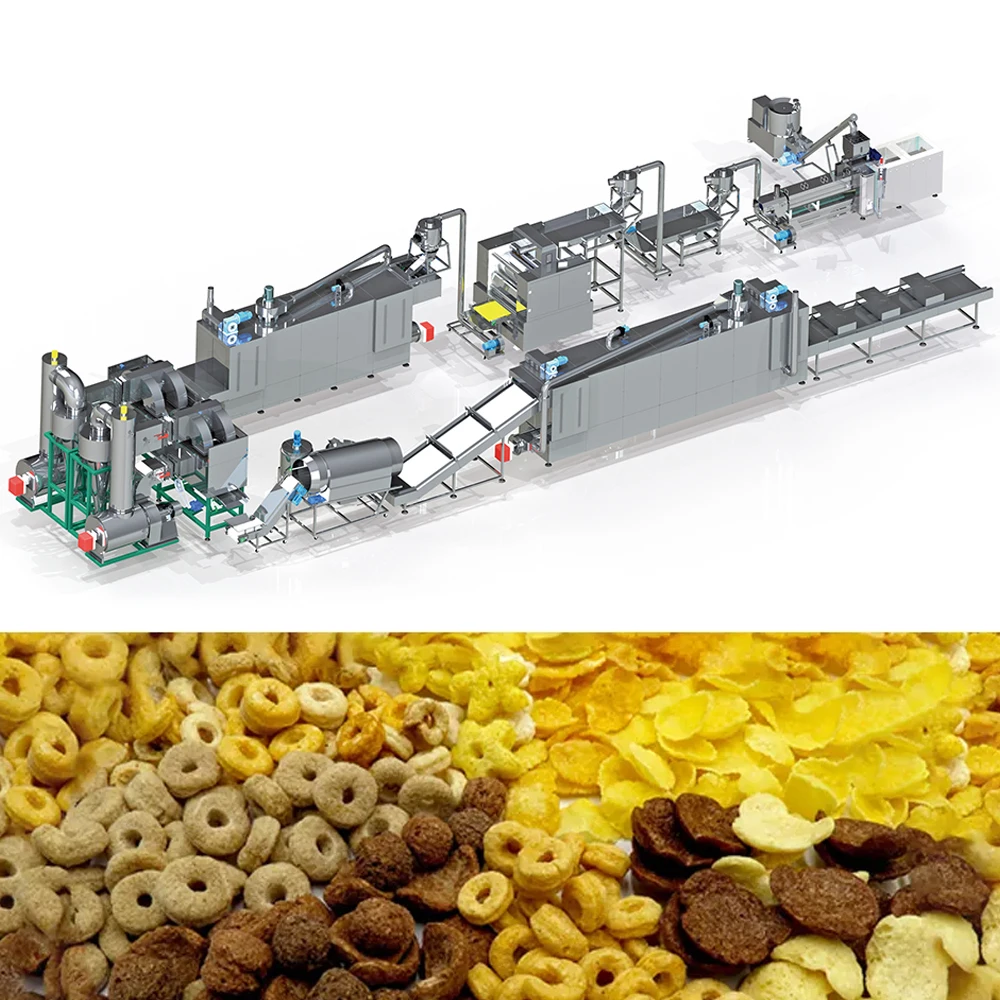
Screw Configuration Matched to Material — Our twin-screw corn flakes extrusion lines are built around your specific corn variety, moisture content, and target flake density, with barrel profiles and die geometry calibrated before the machine ever leaves the factory.
Technical Specifications
| Parameter | Value |
|---|---|
| Product Type | Corn Flakes Breakfast Cereal Production Line |
| Models Available | MT70, MT85, MT75 |
| Extruder Type | Twin Screw |
| Installed Power | MT70: 160 kW; MT85: 190 kW; MT75: 210 kW |
| Power Consumption | MT70: 120 kW; MT85: 140 kW; MT75: 150 kW |
| Output Capacity | MT70: 150–200 kg/h (basis not stated in source); MT85: 300–400 kg/h (basis not stated in source); MT75: 300–500 kg/h (basis not stated in source) |
| Overall Dimensions (L×W×H) | MT70: 41 × 1.5 × 2.2 m; MT85: 43 × 1.5 × 3.2 m; MT75: 45 × 1.5 × 3.5 m |
| Control System | PLC control with MCC integration |
| Flaking Machinery | Hydraulic double-roller system, infrared sensor temperature control |
| Dryer Heating Source | Gas or Electric |
| Hot Air Roasting Oven | Vibrating pan, conciliation burner, dual circulating fans, cyclone dust removal |
| Coating System | Double tumble sugar melting, elevator, coating drum, spraying nozzle |
| Screw Material | Wear-resistant alloy, extended service life |
| Lubrication | Automatic lubricating and cooling |
| Assembly State | Complete turnkey production line |
| Standards | CE certified, ISO certified |
Application Suitability
| Application | Material or Output |
|---|---|
| Traditional corn flakes | Whole corn grits or corn flour with controlled moisture for flaking and roasting |
| Sugar-coated breakfast cereal | Corn flakes base with sugar syrup coating in tumble drum |
| Chocolate-coated cereal | Extruded corn pellets with chocolate enrobing post-roast |
| Various shaped cereal snacks | Alternative die configurations on the same extrusion platform |
Why Nominal Capacity Figures Mislead on Corn Flakes Extrusion Lines
A corn flakes extrusion production line rated at a single throughput number rarely holds that output when your actual corn variety, moisture content, and target flake density differ from the test material.
Buyers frequently receive equipment quoted on a standard corn grit specification, only to discover during commissioning that their locally sourced corn behaves differently under shear and heat. The starch gelatinisation window shifts, expansion ratios fall outside specification, and the flaking rollers produce fractured pieces rather than intact flakes. [NEED_CITE: raw material variability in cereal extrusion processing] When throughput drops to half the expected volume, the entire line economics collapse — drying cycles lengthen, roasting oven occupancy doubles, and coating drums run below their designed fill level.
Barrel Temperature Profiling and Starch Gelatinisation Control
The corn flakes extrusion production line specifications depend heavily on how precisely the barrel temperature zones manage the transition from raw corn grit to fully gelatinised dough. Twin-screw extrusion generates shear heat mechanically, but external barrel zone heating maintains the thermal profile across five or more sequential sections. Each zone targets a specific temperature band that progressively converts crystalline starch structures into an amorphous, pliable mass suitable for downstream flaking. If the gelatinisation degree falls short, the corn dough tears rather than sheets under the flaking rollers; if it overshoots, the material becomes excessively sticky and adheres to the roller surfaces.
Moisture Injection, Shear Rate, and Expansion Ratio
Water introduction into the extrusion barrel determines how much energy the starch granules absorb before exiting through the die. [NEED_CITE: moisture content effects on twin-screw extrusion expansion] Higher moisture content lowers melt viscosity and reduces the shear-induced temperature spike, which in turn limits the expansion ratio at the die exit. For corn flakes destined for hydraulic flaking, a controlled, moderate expansion is essential — too much puffing creates fragile, hollow pellets that shatter under roller pressure; too little produces dense, hard pieces that resist flattening and yield thick, uneven flakes. The screw configuration — including the number and placement of kneading blocks versus conveying elements — governs residence time and the intensity of mechanical shear applied to the corn mass.
Decoding Installed Power and Hydraulic Flaking Pressure
The installed power figures across the three models reflect not only the extruder main drive but also the cumulative load of the hydraulic flaking system, roasting oven burners, and coating drum motors. The MT75’s higher installed power accommodates its larger screw diameter and the greater hydraulic pressure required to flatten higher-throughput corn dough pellets into consistent flakes. The infrared sensor temperature control on the flaking machinery monitors roller surface heat in real time, preventing the corn dough from cooling below its glass transition temperature — a state where it fractures instead of compressing. The automatic lubricating and cooling function on the extruder gearbox protects bearings under continuous high-torque operation.
What Happens When Extrusion Parameters Are Not Material-Specific
When a line ships with generic screw configurations and barrel settings copied from a reference build rather than calibrated to the buyer’s corn source, the consequences surface during the first production run. The extruder may run, but the output pellets arrive at the flaking station with inconsistent internal moisture and variable degrees of gelatinisation. The hydraulic rollers then produce a mix of intact flakes and crushed fragments, forcing operators to constantly adjust roller gap and pressure. [NEED_CITE: extrusion parameter mismatch and product quality variance] Downstream, the roasting oven cannot deliver uniform surface blistering because flake thickness varies from piece to piece, resulting in some flakes that are over-dried and brittle while others remain chewy and under-toasted.
Engineering Confidence Before Shipment
Our in-house testing workshop runs trial production on the buyer’s actual corn raw material before the line ships, generating a documented screw and die configuration record specific to that material. The barrel temperature profile, moisture injection rate, and screw speed are locked in based on trial results, not estimated from catalogue defaults. Electrical schematics and voltage specifications are confirmed against the target market’s grid standards before panel fabrication begins. The PLC control system is programmed with the validated parameter set, so operators inherit a proven recipe on day one of commissioning rather than starting development from scratch. [NEED_CITE: pre-shipment trial run protocols in food extrusion manufacturing]
Documentation & Verification
- Line layout and capacity calculation showing throughput matching from extrusion through coating
- Screw and die configuration record mapped to your corn raw material and target flake density
- Trial run report on customer raw material conducted in testing workshop before dispatch
- Electrical schematic with voltage, frequency, and PLC language confirmed for destination market
- CE declaration of conformity and ISO certificate documentation
- Operation and maintenance manual with wear parts list and replacement intervals
Installation, Commissioning & Support
- Overall dimensions up to 45 × 1.5 × 3.5 m require confirmed floor space, ceiling clearance, and utility routing before foundation work
- Installed power up to 210 kW necessitates dedicated electrical circuits with confirmed voltage and frequency matching local grid supply
- Twin-screw extruder barrel sections and hydraulic flaking rollers ship partially disassembled and are aligned on-site during installation
- PLC control parameters from the factory trial run are verified and fine-tuned during commissioning with operators present
- Wear parts list covering screws, die inserts, and flaking roller surfaces ensures spare inventory is on hand before first replacement is due
- Automatic lubricating system commissioning includes training on refill intervals and cooling circuit maintenance
How to Structure a Meaningful Inquiry
Technical buyers evaluating corn flakes extrusion production line specifications should provide their corn raw material source and typical moisture content, the target flake thickness and bowl-life performance requirements, and the desired hourly output in kilograms. Include your facility’s available floor space, ceiling height, and local electrical voltage and frequency standards. Specify the PLC control language preference and whether sugar-coating or chocolate-coating variants are part of the initial production plan.
Frequently Asked Questions
Q: How is output capacity verified against my specific corn raw material and moisture content?
A: We conduct trial runs in our in-house testing workshop using your actual corn material before the line ships. The trial establishes the validated throughput under your specific moisture content, starch composition, and target flake density. The resulting test report documents achievable output, providing a realistic production baseline rather than a generic catalogue figure.
Q: How is screw configuration and die design selected for my target flake density and expansion ratio?
A: Screw element arrangement — the ratio of kneading blocks to conveying segments — and die geometry are specified after trial runs on your corn raw material. The configuration targets the expansion ratio and pellet structure required for your flaking process, ensuring the hydraulic rollers produce intact, uniform flakes rather than fractured or overly dense pieces.
Q: What barrel temperature profile and moisture/shear parameters control starch gelatinisation?
A: The barrel is divided into sequential heating zones, each targeting a temperature band that progressively gelatinises the corn starch. Moisture injection rate and screw speed together determine the residence time and shear intensity. These parameters are calibrated during the pre-shipment trial to achieve the gelatinisation degree your flaking and roasting stations require.
Q: How are voltage, frequency, and PLC control language confirmed before shipment?
A: Electrical schematics and control panel specifications are reviewed with the buyer during the design phase, matching your facility’s grid voltage and frequency. The PLC human-machine interface language is set to your preference before panel fabrication, preventing commissioning delays caused by miscommunication between operators and the control system.
Q: Is a trial run on my raw material performed before the line ships?
A: Yes. Our in-house testing workshop runs your corn material through the configured extruder, flaking machinery, and roasting oven before dispatch. The trial run report documents screw configuration, barrel temperature profile, moisture settings, and resulting flake characteristics, so the line arrives with a proven production recipe rather than untested defaults.