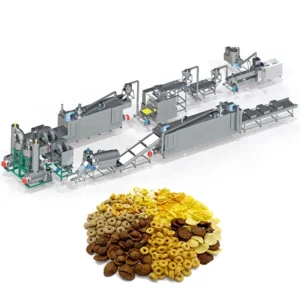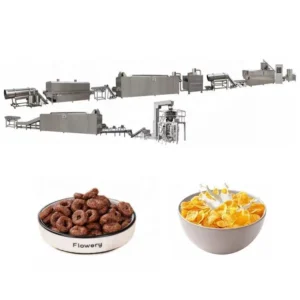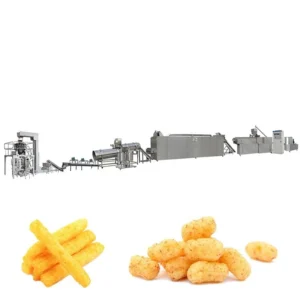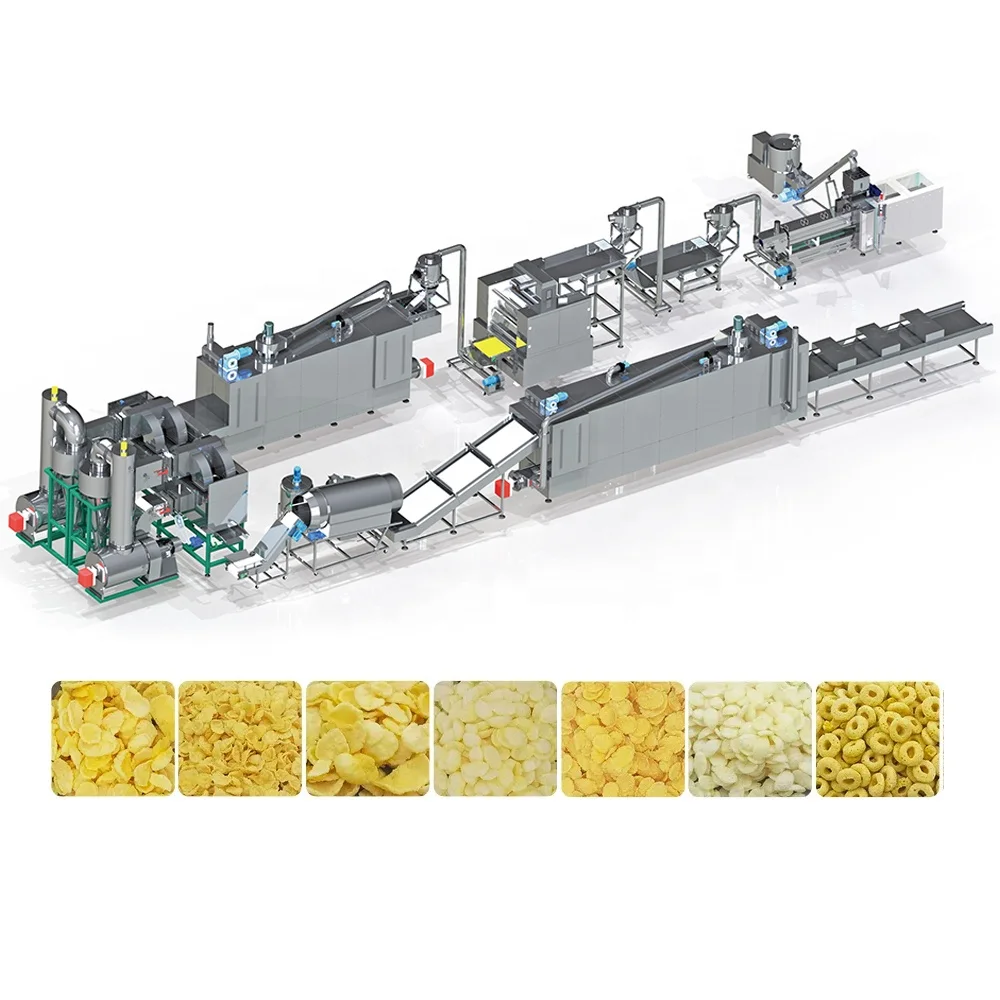
Screw configuration matched to grain — Every extruder in this corn flakes line is configured to the buyer’s actual raw material and target flake density before shipment, not assembled from a generic screw set.
Technical Specifications
| Parameter | Value |
|---|---|
| Model | MT75 |
| Product Type | Twin Screw Corn Flakes Production Line |
| Screw Type | Twin-screw |
| Installed Power | 210 kW |
| Power Consumption | 150 kW |
| Output Capacity | 300–500 kg/h (basis not stated in source — confirm raw material type, moisture content and flake thickness) |
| Overall Dimensions | 45 × 1.5 × 3.5 m |
| Control System | PLC at flaking station, MCC line-level control |
| Basic Raw Materials | Corn, rice, wheat, oat, barley powder |
| Flaking Machine | PLC control, hydraulic double-roller system, separate roller motors, infrared sensor temperature control |
| Dryer Heating Source | Gas or Electric |
| Hot Air Roasting Oven | Vibrating pan, conciliation burner, dual circulating fans, cyclone dust removal |
| Coating System | Double tumble drum for sugar melting, elevator, coating drum, spraying nozzle |
| Standards | CE certified, ISO certified |
Application Suitability
| Application | Material or Output |
|---|---|
| Natural corn flakes | Corn grits or corn flour, flaked and roasted to target density |
| Sugar-coated corn flakes | Corn base with sugar slurry applied through coating drum |
| Multi-grain breakfast cereal | Rice, wheat, oat, barley powder and blended cereal formulations |
| Shaped cereal pieces | Ball, tube, stick, ring, fruit loop, star, wheel, flower, heart profiles via extruder die changes |
What "300–500 kg/h" Actually Requires on Your Grain
Capacity only holds when screw profile, barrel zones and moisture input are tuned to the exact flour or grits being fed.
I have stood in a humid workshop outside Lagos watching a corn flakes extrusion line choke because the screw configuration was copied from a setup running yellow corn, while the buyer sourced local white corn with a completely different starch structure. The flakes came out dense and hard instead of light and crisp, and the whole line had to be shut down for reconfiguration. That kind of mismatch is the most frequent cause of corn flakes extrusion technology production line failures in the field [NEED_CITE: raw material variability impact on extrusion throughput].
Barrel Temperature Profiling Across the Feed Zones
Starch gelatinisation in corn flakes does not happen at a single point — it builds progressively across the barrel zones. The corn flakes extrusion technology production line uses a multi-zone barrel where temperature is stepped to control how early moisture converts to steam inside the dough matrix. Getting this profile wrong means the dough exits the die either under-cooked with raw starch centres, or over-sheared into a sticky mass that cannot be flaked.
Moisture, Shear and the Expansion Window
The twin-screw design allows independent control of shear rate and residence time, which determines how much mechanical energy transfers into the dough. Corn with higher protein content absorbs shear differently than pure starch cereals, and the screw configuration must compensate. Too little shear leaves the flake dense; too much causes premature expansion before the flaking rollers can compress the pellet into a uniform sheet [NEED_CITE: relationship between screw shear and starch gelatinisation in cereal extrusion].
How Installed Power Maps to Line Throughput
The MT75 carries 210 kW installed power with approximately 150 kW typical consumption, leaving thermal and mechanical headroom for harder grains or higher-moisture formulations. The flaking station draws additional power through its hydraulic double-roller system and separate roller motors. When the roasting oven and dryer are gas-fired rather than electric, the electrical load drops substantially, which matters in regions where transformer capacity is limited. The MCC line-level control distributes power across stations so no single circuit is overloaded during startup surges.
The Hidden Cost of a Mismatched Flaking Station
A flaking machine that cannot hold consistent roller pressure produces flakes with uneven thickness — some brittle, some chewy — and the roasting oven then over-dries the thin ones while the thick ones stay soft in the middle. The hydraulic system on this line uses PLC feedback with infrared sensor temperature control to keep the roller gap stable, but that only works if the extruder upstream is delivering a uniform pellet density. When the extrusion parameters drift, even a well-calibrated flaking station cannot compensate, and the final product falls outside the texture spec the market expects [NEED_CITE: flaking roller pressure consistency and cereal texture standards].
Why Procurement on This Line Differs
Screw configuration and die design are specified to your raw material and target flake density, not pulled from a generic catalogue. The in-house testing workshop runs trial production on your actual corn flour or grits before the line ships, so you see the real output rather than a nominal figure. Every station — mixing, extruding, flaking, drying, roasting, coating, cooling — is sized so throughput matches across the entire line instead of bottlenecking at one point. The flaking machine and roasting oven are engineered together so the flake thickness and roasting temperature produce the surface bubbling and crispness your market requires. Voltage, frequency and control language are confirmed against your facility before production begins, avoiding commissioning delays.
Documentation & Verification
- Line layout showing throughput calculation for each station on your cereal formulation
- Screw and die configuration record for your specific grain type and flake target
- Trial run report produced in the testing workshop using your raw material sample
- Electrical schematic with voltage and frequency marked for your destination market
- CE declaration of conformity and ISO certificate copies included with shipment
- Factory test record documenting run parameters and output observations before dispatch
Installation, Commissioning & Support
- Foundation plan accounts for the 45 m line length and vibrating roasting oven load points
- Power supply layout separates the 210 kW extruder circuit from flaking and roasting loads
- MCC panel labels and PLC interface configured to your local language before arrival
- First-run commissioning includes screw speed and barrel zone tuning on your grain supply
- Operator training covers die changeover for different cereal shapes and flake thickness adjustment
- Wear parts list with screw and die replacement intervals based on your material abrasiveness
Before You Request a Quote
To configure this corn flakes extrusion technology production line correctly, we need your raw material type — whether corn grits, corn flour, or a multi-grain blend — along with a sample for the testing workshop. Share your target flake density and whether the product is natural or sugar-coated, plus the voltage and frequency at your plant. Floor space and ceiling height help us plan the dryer and roasting oven placement, and any existing upstream milling or downstream packing equipment should be noted so throughput can be matched.
Frequently Asked Questions
Q: How is screw configuration determined for a specific grain and flake target?
A: The screw elements are arranged based on your raw material’s starch and protein content, target flake density and desired surface texture. Trial runs in the testing workshop confirm the configuration before the extruder is built, using your actual flour or grits sample to validate expansion and cooking behaviour across the barrel zones.
Q: What role does extrusion moisture play in corn flakes density control?
A: Moisture added at the mixer determines how much steam forms inside the dough during extrusion, which sets the pellet density before flaking. Higher moisture increases gelatinisation but can cause excessive expansion if shear is not adjusted. The twin-screw design allows moisture and shear to be balanced independently for each grain formulation.
Q: How does flaking roller pressure affect final flake crispness?
A: Roller pressure compresses the extruded pellet into a uniform sheet, and uneven pressure produces flakes that roast inconsistently. The hydraulic double-roller system on this line maintains constant gap width through PLC feedback, with infrared sensors monitoring temperature to prevent the dough from sticking or tearing during compression.
Q: What trial runs are performed before the line ships?
A: Your raw material is run through the extruder and flaking station in the testing workshop to verify screw configuration, barrel temperature profile and flake thickness. A trial run report documenting output parameters and product samples is provided before the line is cleared for dispatch.