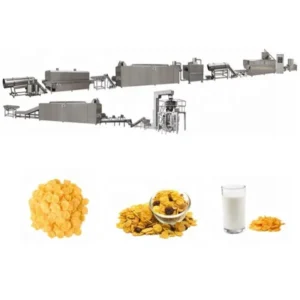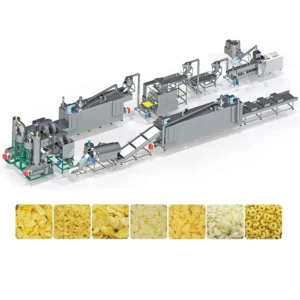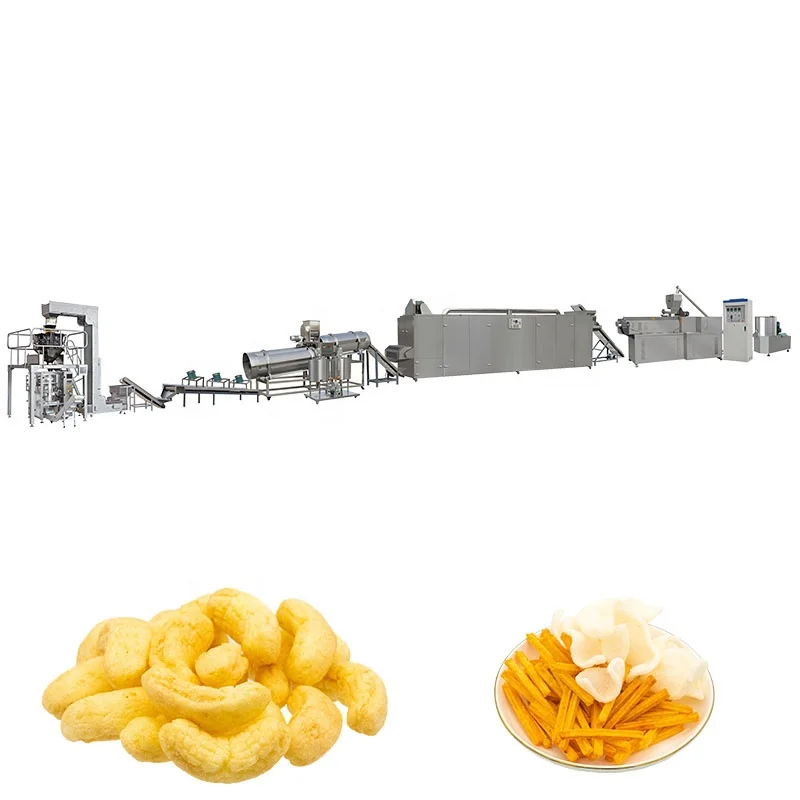
Screw Configuration Matched to Raw Material — every MT-75 barrel segment and die plate is specified after reviewing the buyer’s grain blend and target flake density, not pulled from a generic snack extruder template.
Technical Specifications
| Parameter | Value |
|---|---|
| Model | MT-75 |
| Product Type | Twin Screw Extruder Corn Flakes Production Line |
| Screw Type | Twin screw |
| Output Capacity | 200–300 kg/hr (basis not stated in source — confirm raw material, moisture content and product format) |
| Voltage & Frequency | 220V / 380V (frequency to be confirmed per market) |
| Rated Power | 3 kW (verify against full line power consumption) |
| Control System | PLC control system (flaking machinery) |
| Overall Dimensions | 1330 × 440 × 960 mm (single station reference — confirm full line footprint) |
| Net Weight | 50 kg (single station reference — confirm full line weight) |
| Heating Source | Gas / Electric (dryer and roasting oven) |
| Flaking System | Hydraulic double rollers with separate motor drive; infrared sensor temperature control |
| Roasting Oven | Hot air circulation, conciliation burner, dual circulating fans, cyclone dust removal |
| Coating System | Double tumble sugar melting tank, elevator, coating drum, spraying nozzle |
| Line Stations (Natural) | Mixing → Extruding → Flaking → Drying → Hot Air Roasting → Cooling → Packing |
| Line Stations (Sugar Coated) | Mixing → Extruding → Flaking → Drying → Hot Air Roasting → Sugar Spraying → Coating → Drying → Cooling → Packing |
| Assembly State | Complete turnkey line |
| Warranty | 1 year |
| Certification | CE, ISO |
| Core Components | Gearbox |
| Machinery Test Report | Provided |
| Video Outgoing Inspection | Provided |
Application Suitability
| Application | Material or Output |
|---|---|
| Natural corn flakes for breakfast cereal | Corn grits, rice, wheat, oat, barley blends |
| Sugar-coated corn flakes | Same grain bases with sugar syrup coating |
| Multi-grain breakfast flakes | Blended cereal grains requiring controlled gelatinisation |
| Fortified breakfast cereal | Grain blends with added vitamin and mineral premix |
Why "200 kg/hr on Corn Flakes" Means Nothing Without the Raw Material Profile
Capacity on a corn flake extruder only matters when tied to a specific grain blend, moisture percentage and target flake density.
A twin-screw line running high-starch corn grits at controlled moisture will hold steady throughput, but switch to a barley-heavy blend with lower starch content and the same screw profile will struggle to gelatinise properly. I have watched production lines in the Middle East lose hours of output because the screw configuration was copied from a standard snack build without accounting for the buyer’s actual flour composition. The corn flakes extrusion technology twin screw platform is only as capable as the parameter set loaded into it. [NEED_CITE: starch gelatinisation temperature thresholds by grain type]
Barrel Temperature Profiling for Consistent Gelatinisation
The MT-75 barrel is segmented so that each heating zone can be set independently, which matters because corn, rice and wheat each reach peak starch gelatinisation at different temperatures. Running a uniform heat profile across the barrel causes uneven expansion — some pellets over-expand and shatter downstream, while others stay dense and produce flakes that refuse to crisp in milk. Proper profiling requires matching the barrel zone settings to the specific grain blend and its moisture content entering the extruder.
Die Geometry and Downstream Flaking Roller Gap
The die plate on the MT-75 determines the cross-section of extruded pellets before they hit the hydraulic double rollers. If the die opening is too large relative to the roller gap, the pellets get crushed rather than flattened, producing irregular flakes with weak edges. Matching die design to the flaking station’s hydraulic pressure and roller clearance is part of the corn flakes extrusion technology twin screw configuration process, and it must be validated against the buyer’s target flake thickness before the line ships. [NEED_CITE: pellet-to-flake thickness reduction ratios in cereal processing]
What the PLC Control System Actually Governs on This Line
The PLC on the MT-75 manages screw speed, barrel zone temperatures and the flaking roller motor independently, which keeps the relationship between extrusion rate and flaking pressure stable across production runs. Without coordinated control, a speed adjustment at the extruder can overload the flaking station or leave the roasting oven running empty. The infrared sensor on the flaking rollers feeds real-time temperature data back to the PLC, preventing the rollers from scorching the pellet surface before it is properly flattened.
Reading the Specs That Matter for Flake Density
The 3 kW rated power figure should be verified against the full line’s total consumption, because the roasting oven, dryer and coating system each draw significant additional load. The voltage options of 220V and 380V must be confirmed alongside frequency — a 50 Hz versus 60 Hz supply changes motor RPM at every station, which shifts throughput and can throw off the extruder-to-dryer balance. The hydraulic double rollers with separate motor drive allow independent speed adjustment from the extruder, a critical feature when tuning flake density for different market preferences.
What Happens When the Extruder Is Specified Without Matching Downstream Capacity
I once walked into a facility where the extruder was sized correctly but the roasting oven could not keep pace, creating a bottleneck that forced the extruder to idle every few minutes. Each restart introduced temperature instability in the barrel, producing a batch of under-gelatinised pellets that became tough, chewy flakes rather than crisp ones. The hot air circulation system on the MT-75 line uses dual circulating fans and a cyclone dust removal device to maintain even heat distribution, but only if the oven’s throughput is calculated to match the extruder’s actual output on the buyer’s specific recipe. [NEED_CITE: thermal balance requirements between extruder and roasting stages]
Why Procurement Should Start With a Raw Material Trial
The MT-75 line can be configured for both natural and sugar-coated corn flakes on a single extrusion platform because the coating system sits downstream of the roasting stage. The double tumble sugar melting tank and spraying nozzle add a separate process loop without requiring changes to the screw or die setup. This flexibility only holds if the base flake is structurally sound — sugar coating will amplify any density inconsistency, as uneven flakes absorb syrup at different rates and emerge with blotchy coverage. Testing the buyer’s grain blend before shipment catches these issues while adjustments are still cheap.
What Differentiates This Line Beyond the Brochure
Screw and die configuration is documented against the buyer’s specific grain blend and target density, not pulled from a stock build. The in-house testing workshop runs the buyer’s actual raw material through the extruder before dispatch, generating a trial run report that confirms expansion ratio and flake texture. Throughput is calculated across every station — extruder, flaking rollers, dryer, roasting oven and coating drum — so that no single station bottlenecks the others. Electrical schematics are confirmed for the buyer’s voltage and frequency before production begins. The entire line from batching through packing comes from one supplier, eliminating the integration gaps that appear when stations are sourced separately.
Documentation & Verification
- Screw and die configuration record matched to your grain blend and target flake density
- Trial run report on your supplied raw material confirming expansion ratio before dispatch
- Line layout drawing showing throughput balance between extruder, flaking rollers and roasting oven
- Electrical schematic with voltage and frequency confirmed for your facility’s supply
- CE declaration of conformity and ISO certificate for customs and regulatory clearance
- Operation and maintenance manual covering PLC parameter ranges and roller calibration
Installation, Commissioning & Support
- Foundation plan accounts for the hydraulic double roller assembly’s vibration and load distribution
- Dedicated electrical circuit sized to the confirmed full-line power draw at your local voltage and frequency
- PLC interface language configured to your operators’ preference before the control cabinet ships
- First production run supervised on-site with screw speed and barrel zones tuned to your grain blend
- Wear parts list specifies screw elements, die plates and roller surfaces with replacement intervals
- Cyclone dust removal device on the roasting oven requires periodic filter inspection per the maintenance schedule
What to Include in Your Inquiry
Share the grain blend or blends you intend to run, along with typical moisture content and any vitamin or mineral premix additions. Specify your target flake thickness and whether you need both natural and sugar-coated variants. Confirm your facility’s voltage, frequency and available floor space so the line layout and electrical package can be prepared before quotation.
Frequently Asked Questions
Q: How is screw configuration selected for different grain blends and target flake densities?
A: The screw element arrangement and die geometry are chosen after reviewing your specific grain composition, starch content and the flake density your market expects. A corn-dominant blend requires a different shear profile than an oat-heavy mix. Configuration is documented and validated through a trial run on your raw material before the line ships.
Q: What barrel temperature profile and moisture range are needed for proper starch gelatinisation in corn flakes?
A: Each barrel zone is set independently based on the grain blend’s gelatinisation threshold and the moisture content of the material entering the extruder. Too low a temperature leaves raw starch centres that produce tough flakes; too high causes over-expansion and shattering. Exact profiles are established during the pre-shipment trial.
Q: How is the extruder’s expansion ratio matched to the downstream flaking and roasting stations?
A: Die opening size, roller gap and roasting temperature are calculated together so that extruded pellets flatten to the target thickness without cracking, then toast evenly. If one station is misaligned, flakes emerge either too dense to crisp or too fragile to survive coating and packing.
Q: Can the line produce both natural and sugar-coated corn flakes without hardware changes?
A: Yes. The sugar coating system operates downstream of the roasting oven and uses a separate process loop with the double tumble melting tank and spraying nozzle. Switching between natural and coated variants requires only a recipe change in the PLC, not mechanical reconfiguration of the extruder or flaking rollers.
Q: Is a trial run on my raw material available before shipment to confirm flake texture and density?
A: The in-house testing workshop runs your actual grain blend through the MT-75 extruder and flaking rollers before the line ships. The resulting trial run report documents expansion ratio, flake thickness and texture so you can verify product quality before the equipment leaves the factory.