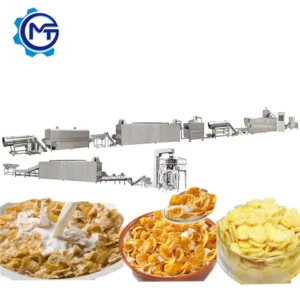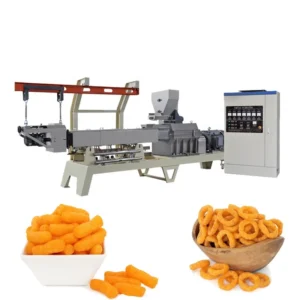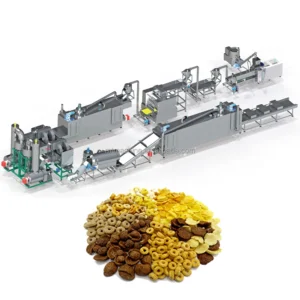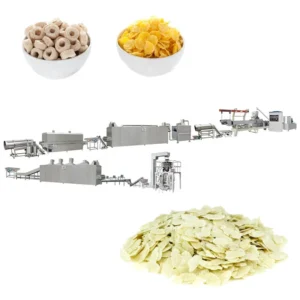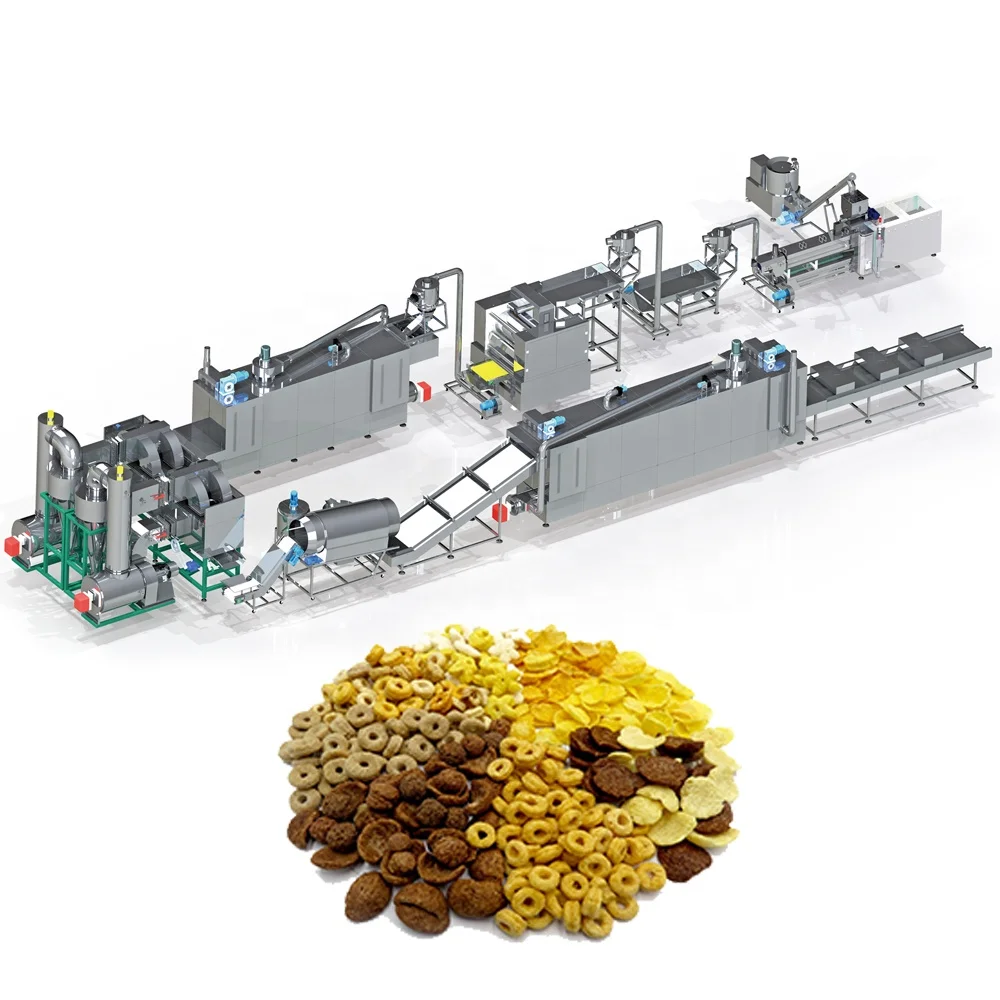
Custom Screw Configuration — Twin screw geometry and barrel temperature profile are matched to your specific corn or cereal raw material before the line ships, not copied from a generic build.
Technical Specifications
| Parameter | Value |
|---|---|
| Model | MT70, MT85, MT75 |
| Product Type | Twin Screw Corn Flakes Extrusion Line |
| Screw Type | Twin Screw |
| Installed Power (MT70) | 160 kW |
| Installed Power (MT85) | 190 kW |
| Installed Power (MT75) | 210 kW |
| Power Consumption (MT70) | 120 kW |
| Power Consumption (MT85) | 140 kW |
| Power Consumption (MT75) | 150 kW |
| Output Capacity (MT70) | 150–200 kg/h (basis to be confirmed on buyer’s raw material and moisture content) |
| Output Capacity (MT85) | 300–400 kg/h (basis to be confirmed on buyer’s raw material and moisture content) |
| Output Capacity (MT75) | 300–500 kg/h (basis to be confirmed on buyer’s raw material and moisture content) |
| Overall Dimensions (MT70) | 41 × 1.5 × 2.2 m |
| Overall Dimensions (MT85) | 43 × 1.5 × 3.2 m |
| Overall Dimensions (MT75) | 45 × 1.5 × 3.5 m |
| Control System | PLC for flaking station; MCC/PLC for extrusion line |
| Flaking Station | Hydraulic double-roller system, independent motor drive, infrared sensor temperature control |
| Dryer Heating Source | Gas or Electric (selectable) |
| Roasting Oven | Hot air roasting with conciliation burner, two circulating fans, cyclone dust removal |
| Coating System | Double tumble for sugar melting, elevator, coating drum, spraying nozzle |
| Raw Materials | Corn, rice, wheat, oat, barley powder |
| Final Product Shapes | Natural corn flakes, sugar-coated flakes, ball, tube, stick, ring, fruit loop, star, wheel, flower, heart |
| Voltage & Frequency | Configurable to local supply |
| Assembly State | Complete line from mixing to packing |
| Certification | CE, ISO |
Application Suitability
| Application | Material or Output |
|---|---|
| Natural corn flakes production | Corn grits or corn flour base |
| Sugar-coated breakfast cereal | Corn, rice, or wheat base with sugar spray coating |
| Shaped cereal snacks (rings, balls, stars) | Corn, oat, or barley powder via die adjustment |
| Fortified breakfast cereal | Blends with added vitamins and minerals requiring controlled gelatinisation |
| Multi-grain flake production | Rice, wheat, oat, and barley powder combinations |
Why Nominal Capacity Rarely Survives Contact With Your Raw Material
A corn flakes extrusion line rated at 300 kg/h on standard corn grits may drop below 200 kg/h the moment your supplier delivers flour with two points higher moisture.
I learned this the hard way during a commissioning in the Gulf region. The line ran perfectly during factory acceptance on the standard test corn. Three weeks later, the buyer’s locally sourced corn flour arrived with elevated moisture content, and every flake coming off the roller blistered on the surface. An entire batch was scrapped before we re-profiled the barrel temperature zones and adjusted the flaking roller gap. When evaluating corn flakes extrusion line specifications, the number on the quote sheet is only meaningful if it was established on raw material that matches yours [NEED_CITE: raw material moisture variability in breakfast cereal processing].
How Screw Geometry Controls Starch Gelatinisation in Corn Flakes
The twin screw configuration on the MT70, MT85, and MT75 models governs how thoroughly starch granules are cooked before the dough reaches the die. Corn flakes extrusion line specifications become meaningful only when screw pitch, kneading block arrangement, and barrel zone temperatures are tuned to the specific cereal base. Corn requires a different shear profile than oat or barley, and running a generic screw build on an unfamiliar grain will produce uneven gelatinisation — some sections undercooked, others degraded.
Barrel Temperature Profiling Across the Cooking Zones
Each barrel zone on the MT-series extruder operates under independent temperature control, allowing the thermal profile to ramp gradually from the feed section through the metering and cooking zones. This staged heating prevents the sudden moisture flash-off that causes internal voids in the extrudate. On a corn base, the transition from the first heating zone to the die face typically spans several distinct setpoints [NEED_CITE: thermal profile management in twin screw food extrusion]. Getting this wrong produces dough that either fails to flake properly or emerges with surface cracking that worsens during roasting.
Reading the Specs That Actually Matter for Flake Density
The installed power figures — 160 kW on the MT70, 190 kW on the MT85, 210 kW on the MT75 — indicate the mechanical energy available for shear and cooking inside the barrel. Higher installed power supports longer residence times and more thorough gelatinisation, which is necessary when processing harder grains like corn at higher throughputs. The flaking station uses a hydraulic double-roller system with independent motor drive, meaning roller gap and surface speed are adjusted separately. This matters because flake thickness and density are determined by the gap at the nip point combined with the dough temperature arriving from the extruder. The infrared sensor temperature control on the rollers maintains consistent surface conditions across long production runs, preventing density drift that would otherwise show up as uneven roasting downstream.
The Hidden Cost of Mismatched Dryer and Roaster Capacity
An extruder producing at full output means nothing if the dryer cannot remove moisture fast enough or the roasting oven cannot deliver uniform hot air across the full belt width. Buyers frequently discover this bottleneck after installation, when the line must be throttled back to prevent product accumulating between stations. On the MT-series lines, the roasting oven is equipped with two separate circulating fans and a conciliation burner, while the cyclone dust removal device handles particulate generated during roasting. If the dryer heating source — gas or electric — is not matched to the site utility supply, the entire line stalls at a fraction of the extruder’s rated output [NEED_CITE: throughput matching across breakfast cereal line stations].
Why Buying From One Source Changes the Commissioning Experience
When every station from mixing through packing comes from a single supplier, throughput is calculated across the full chain before the line is built. The screw configuration and die design are specified to your raw material and target flake density, not borrowed from a previous installation on a different grain. The in-house testing workshop runs trial production on your actual corn, rice, or oat flour before the equipment leaves the factory — so starch gelatinisation, flake thickness, and roasting behaviour are verified before you see the line on your floor. Electrical schematics are prepared with your local voltage and frequency confirmed, and the PLC control language is set before shipment rather than discovered as a problem during commissioning.
Documentation & Verification
- Screw and die configuration record specifying the geometry matched to your cereal raw material
- Trial run report produced on your corn or grain flour in the testing workshop before dispatch
- Line layout drawing showing throughput calculation across mixing, extrusion, flaking, drying, roasting, and packing
- Electrical schematic with confirmed voltage, frequency, and PLC language for your facility
- Factory test record documenting dimensional and operational checks on every station before crating
- Operation and maintenance manual covering roller gap adjustment, barrel zone setpoints, and wear part replacement intervals
Installation, Commissioning & Support
- Foundation plan accounting for the MT75 line footprint of 45 m length and utility connections across all stations
- Dedicated electrical circuit sizing based on the MT85 installed power of 190 kW with local voltage confirmation
- Hydraulic system commissioning on the flaking station with roller gap and pressure set to target flake thickness
- Barrel temperature profile tuning across all heating zones using buyer’s actual raw material moisture content
- Operator training on PLC interface for flaking control and MCC panel for extruder start-up and shutdown sequences
- Wear parts inventory covering screw elements, die plates, and flaking roller surfaces for initial replacement cycles
What to Prepare Before Requesting a Quote
Before pricing a line, the engineering team needs to understand your production context. Share the specific cereal base you intend to process — whether corn grits, rice flour, oat, or a blend — along with the moisture content your supplier typically delivers. Confirm the voltage and frequency at your facility, the PLC language preference for your operators, and the available floor space including ceiling height for the dryer and roasting oven. If you are running existing upstream mixing or downstream packing equipment, provide interface details so the line can be matched at the connection points.
Frequently Asked Questions
Q: How is extruder capacity verified against my specific raw material and moisture content?
A: Before shipment, a trial run is conducted in the in-house testing workshop using your actual corn, rice, or cereal flour. The screw configuration, barrel temperature profile, and die design are adjusted during this run. A test report documenting throughput, gelatinisation quality, and flake density is provided so the capacity figure reflects your material, not a generic benchmark.
Q: What screw configuration and die design are specified for corn versus rice or oat base?
A: Corn requires higher shear energy and a longer cooking zone to fully gelatinise its starch compared to rice or oat. The screw element arrangement — including kneading block positions and reverse-flight sections — is selected accordingly. Die aperture and land length are matched to the target flake thickness and the expansion behaviour of the specific grain being processed.
Q: How is flaking roller gap and temperature controlled to achieve target flake thickness?
A: The hydraulic double-roller system allows independent adjustment of gap and roller speed. Infrared sensors monitor roller surface temperature in real time, maintaining consistent conditions so dough arriving from the extruder flattens to uniform thickness without sticking or tearing. Both gap and temperature are recorded during the trial run and documented for your production setup.
Q: How are voltage, frequency, and PLC control language confirmed before shipment?
A: During the specification confirmation stage, your local electrical supply details and operator language preference are recorded on the electrical schematic. Motors, heaters, and control panels are built to match. The PLC interface and MCC labeling are completed in the confirmed language before factory testing, eliminating commissioning delays caused by incompatible voltage or unreadable controls.
Q: What is the process for trial runs on customer raw material before the line ships?
A: Once your raw material arrives at the testing workshop, the line is assembled and run under production conditions. Extruder parameters, flaking gap, dryer temperature, and roasting profile are tuned iteratively. The finished flakes are evaluated for density, surface quality, and crispness. A full report is shared with the buyer, and any necessary configuration changes are made before the line is disassembled for packing and shipment.