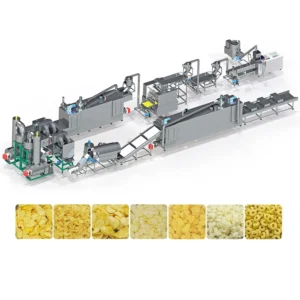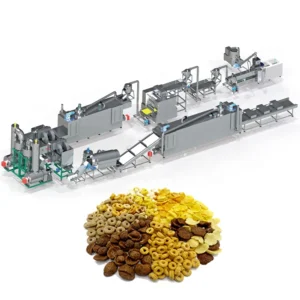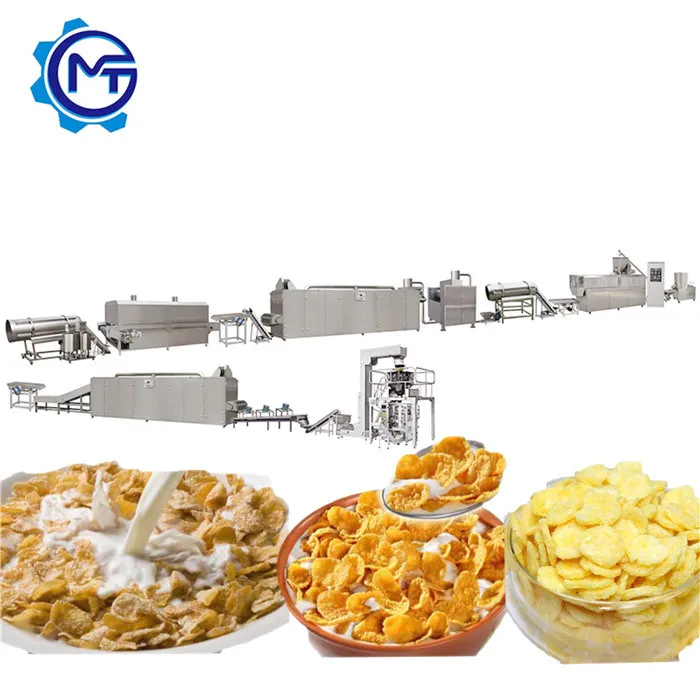
Screw Geometry Matched to Formulation — We run your actual cereal grain through our testing workshop and lock screw element layout, die orifice, and moisture profile before the MT75 ships, so extrusion density holds on your raw material rather than a generic test blend.
Technical Specifications
| Parameter | Value |
|---|---|
| Model | MT75 |
| Product Type | Corn Flakes Production Line (Twin-Screw Extrusion) |
| Screw Type | Twin Screw |
| Installed Power | 210 kW |
| Power Consumption | 150 kW |
| Output Capacity | 300–500 kg/h (basis not stated in source — confirm raw material, moisture, flake thickness) |
| Overall Dimensions (L×W×H) | 45 × 1.5 × 3.5 m |
| Control System | PLC |
| Flaking Station | Hydraulic double-roller system, dual independent motors, infrared sensor temperature control |
| Dryer Heating Source | Gas or Electric |
| Roasting Station | Hot-air oven with vibrating pan, high-temperature spraying tubes, dual circulating fans, cyclone dust removal |
| Coating Station | Double tumble sugar melter, elevator, coating drum, spraying nozzle |
| Line Stations | Mixing → Extruding → Flaking → Drying → Hot Air Roasting → Sugar Spraying → Sugar Coating → Drying → Cooling → Packing (natural line omits sugar stations) |
| Basic Raw Materials | Powder of corn, rice, wheat, oat, barley |
| Final Product Shapes | Natural corn flakes, sugar-coated corn flakes, ball, tube, stick, ring, fruit loop, star, wheel, flower, heart (by die change) |
| Certification | CE |
Application Suitability
| Application | Material or Output |
|---|---|
| Natural corn flakes for breakfast cereal retail | De-germed corn grits, flaked and roasted to target crispness and bowl life |
| Sugar-coated corn flakes | Corn-based extrudate passed through double tumble coating with sugar syrup |
| Multi-grain cereal flakes | Rice, wheat, oat, and barley powders processed through the same twin-screw platform |
| Variety-shape extruded cereal snacks | Rings, stars, fruit loops, and other formats produced by die change on the extruder |
What "500 kg/h" Leaves Out About Corn Flakes Extrusion Lines
Nominal capacity means nothing until the extruder runs your specific grain at your target moisture and flake thickness.
I learned this on a European commissioning where the line was rated on standard corn flour, but the buyer’s actual de-germed corn grits ran coarser. The screw intake became unstable, expansion fluctuated, and flake thickness drifted outside spec for the first two weeks. The corn flakes extrusion production line specifications on paper looked fine; the reality on the factory floor told a different story. That is why every MT75 configuration we ship starts with a trial run on the buyer’s real material [NEED_CITE: importance of raw material verification in extrusion projects].
Barrel Zone Profiling and Screw Element Layout
The MT75 twin-screw extruder uses a modular barrel with independently heated zones. Screw element sequencing — conveying, kneading, and reverse-pitch sections — is selected based on the starch gelatinisation behaviour of your grain blend. A corn-dominant formulation requires different shear intensity and residence time compared to an oat-heavy mix. The corn flakes extrusion production line specifications we quote reflect the screw configuration tested on your material, not a generic arrangement carried over from a previous build.
Die Geometry and Flake Expansion Control
Die orifice diameter and land length determine the extrudate rope’s expansion ratio and surface texture as it exits the barrel. For corn flakes, the die must produce a consistent rope diameter so the hydraulic double-roller flaking station can press each piece to uniform thickness. If the die geometry does not match the formulation’s expansion behaviour, flakes emerge too thin and brittle or too thick and doughy. The die design is locked during the in-house trial and recorded in the configuration documentation shipped with the line [NEED_CITE: die design influence on extrudate density and texture].
Reading the Spec Sheet Beyond Installed Power
The MT75 lists 210 kW installed power and 150 kW operating consumption across the full line from mixer to packer. The 45-meter line length reflects the number of stations required for a complete corn flakes process: extrusion, flaking, primary drying, hot-air roasting, sugar coating, secondary drying, and cooling. The hydraulic double-roller flaking station uses dual independent motors and infrared temperature sensing to maintain consistent pressure and roller surface condition. The hot-air roasting oven employs two separate circulating fans and a cyclone dust removal device to achieve even surface blistering without scorching. These corn flakes extrusion production line specifications tell you whether the line fits your facility and utility infrastructure, not just what it produces per hour.
When Downstream Stations Cannot Keep Up
A frequent failure mode in cereal lines is mismatched throughput between the extruder and the flaking or drying stations. If the flaking rollers cannot process the extrudate rope at the rate the twin-screw produces it, material backs up, moisture drops, and the flakes lose the pliability needed for clean pressing. Similarly, if the hot-air roasting oven lacks sufficient residence time or airflow capacity, flakes exit under-toasted with poor crispness and short bowl life. These bottlenecks are not visible in a single-number capacity claim [NEED_CITE: line throughput balancing in multi-station food processing].
Why the MT75 Is Configured Before It Is Quoted
Each MT75 line is laid out station by station so that mixer batch size, extruder throughput, flaking roller width, dryer belt length, and coating drum volume are calculated against the same target output. The PLC control system coordinates start-up sequencing and speed references across every station. The screw configuration and die design are specified to the buyer’s cereal formulation and confirmed through an in-house trial run. The roasting oven, with its dual circulating fans and vibrating pan, is sized to match the dryer output so flakes receive uniform heat treatment. Electrical schematics confirm voltage, frequency, and control language before production begins, eliminating commissioning delays on site.
Documentation & Verification
- Line layout drawing showing station-by-station throughput calculation for your target capacity
- Screw element sequence and die geometry record specific to your cereal formulation
- Trial run report from our testing workshop on your actual raw material before shipment
- Electrical schematic confirming voltage, frequency, and PLC interface language for your market
- CE declaration of conformity covering the complete extrusion and downstream line
- Operation and maintenance manual with wear parts list for screws, dies, and flaking rollers
Installation, Commissioning & Support
- 45-meter line footprint requires level concrete floor with drainage provisions for the dryer and cooling sections
- 210 kW installed load demands dedicated three-phase supply; voltage and frequency confirmed before production
- Extruder barrel, flaking rollers, and roasting oven ship in separate modules for container loading and on-site assembly
- First-run commissioning includes screw speed, barrel temperature, and flaking pressure calibration on your grain
- Operator training covers PLC navigation, die change procedure, and daily cleaning of the twin-screw barrel
- Wear parts list identifies screw elements, die plates, and flaking roller surfaces with recommended replacement intervals
What We Need to Configure Your Line
Share your primary grain type and particle size, target flake thickness, and whether you plan to run natural or sugar-coated variants. Confirm your facility voltage and frequency, available floor length, and ceiling height for the dryer and roasting stations. If you have existing upstream batching or downstream packing equipment, provide interface details so the MT75 integrates without redundant conveyors.
Frequently Asked Questions
Q: How is output capacity verified on the buyer’s actual cereal formulation?
A: We conduct a trial run in our testing workshop using the buyer’s supplied raw material at the target moisture level. Extruder screw speed, barrel temperature profile, and die selection are adjusted until flake density and thickness meet specification. The resulting parameters are documented and locked for production, so the capacity figure we quote reflects your grain, not a generic test flour.
Q: How are screw elements and die geometry selected for different flake densities?
A: Screw element sequencing controls shear intensity and residence time inside the barrel, which determines starch gelatinisation degree and extrudate expansion. Die orifice size and land length shape the rope diameter before flaking. We adjust both based on the target bowl life and crispness the buyer’s market expects, then confirm the combination during the pre-shipment trial run.
Q: What voltage, frequency, and PLC language options are confirmed before shipping?
A: Electrical schematics are reviewed with the buyer before production starts. We confirm supply voltage, phase configuration, and frequency for the destination market. The PLC interface language is set to the buyer’s preference. This prevents rewiring delays and operator confusion during on-site commissioning.
Q: How is the flaking station matched to extruder output?
A: The hydraulic double-roller flaking station is sized so its roller width and line speed can process the full extrudate output without material backlog. Dual independent motors allow separate roller speed adjustment, and infrared temperature control maintains consistent surface condition. This prevents throughput bottlenecks between extrusion and flaking stages.
Q: What does the in-house trial run cover and what documentation is delivered?
A: The trial run processes the buyer’s raw material through extrusion, flaking, and roasting to verify flake thickness, density, and crispness. We deliver a trial run report with the confirmed screw configuration, die geometry, barrel temperature profile, and moisture settings. This record travels with the machine so on-site commissioning starts from a known baseline.