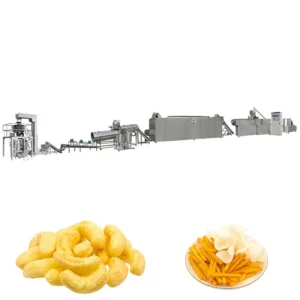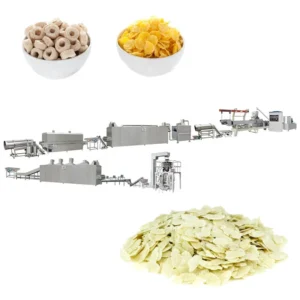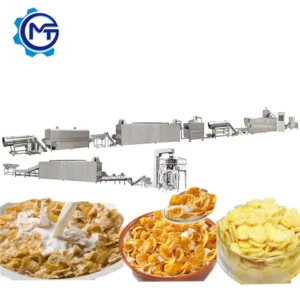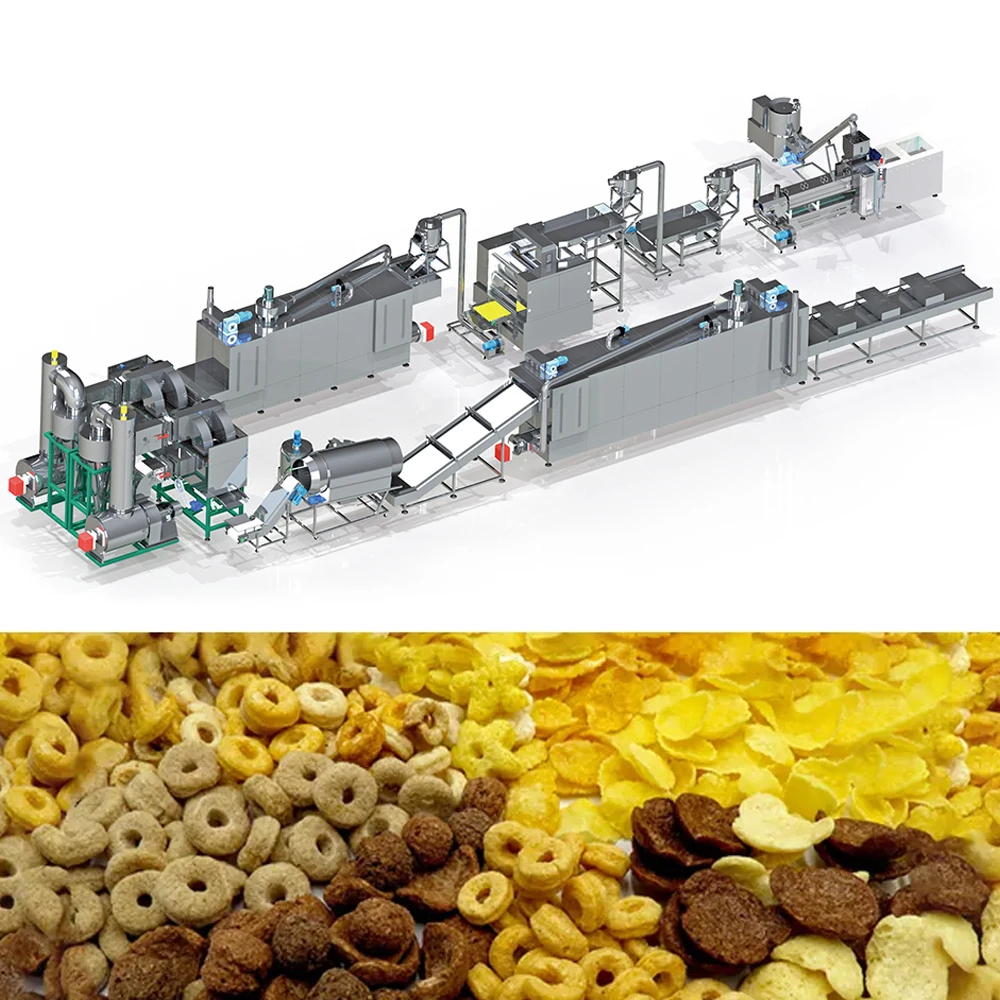
Screw & Die Engineering — Every element profile and die aperture is matched to the buyer’s corn, rice, or multi-grain formulation to control gelatinisation and flake density from the start.
Technical Specifications
| Parameter | Value |
|---|---|
| Product Type | Corn Flakes Breakfast Cereal Production Line |
| Model Options | MT70 / MT75 / MT85 |
| Extruder Type | Twin Screw |
| MT70 Installed Power | 160 kW |
| MT70 Power Consumption | 120 kW |
| MT70 Output Capacity | 150–200 kg/h (basis not stated in source — confirm raw material / moisture content / flake thickness) |
| MT70 Overall Dimensions | 41 × 1.5 × 2.2 m |
| MT75 Installed Power | 210 kW |
| MT75 Power Consumption | 150 kW |
| MT75 Output Capacity | 300–500 kg/h (basis not stated in source — confirm raw material / moisture content / flake thickness) |
| MT75 Overall Dimensions | 45 × 1.5 × 3.5 m |
| MT85 Installed Power | 190 kW |
| MT85 Power Consumption | 140 kW |
| MT85 Output Capacity | 300–400 kg/h (basis not stated in source — confirm raw material / moisture content / flake thickness) |
| MT85 Overall Dimensions | 43 × 1.5 × 3.2 m |
| Flaking Drive | Hydraulic system for double rollers; double motors for separate roller driving |
| Flaking Temperature Control | Infrared sensor for even temperature pipe control |
| Dryer Heating Source | Gas / Electric |
| Roasting Oven | Vibrating pan, conciliation burner, dual circulating fans, cyclone dust removal |
| Control System | PLC |
| Voltage & Frequency | Customizable (415V 50/60Hz, 440V 50/60Hz, 220V 60Hz available) |
| Key Features | Automatic screw lubrication and cooling, modular line stations, CE and ISO certified |
Application Suitability
| Application | Material or Output |
|---|---|
| Natural Corn Flakes | Corn grits or corn flour, toasted without sugar coating |
| Sugar-Coated Flakes | Corn, wheat, or oat base with sugar syrup tumble coating |
| Multi-Grain Cereal Shapes | Rice, barley, or oat powder blends for rings, balls, stars, and fruit loops |
| Fortified Breakfast Cereal | Vitamin and mineral premix blended with corn or wheat base for consistent dosing per serving |
Why "300 kg/h" Means Nothing Without the Screw Profile
Specifying a corn flakes extrusion line screw configuration die design without referencing the raw material formulation is the most common reason cereal lines fail to hold their rated output. A screw profile that works for degenerated corn grits at 15% moisture will over-shear a wheat-heavy blend and produce flakes that disintegrate during roasting.
I have walked into plants in Central America where the extruder was churning out volume, but the flakes turned to mush within seconds of hitting milk. The line was running at capacity, yet the product was unsaleable. The root cause was always the same: a generic screw build copied from another application, with no compression ratio adjustment for the buyer’s actual grain mix. When the corn flakes extrusion line screw configuration die design is specified against a lab sample of your raw material rather than a catalogue default, the gelatinisation degree, expansion ratio, and final density all land where the market expects them. [NEED_CITE: starch gelatinisation degree and bowl life correlation in breakfast cereal]
Barrel Temperature Zoning and Starch Behaviour
The barrel on a twin-screw extruder for cereal work is divided into multiple heating zones, each governing a different stage of starch transformation. Early zones hydrate the grits and begin gelatinisation, while the metering zones near the die control melt temperature and shear input. If the corn flakes extrusion line screw configuration die design does not account for the specific amylose-to-amylopectin ratio of your grain, you end up with either under-gelatinised flakes that crack during flaking, or over-gelatinised mass that sticks to the rollers. The PLC-controlled barrel profile lets operators adjust each zone independently once the baseline is established during a trial run.
Die Geometry and Flake Density Control
Die aperture, land length, and face pattern collectively determine how much the extrudate expands as it exits the barrel. A wider aperture with a short land produces a low-density pellet that flakes into a thick, soft flake — wrong for a market that expects a crisp, thin flake with long bowl life. Narrowing the aperture and extending the land increases shear at the die face, raising density and producing the thin, glassy flake that holds crunch in cold milk. The corn flakes extrusion line screw configuration die design record you receive with the machine must document every one of these dimensions so that replacement dies produce identical output years later. [NEED_CITE: die land length effect on extrudate expansion in cereal processing]
Reading the Power and Capacity Figures
Installed power on the MT75 sits at 210 kW with a running consumption around 150 kW — the gap between those two numbers reflects the torque reserve needed when feed moisture or ambient temperature shifts during a long run. Output capacity is listed as 300–500 kg/h for the MT75, 150–200 kg/h for the MT70, and 300–400 kg/h for the MT85, but every one of those figures depends on raw material, moisture content, and target flake thickness. When sizing the downstream dryer and roasting oven, the calculation must start from the actual formulation you plan to run, not the upper bound of the range. The flaking station uses a hydraulic double-roller drive with separate motors for each roller, which allows independent speed adjustment to control sheet thickness down to fractions of a millimetre before the product enters the dryer.
What Happens When the Dryer Is Undersized
An extruder pushing maximum output into a dryer that cannot remove moisture fast enough creates a bottleneck that no amount of screw adjustment can fix. Flakes emerge from the dryer with residual moisture above the safe storage threshold, and within weeks the bags are swelling on the warehouse shelf. The hot air roasting oven on this line uses dual circulating fans and a cyclone dust removal device, which together maintain even surface blistering and pull fines out of the air stream before they can settle back on the product. If throughput is balanced at the quoting stage rather than after commissioning, these problems never surface. [NEED_CITE: moisture content thresholds for shelf-stable breakfast cereal packaging]
Engineering and Testing Before Shipment
Every line leaves the workshop with a screw and die configuration record that matches your raw material, not a generic template. Trial runs are conducted in the testing workshop using the buyer’s own grain supply, and the resulting gelatinisation, expansion, and density data are documented before the machine is crated. The line layout and capacity calculation shows throughput balance between the extruder, flaker, dryer, and roasting oven, so no single station bottlenecks the next. Electrical schematics arrive with voltage and frequency confirmed against the buyer’s plant supply, and the control language is set before the PLC is powered on for the first time.
Documentation & Verification
- Screw and die configuration record specifying element profile, compression ratio, and die aperture to your formulation
- Trial run report on customer raw material documenting gelatinisation, expansion, and density data before dispatch
- Line layout and capacity calculation showing throughput balance across extruder, flaker, dryer, and roasting oven
- Electrical schematic with voltage, frequency, and PLC language matched to plant supply
- CE declaration of conformity and ISO certificate for customs and regulatory clearance
Installation, Commissioning & Support
- MT75 line requires a floor span of up to 45 m in length with 3.5 m headroom for the roasting oven exhaust
- Dedicated power circuit rated for 210 kW installed load on the MT75, with voltage confirmed before energising
- Extruder barrel and screw elements ship separated; reassembly and alignment verified during on-site commissioning
- First production run supervised to confirm flake thickness, roasting colour, and moisture content within target range
- Wear parts list covering screws, dies, and flaking roller shells with recommended first-replacement intervals
- Operator training covers PLC navigation, barrel temperature adjustment, and hydraulic roller pressure setting
What to Prepare Before Requesting a Quote
To configure the corn flakes extrusion line screw configuration die design correctly, the starting point is your raw material specification — grain type, grit size, and typical moisture content at intake. Alongside that, confirm the target flake thickness, whether the end product is natural or sugar-coated, and the daily output your market absorbs. Plant voltage and frequency must be stated so the motor and PLC spec match your grid. If you are adding this line alongside existing mixing or packing equipment, provide the interface dimensions so throughput gaps do not appear at the boundaries.
Frequently Asked Questions
Q: How do screw configuration and barrel temperature profile affect starch gelatinisation and final flake crispness?
A: Screw element arrangement controls shear intensity and residence time inside each barrel zone. Combined with independent zone heating, this determines how completely starch granules hydrate and gelatinise before the die. Under-gelatinised dough produces brittle flakes that shatter; over-gelatinised dough creates dense flakes that turn soggy quickly in milk. The correct profile is established during a trial run on your specific grain blend.
Q: What die design parameters control corn flake thickness and expansion ratio?
A: Die aperture diameter, land length, and the number of openings per die face govern how much the extrudate expands as pressure drops at the exit. A smaller aperture with longer land increases shear and produces denser, thinner pellets that flake into crisp sheets. These dimensions are recorded in the configuration file so replacement dies replicate the original output exactly.
Q: How is moisture content and shear input managed across twin-screw extrusion zones?
A: Moisture is introduced at the preconditioner or feed port and controlled zone by zone through barrel steam injection or cooling jackets. Shear input is adjusted by changing screw element stagger angle and flight depth. Together they maintain consistent dough viscosity so flake density stays within specification even when ambient humidity shifts during a long production run.
Q: What differs between natural corn flakes and sugar-coated flakes in drying and roasting settings?
A: Natural flakes require higher roasting temperatures to develop surface blistering and a toasted colour, with moisture pulled down to a lower final target. Sugar-coated flakes pass through a tumble coating drum after initial drying, then enter a secondary dryer at a gentler temperature to set the sugar shell without caramelising it to the point of sticking in the packaging.
Q: How does raw material composition change the extrusion screw profile required?
A: Corn, wheat, rice, and oat flours each have different amylose content, protein levels, and particle size distributions. A screw profile that gelatinises corn grits evenly may over-shear a wheat-heavy blend or fail to hydrate coarse oat particles. The screw element arrangement must be specified after a trial run on the actual formulation the line will run in production.