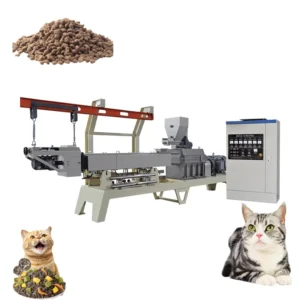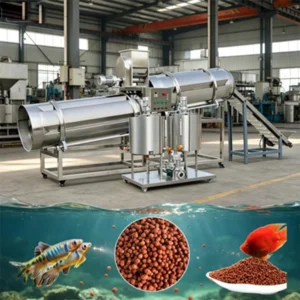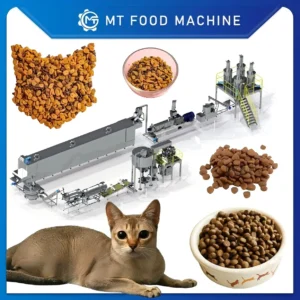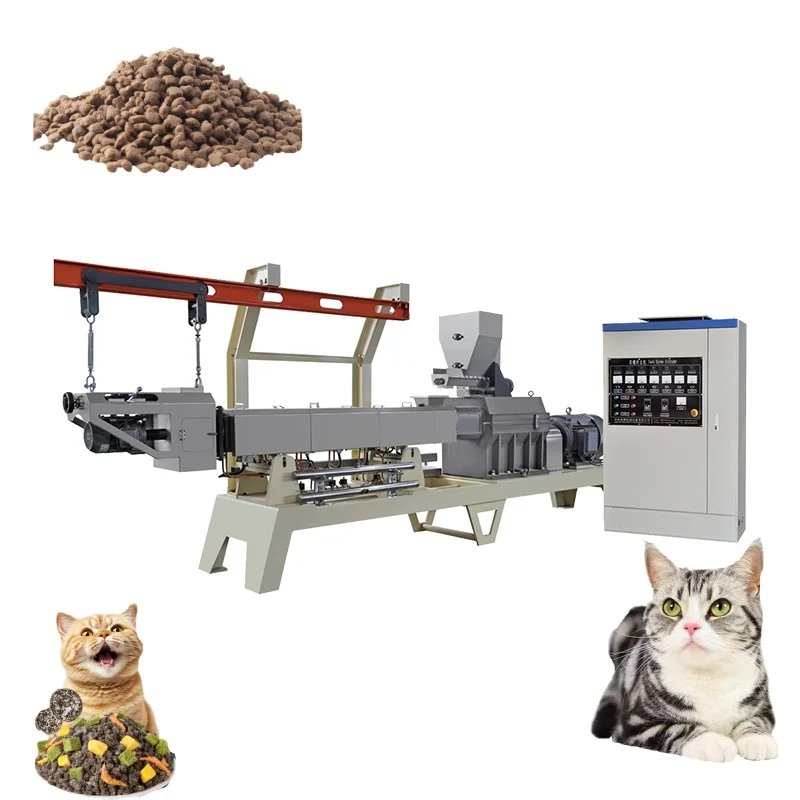
Matched screw geometry — Trial runs on customer raw material define the extrusion parameters before the machine leaves the factory, securing repeatable density across kibble formats.
Technical Specifications
| Parameter | Value |
|---|---|
| Product Type | Twin Screw Pet Food Extruder Line |
| Output Capacity | Up to 3 tons per hour (basis not stated in source — confirm raw material, moisture, kibble size) |
| Applications | Dry dog and cat kibble, aquaculture fish feed |
| Control System | Automated PLC and MCC control |
| Warranty | 1 year |
| Process Documentation | Fish feed process drawing included |
| Construction | Food-grade contact materials |
Application Suitability
| Application | Material or Output |
|---|---|
| Dry dog and cat kibble | Corn, meat meal, bone meal, vitamin premix blends |
| Floating fish feed | Fish meal, soy, starch binders with controlled expansion |
| Sinking aquaculture feed | High-protein formulations with density adjustment |
| Premium pet food | Multi-ingredient blends requiring uniform starch gelatinisation |
Why Nominal Capacity Figures Mislead Pet Food Buyers
Actual throughput depends entirely on your formulation and target kibble density, not the number printed on a brochure.
A twin-screw line rated for a certain hourly output on standard corn-based recipes will behave differently when you introduce high-protein or high-fat blends. I have seen installations where the extruder ran at barely half the quoted rate because the screw configuration was never tested against the buyer’s actual raw material. The result is a bottlenecked line where the dryer, flavouring drum, and packing station all wait on a starved extruder. That mismatch is why verifying pet food extrusion machinery specifications against your specific formulation should happen before any purchase order is signed [NEED_CITE: throughput variance across raw material formulations in twin-screw extrusion].
Barrel Temperature Profile and Starch Gelatinisation
The barrel is divided into multiple heating and cooling zones that control how starch in the raw mix gelatinises during extrusion. Proper gelatinisation determines kibble digestibility, expansion ratio at the die face, and ultimately whether the finished pet food extrusion machinery specifications meet the density target your market expects. Each zone responds to moisture content and residence time, meaning the profile must be tuned to your recipe rather than set once and forgotten.
Screw Configuration as the Real Variable
The combination of conveying, kneading, and reverse screw elements inside the barrel dictates shear intensity and material dwell time. A recipe heavy in meat meal requires a different screw layout than one built primarily on corn grits. Getting this wrong produces kibble that is either under-expanded and too dense, or over-expanded and fragile enough to shatter during packing and transport. Screw configuration is where pet food extrusion machinery specifications either match your product or fail it [NEED_CITE: twin-screw element arrangement and shear effects on extruded kibble].
Reading the Specification Sheet Critically
When comparing lines, pay attention to whether the supplier states capacity against a defined raw material and moisture level or leaves it open. Motor power, barrel length-to-diameter ratio, and the number of temperature zones all influence how well the extruder handles demanding formulations. A PLC-controlled system allows operators to store and recall parameter sets for different recipes, which matters when you switch between dog food and cat food runs. Confirming electrical specifications — voltage, frequency, and control panel language — before production begins prevents commissioning delays that have nothing to do with the machine’s mechanical capability.
The Cost of Skipping a Pre-Shipment Trial
Running the extruder on generic test material at the factory tells you almost nothing about how it will perform on your high-protein aquatic feed or your fat-enriched puppy kibble recipe. Without a trial on your actual raw material, you risk discovering density problems, uneven expansion, or throughput shortfalls only after installation, when reconfiguring screws and dies costs both time and production schedules [NEED_CITE: commissioning delays from untested extrusion configurations].
What Sets This Line Apart in Practice
The screw configuration and die design are specified to your raw material and target product rather than copied from a generic template. An in-house testing workshop allows trial runs on your actual formulation before shipment, so you see real kibble samples and a documented run report. Twin-screw expertise spans pet food, aquatic feed, and specialty applications, meaning the engineering team understands how different formulations behave under shear and heat. Complete line throughput is matched station by station — extruder, dryer, coating drum, cooler, and packer — so no single machine bottlenecks the others. Pre-sales consultation covers line layout and utility planning, followed by on-site installation, commissioning, and operator training.
Documentation & Verification
- Screw and die configuration record matched to your raw material blend
- Trial run report on customer formulation before dispatch
- Electrical schematic and voltage confirmation for your local grid
- Machine specification sheet with capacity stated against defined material
- CE declaration of conformity for export compliance
- Fish feed process drawing with full line layout
Installation, Commissioning & Support
- Foundation plan accounts for extruder weight and vibration isolation requirements
- Dedicated electrical circuit sized to PLC-controlled motor and heating loads
- Barrel segments and screw elements shipped disassembled for site fitting
- First-run parameter tuning against your raw material and target kibble size
- Operator training covering screw speed, barrel zones, and moisture adjustment
- Wear parts list with lead times for screws, dies, and barrel liners
Starting Your Line Specification
To configure a twin-screw extruder that matches your production target, share your raw material formulation including protein and fat ratios, the kibble sizes and densities your market requires, and your local voltage and frequency standards. If you have existing upstream mixing or downstream packing equipment, note the interface dimensions so the line integrates without throughput gaps.
Frequently Asked Questions
Q: How is output capacity verified against my raw material and kibble specification?
A: A trial run is conducted in the testing workshop using your actual raw material blend. The run records throughput, screw speed, barrel temperatures, and kibble density against your target specification. You receive a documented report before the line ships, so capacity figures reflect your formulation rather than a generic benchmark.
Q: What screw configuration and die design is selected for my target product?
A: The screw element arrangement — conveying, kneading, and reverse sections — is configured based on your raw material composition and desired kibble texture. Die aperture and shape are matched to the target kibble size and expansion ratio. Both are documented in a configuration record provided with your machine.
Q: How do barrel temperature zones and moisture control affect expansion and density?
A: Each barrel zone manages starch gelatinisation at a specific stage of extrusion. Moisture level and temperature together determine how much the kibble expands at the die face. Adjusting these parameters controls whether the final product floats or sinks for aquatic feed, or achieves the correct bite hardness for dry pet kibble.
Q: Can a trial run be performed on my raw material before shipment?
A: Yes. The in-house testing workshop runs your actual formulation through the extruder before dispatch. This confirms screw configuration, barrel profile, and die selection produce kibble that meets your density, expansion, and texture requirements, eliminating guesswork during on-site commissioning.