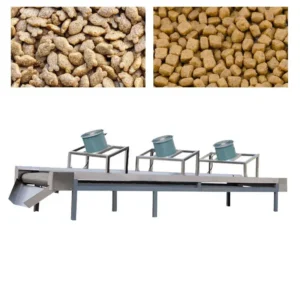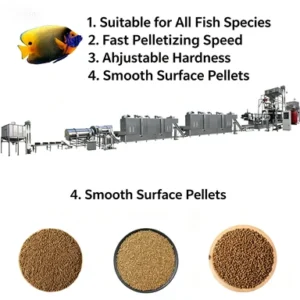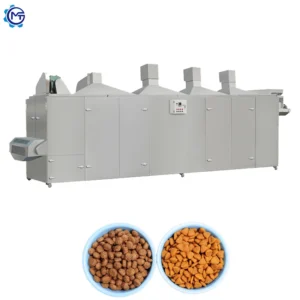
Customised screw geometry — We configure every barrel zone and die plate to the buyer’s actual aquatic feed formulation rather than copying a generic twin-screw build, so pellet density stays within specification from the first hour of production.
Technical Specifications
| Parameter | Value |
|---|---|
| Product Type | Twin-Screw Fish Feed Extrusion Line |
| Extruder Type | Twin-screw |
| Construction Material | 304 stainless steel contact parts |
| Suitable Species | Trout, salmon, catfish |
| Output Capacity | 4-5 t/h (basis not stated in source — confirm raw material formulation, moisture content, and pellet size) |
| Control System | Available with PLC or MCC control (basis to be confirmed) |
| Voltage & Frequency | Configurable to target market electrical standard (basis to be confirmed) |
| Line Stations | Mixing, extrusion, drying, coating, packing scope (basis to be confirmed) |
| Standards | CE / ISO declaration (basis to be confirmed) |
Application Suitability
| Application | Material or Output |
|---|---|
| Trout feed production | High-protein formulations requiring slow-sinking pellets with controlled density |
| Salmon aquaculture feed | Oil-enriched recipes needing precise expansion and fat-coating compatibility |
| Catfish floating pellet lines | Starch-based mixtures where gelatinisation determines buoyancy and water stability |
| Multi-species hatchery feed | Small-diameter pellet formats with tight size tolerances for fry and fingerling stages |
What Generic Screw Builds Cost Fish Feed Producers
Floating feed sinking, or pellet density drifting outside the specification the market expects, traces back to screw configuration and die design copied from a generic catalogue rather than tuned to the buyer’s actual raw material blend.
I have watched a Southeast Asian aquaculture producer lose weeks of commissioning because the extruder arrived with a screw profile optimised for corn-heavy kibble, while their recipe ran forty percent fish meal. The pellets came out dense, sank immediately, and the dryer could not keep up with the moisture load. The twin-screw fish feed extrusion line screw configuration die design package must reflect the protein-to-starch ratio the producer actually uses, not a laboratory ideal. [NEED_CITE: Typical consequences of mismatched screw profiles in aquatic feed extrusion]
Barrel Temperature Profiling for Starch Gelatinisation
Each barrel zone on this twin-screw fish feed extrusion line screw configuration die design setup carries independent heating and cooling circuits. The operator sets a gradient that starts gentle in the feed section and climbs through the compression zones, ensuring starch granules swell and rupture at the correct point. If zone three runs too hot, the melt viscosity drops prematurely and the pellets expand unevenly at the die face. Proper profiling keeps gelatinisation consistent across batches that vary in ambient moisture.
Die Geometry and Pellet Buoyancy Control
Die plate thickness, orifice diameter, and land length together determine how much shear the melt experiences in the final milliseconds before exit. A longer land increases back-pressure, densifying the pellet and pushing it toward a sinking format. Swapping to a thinner die with shorter lands lowers that resistance and traps more steam expansion, producing a floating pellet. Matching die geometry to the target species is therefore a calculation, not a guess. [NEED_CITE: Relationship between die land length and pellet density in aquatic feed extrusion]
Reading the Specification Sheet Against Real Formulations
The output capacity of 4-5 t/h is a reference figure that shifts depending on the raw material formulation, incoming moisture, and the pellet diameter being run. A catfish line pushing three-millimetre sinking pellets through a high-protein recipe will land at a different throughput than a salmon line running five-millimetre floating pellets on a starch-forward mix. The 304 stainless steel contact zones resist corrosion from the chloride and oil content typical in aquatic recipes, keeping sanitation intervals predictable. Available PLC or MCC control options let the buyer choose between full recipe memory and simpler relay-based logic depending on operator skill level on the factory floor. Twin-screw extrusion with screw configuration specified to raw material and target product means the documentation package should include a screw and die configuration record tied to the buyer’s exact formula.
The Hidden Cost of Skipping a Pre-Shipment Trial
When an extruder ships without a trial run on the customer’s actual flour, fish meal, and oil blend, the first production run becomes the trial. Commissioning stretches from days into weeks, raw material burns through the budget, and the producer faces late deliveries to their farm customers. I have seen density specifications missed by enough margin that an entire batch of floating feed had to be re-ground and re-extruded, doubling the labour and energy cost. [NEED_CITE: Cost of post-installation troubleshooting versus pre-shipment material trials]
Why Source This Line From a Single Extrusion Supplier
The line arrives with throughput matched across every station — mixer batch size, extruder output, dryer residence time, and coating drum volume — so no single unit bottlenecks the rest. Screw and die configuration records ship with the machine, giving the maintenance team a baseline to return to after each screw replacement. An in-house testing workshop runs the buyer’s raw material before crating, catching density or expansion issues while corrections cost days instead of weeks. Food-grade 304 stainless steel contact materials throughout wet zones meet the hygiene expectations of export-market aquaculture brands. Pre-sales consultation carries through to on-site installation, operator training, and ongoing wear-part supply, keeping the line productive past the warranty period.
Documentation & Verification
- Screw and die configuration record matched to your aquatic feed formulation
- Trial run report on customer raw material produced in our testing workshop before dispatch
- Line layout and capacity calculation with throughput balanced across every station
- Electrical schematic and voltage confirmation aligned to your local grid standard
- CE declaration of conformity and ISO certificate included in the shipping dossier
Installation, Commissioning & Support
- Foundation plan accounts for the full line footprint including dryer and cooler sections
- Dedicated power circuit sized to the confirmed extruder motor and barrel heater load
- Extruder barrel sections ship separated to fit standard container door clearances
- First-run parameter setting covers barrel zones, screw speed, and feeder rate on your recipe
- Operator training includes screw swap procedures and die plate replacement intervals
- Wear parts list identifies every screw element, die plate, and cutter bearing by part number
Preparing Your Enquiry
Send us your target species, pellet diameter range, and whether you need floating or sinking formats. Include the raw material breakdown with protein, starch, and fat percentages so the screw profile can be scoped before quoting. Confirm your local voltage and frequency, the control language your operators read, and whether existing upstream mixers or downstream dryers will remain in the line. If you can ship a sample of your actual blend, we run it in the testing workshop and include the trial report with the proposal.
Frequently Asked Questions
Q: How are screw configuration and die design matched to specific fish feed raw materials?
A: We review your protein, starch, and fat percentages, then select screw element geometry — conveying, kneading, and reverse sections — along with die plate thickness and orifice count. The goal is to hit the target expansion and density for your species. A trial run on your actual blend confirms the setup before the line ships.
Q: What barrel temperature profile is needed for starch gelatinisation in aquatic feed?
A: The profile typically starts around sixty degrees in the feed zone and climbs through successive sections, giving starch granules time to absorb moisture and rupture under shear. Exact set-points depend on your recipe’s starch source and incoming moisture. Independent zone heaters let operators fine-tune the curve during commissioning.
Q: How do I verify output capacity against my actual raw material formulation?
A: Provide your recipe, pellet diameter, and moisture content. We calculate expected throughput and, when possible, run a trial on your sample material in our testing workshop. The resulting report shows real output, pellet density, and expansion ratio, giving you a data point rather than a catalogue estimate.
Q: Are trial runs on customer raw material performed before shipment?
A: Yes, when the buyer supplies a representative sample. The trial confirms screw configuration, die selection, barrel temperatures, and moisture addition rate. Findings are documented in a trial run report that ships with the line, so your operators have a proven baseline from the first day of production.
Q: How do extrusion parameters control floating versus sinking pellet density?
A: Floating pellets require high expansion, achieved through elevated barrel temperature, specific screw shear sections, and a die with short land length. Sinking pellets need denser structure, obtained by reducing expansion through cooler barrel zones and longer die lands. Adjusting these parameters lets one line produce both formats across different production runs.