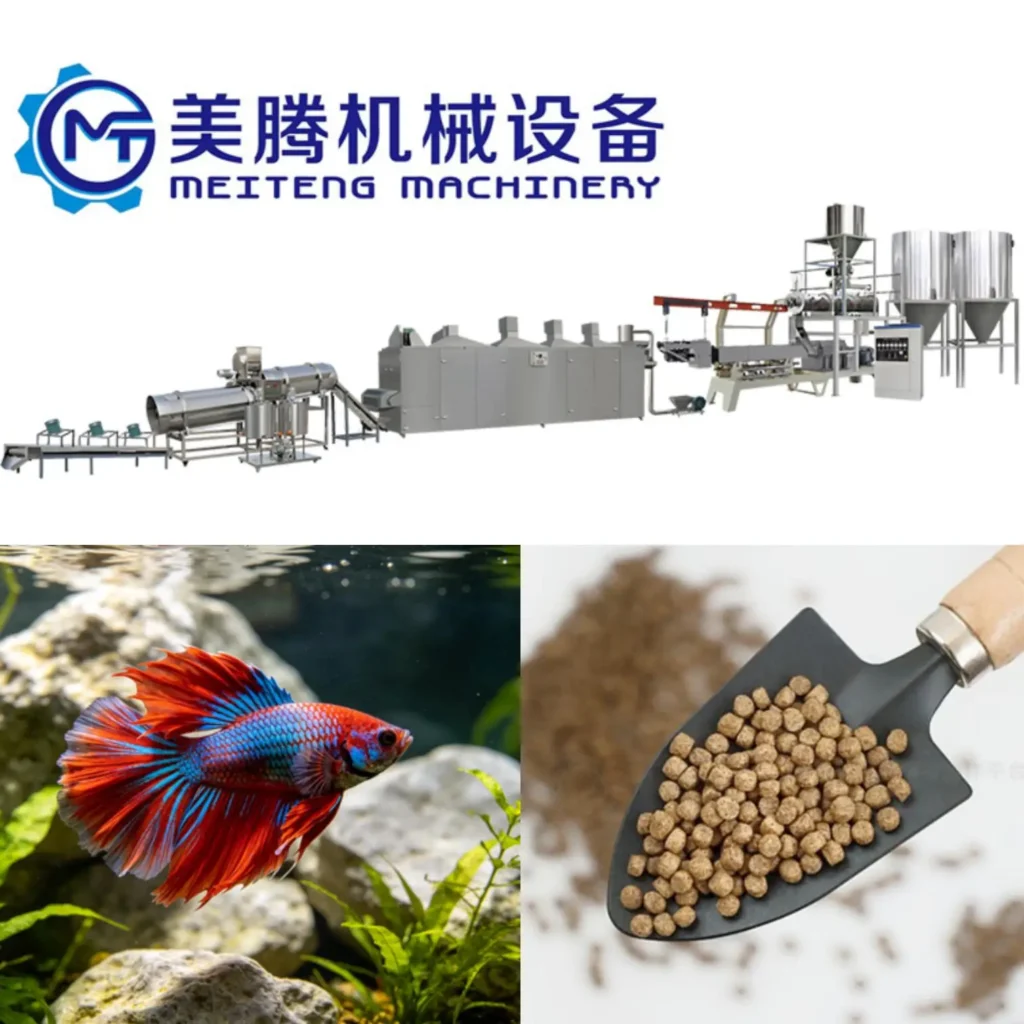
Engineering-Driven Screw Profiles — every barrel zone and die aperture is matched to the buyer’s declared fish meal formulation before metal is cut, eliminating generic builds that cause floating feed to sink.
Technical Specifications
| Parameter | Value |
|---|---|
| Product Type | Twin-Screw Fish Feed Extrusion Production Line |
| Output Capacity | 1.0–1.2 t/h (basis not stated in source — confirm raw material formulation, moisture content and pellet diameter) |
| Screw Type | Twin-screw |
| Construction Material | 304 stainless steel food-grade contact parts |
| Control System | PLC and MCC (based on manufacturer standard configuration) |
| Line Configuration | Complete line from batching to packing (specific stations to be confirmed) |
| Target Species | Trout, salmon, catfish (floating and sinking feed) |
| Certification | CE, ISO |
Application Suitability
| Application | Material or Output |
|---|---|
| Floating pellets for surface-feeding trout and salmon | High-starch formulations requiring controlled expansion and low bulk density |
| Sinking pellets for catfish and bottom-feeding species | Higher-protein blends with restricted gelatinisation to maintain pellet density |
| Multi-species production on a single line | Die changeover between floating and sinking pellet geometries |
| Aqua feed for shrimp and juvenile fish | Fine-diameter dies producing 1–2 mm crumble or micro-pellet output |
Why Generic Screw Configurations Sink Floating Feed
A screw profile copied from a standard pet food build will not gelatinise aqua feed starch correctly, and the pellet sinks before it ever reaches the water surface.
When an aquaculture producer orders a line rated at a nominal throughput, that number is usually based on a reference formulation — often a moderate-starch poultry meal blend. Switch to a high-protein fish meal or a high-fat salmonid recipe without adjusting the screw pitch, compression ratio, or barrel temperature zones, and the starch never reaches the gelatinisation threshold needed to trap steam during expansion [NEED_CITE: starch gelatinisation temperature thresholds in aqua feed extrusion]. The result is a dense pellet that drops to the pond floor, wasting feed and fouling water quality. I have seen entire first batches reworked because the extruder was configured for a formulation the buyer never intended to run. Twin-screw fish feed extrusion technology only delivers consistent buoyancy when the screw elements and die geometry are specified against the actual raw material the mill will process day in and day out.
Barrel Temperature Profiling for Aqua Feed Starch
The barrel on this twin-screw fish feed extrusion line is divided into independently heated and cooled zones. Each zone can be set to a different temperature, allowing the process to stage gelatinisation progressively rather than shocking the formulation with a single thermal spike. For trout and salmon feeds, where starch content is moderate but protein is high, the early zones hold a lower temperature to hydrate the starch granules gently before the compression zone raises shear and heat. Catfish sinking feed, which demands less expansion, benefits from a flatter temperature curve that limits steam generation at the die face.
Die Geometry and Moisture Control for Pellet Buoyancy
The die plate determines not only pellet diameter but also the pressure drop that governs expansion at the moment of extrusion. A die with a high length-to-diameter ratio restricts flow, building internal pressure that drives greater expansion when the product exits — essential for floating pellets targeting trout and salmon cultured in open-water cages. Sinking feed dies use shorter land lengths, allowing the pellet to leave the barrel with less stored energy and therefore less puff. Moisture content at the die face, managed through preconditioning steam injection, works in tandem with die geometry [NEED_CITE: preconditioning moisture and expansion ratio in twin-screw extrusion]. Together these variables let a single line produce both floating and sinking pellets through die changeover and recipe adjustment rather than requiring two separate extruders.
Reading the Specifications That Actually Matter
The twin-screw configuration is the core of this line’s versatility: two intermeshing screws create positive conveying and self-wiping action, which is critical when processing sticky, high-fat fish meal blends that would pack and stall in a single-screw barrel. The 304 stainless steel contact surfaces resist corrosion from the chloride content common in marine-origin raw materials, extending screw and barrel life compared to carbon steel assemblies. The PLC and MCC control system manages barrel zone temperatures, screw speed, and feeder rate from a single interface, reducing operator-dependent variation between shifts. Output capacity is listed at 1.0–1.2 t/h, but that figure must be validated against the buyer’s specific formulation, moisture level, and pellet diameter — a 6 mm floating pellet and a 2 mm sinking crumble will yield very different throughputs on the same machine. Always request a trial run report based on your own raw material before accepting a capacity claim.
The Hidden Cost of Skipping a Pre-Shipment Trial Run
Commissioning an extrusion line on-site without a prior factory trial means the first several tonnes of output are experimental, running on the buyer’s raw material and the buyer’s clock. I once watched a pet food line — configured for standard poultry meal — produce a batch on a high-protein fish meal blend the customer substituted without notification; every pellet sank, and the entire run was scrapped. For aquaculture producers, that kind of loss is magnified because feed spoilage in a pond or cage cannot be reversed [NEED_CITE: economic impact of feed formulation mismatch in aquaculture operations]. A trial run on the actual formulation, documented in a report that records screw configuration, barrel temperatures, and pellet density measurements, shifts that risk back to the factory floor where adjustments cost hours instead of days.
What Distinguishes This Line in Practice
The extruder is never sold as an isolated machine; downstream stations — dryer, coating drum, cooler — are sized to match extruder throughput so no single station bottlenecks the line. Screw and die configurations are recorded against the buyer’s raw material formulation, not pulled from a generic library, which means the first production run starts from a validated baseline. The in-house testing workshop allows trial runs on customer-supplied raw material before the line ships, catching formulation mismatches while corrections are still inexpensive. CE and ISO certification provides documentation required for import clearance in regulated markets. Pre-sales consultation covers line layout, utility planning, and phased installation scheduling, reducing the coordination burden on the buyer’s project team.
Documentation & Verification
- Line layout drawing showing throughput matching across extruder, dryer, coating, and cooling stations
- Screw and die configuration record documented against your declared fish meal formulation
- Trial run report on your raw material including pellet density and expansion ratio measurements
- Electrical schematic with voltage and frequency confirmed for your destination market
- CE declaration of conformity and ISO certificate for import clearance
- Operation and maintenance manual with wear parts list and replacement intervals
Installation, Commissioning & Support
- Foundation plan indicating load points and floor flatness tolerance for the extruder and dryer assembly
- Dedicated electrical circuit specification matching PLC and MCC power draw at your site voltage and frequency
- Modular shipping configuration allowing barrel, motor, and control cabinet to pass standard facility doorways
- On-site commissioning with barrel zone temperature calibration and screw speed tuning on your raw material
- Operator training covering die changeover procedure between floating and sinking pellet production runs
- Wear parts inventory recommendation covering screws, dies, and barrel liners for the first replacement cycle
Before You Request a Quote
To configure the screw profile and die plate correctly, share your intended raw material formulation — including protein source, starch percentage, and fat content — along with the pellet diameters you need for each target species. Specify your local voltage and frequency so the MCC and PLC hardware can be ordered to match. If you plan to produce both floating and sinking feed on the same line, indicate the approximate production split so downstream dryer and cooler capacity can be balanced accordingly.
Frequently Asked Questions
Q: How is screw configuration and die design selected for floating versus sinking fish feed?
A: The screw element sequence and compression ratio are chosen based on the starch and protein content of your formulation. Floating pellets require higher expansion, achieved through a screw profile that builds greater internal pressure before the die. Sinking pellets use a lower-compression configuration and shorter die land length to limit expansion. Both setups are recorded in your configuration file for repeatable changeover.
Q: What raw material formulation is the stated output capacity based on?
A: The 1.0–1.2 t/h capacity is listed without a stated formulation basis. Actual throughput depends on your specific raw material blend, moisture content, and target pellet diameter. A trial run on your formulation is the only reliable way to confirm the output rate your line will sustain in continuous production.
Q: How does barrel temperature profile affect starch gelatinisation and pellet buoyancy?
A: Each barrel zone is independently heated, allowing staged gelatinisation that matches the thermal sensitivity of your starch source. Insufficient gelatinisation leaves unexpanded starch granules, producing dense pellets that sink. Over-gelatinisation can cause excessive expansion and fragile pellets. The PLC records each zone setpoint so the optimal profile is repeatable across production runs.
Q: Is a trial run on my raw material performed before shipment?
A: Yes. Customer raw material is run through the extruder in the in-house testing workshop before dispatch. The trial run report documents screw configuration, barrel temperatures, pellet density, and expansion ratio, providing a validated starting point for on-site commissioning and reducing first-batch waste.