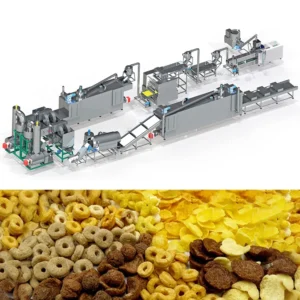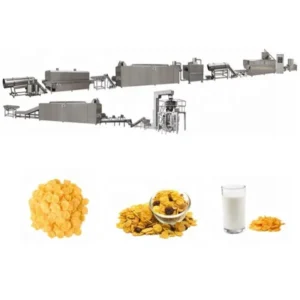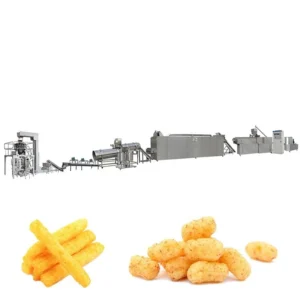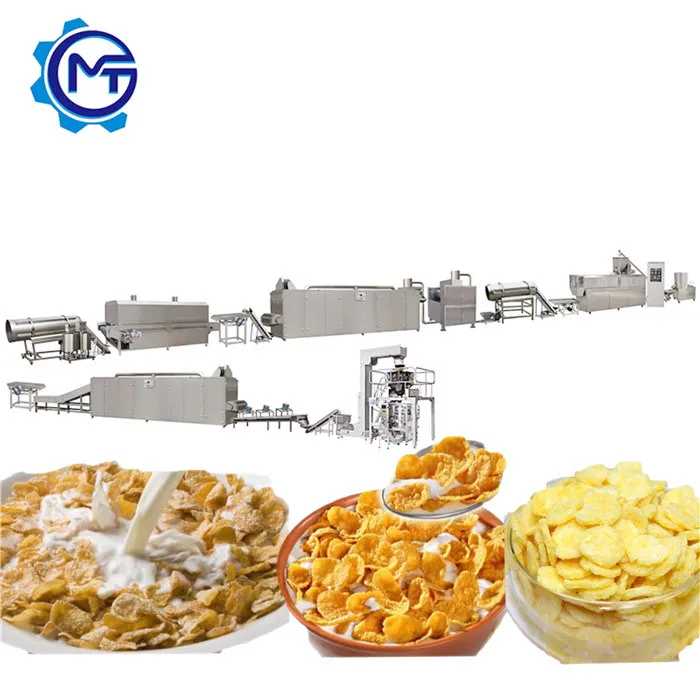
Single-Source Line Integration — every station from mixing to packing is throughput-matched under one supplier, eliminating the bottleneck risk of assembling a corn flakes extrusion processing line turnkey from separate vendors.
Technical Specifications
| Parameter | Value |
|---|---|
| Product Type | Corn Flakes Breakfast Cereal Processing Line |
| Models Available | MT70, MT85, MT75 |
| Extruder Type | Twin Screw |
| Installed Power | MT70: 160 kW; MT85: 190 kW; MT75: 210 kW |
| Power Consumption | MT70: 120 kW; MT85: 140 kW; MT75: 150 kW |
| Output Capacity | MT70: 150–200 kg/h (basis not stated in source); MT85: 300–400 kg/h (basis not stated in source); MT75: 300–500 kg/h (basis not stated in source) |
| Overall Dimensions | MT70: 41 × 1.5 × 2.2 m; MT85: 43 × 1.5 × 3.2 m; MT75: 45 × 1.5 × 3.5 m |
| Control System | PLC control with MCC integration |
| Flaking Machinery | Hydraulic double-roller system, dual motors, infrared sensor temperature control |
| Dryer Heating Source | Gas or Electric (configurable) |
| Roasting Oven | Hot air roasting, vibrating pan, conciliation burner, dual circulating fans, cyclone dust removal |
| Coating System | Double tumble sugar melting, elevator, coating drum, spraying nozzle |
| Basic Raw Materials | Corn, rice, wheat, oat, barley powder |
| Screw Material | Wear-resistant alloy (special technology) |
| Extruder Features | Automatic lubrication, integrated cooling function |
| Assembly State | Complete line (turnkey) |
| Standards | CE certified, ISO certified |
Application Suitability
| Application | Material or Output |
|---|---|
| Natural corn flakes production | Refined or coarse-ground corn grits, whole grain maize |
| Sugar-coated breakfast cereals | Corn base with sugar, honey, or chocolate coating |
| Multi-grain cereal variants | Blends of rice, wheat, oat, and barley powder |
| Shaped breakfast cereals | Balls, tubes, sticks, rings, fruit loops, stars, wheels, flowers, hearts |
| Snack food manufacturers | Partial line utilization for puffed snack extrusion from corn or rice |
Why Nominal Capacity Fails on Your Actual Grain Formulation
A line rated on refined corn flour will stall when you feed it whole-grain coarse meal with high fiber content.
I spent a week in an African cereal plant watching flakes shatter in the dryer because the extruder was tuned for a completely different raw material. The buyer had pulled in locally sourced coarse-ground maize, but the screw configuration and barrel temperature profile were copied from a generic build designed for refined grits. Gelatinization never reached the threshold needed, and the flakes lacked structural integrity. This is a recurring pattern in breakfast cereal projects: the corn flakes extrusion processing line turnkey is quoted on a benchmark material that does not match what actually arrives at the factory door [NEED_CITE: gelatinization degree requirements for whole grain extrusion]. The screw speed, five-zone temperature curve, and die gap all need to be re-established for each specific formulation before the line can hold stable output.
Screw Configuration and Barrel Profile Dictate Flake Integrity
Extrusion is where the entire corn flakes extrusion processing line turnkey succeeds or fails. The twin-screw configuration allows operators to adjust screw element sequencing — conveying, kneading, and reverse elements — to match the fiber content, particle size, and moisture absorption rate of the incoming grain. A high-fiber whole-grain corn meal requires longer residence time and higher shear in the conditioning zone compared to refined corn flour. The barrel temperature profile across multiple heating zones must be mapped to the starch gelatinization window of the specific raw material, or the dough exiting the die will lack the elasticity needed for uniform flaking.
Flaking and Roasting Define the Final Texture
The hydraulic double-roller flaking station uses independent motors for each roller and infrared sensor temperature control to maintain consistent sheet thickness. If the rollers are not matched in speed and surface temperature, the sheet tears or compresses unevenly, producing flakes that toast at different rates. Downstream, the hot air roasting oven relies on a conciliation burner and dual circulating fans to create the surface blistering and internal crispness that buyers expect. The cyclone dust removal device captures fines generated during roasting, keeping the product clean and the workshop environment controlled [NEED_CITE: hot air roasting parameters for breakfast cereal flake blistering].
Reading the Specs Beyond the Nameplate
The installed power figures — ranging across the three models — reflect the total connected load for the complete corn flakes extrusion processing line turnkey, including extruder drive, flaker hydraulics, dryer heating, roasting burner, and coating system. Power consumption values represent typical operating draw under load, which is what your facility electrical planning should be based on. The hydraulic flaking system requires a dedicated circuit separate from the PLC-controlled extruder to prevent voltage sag during roller engagement. The PLC control system manages screw speed, barrel temperature zones, and flaker gap in coordinated logic, while the MCC distributes power across all line stations with individual protection and monitoring for each motor circuit.
The Hidden Cost of Mismatched Station Throughput
When equipment is sourced from separate vendors, the extruder, flaker, dryer, and roasting oven rarely share the same capacity baseline. A flaker that cannot keep pace with extruder output creates a buffer pile of warm dough that skins over and blocks the roller nip. A dryer undersized for the flaker output forces slower line speed, leaving the extruder running below its designed throughput and burning energy on idle barrel heating. These mismatches do not appear in any single vendor’s quotation — they only surface during commissioning, weeks after the equipment has been paid for [NEED_CITE: throughput balancing in multi-station food processing lines]. The consequence is a line that never reaches its quoted output and requires expensive retrofits to correct.
Why This Line Is Specified Differently
Every station in this corn flakes extrusion processing line turnkey is designed with matched throughput from the initial layout calculation, so the flaker, dryer, roasting oven, and coating drum are all sized to handle extruder output without creating bottlenecks. The screw configuration and die design are specified to the buyer’s actual raw material and target flake density, not copied from a generic catalog build. Trial runs are conducted in the in-house testing workshop using the customer’s own grain formulation before shipment, so product development is resolved at the factory rather than during on-site commissioning. Pre-sales engineering covers voltage confirmation, control language, and utility planning for the target market. The complete line — from batching through extrusion, flaking, drying, roasting, coating, cooling, and packing — sits under one supplier’s accountability for layout, installation, and warranty.
Documentation & Verification
- Line layout and capacity calculation showing throughput matching across every station
- Trial run report on your specific corn or multi-grain formulation before dispatch
- Screw and die configuration record matched to target flake density specification
- Electrical schematic with voltage and frequency confirmed for your local grid standard
- Factory test record documenting all station performance under load before packing
Installation, Commissioning & Support
- Foundation planning accounts for the full line length up to 45 meters with vibration isolation for the flaker and roasting oven
- Dedicated electrical circuits specified for the extruder drive and hydraulic flaker to prevent voltage interference
- Line arrives in modular sections packed with plastic bubble film and wooden cases, with fumigation documentation included
- On-site commissioning includes screw speed calibration, barrel temperature curve mapping, and flaker gap setting for your material
- Operator training covers PLC interface navigation, screw element replacement procedure, and daily lubrication checks
- Wear parts list with lead times provided for screws, dies, and flaker roller surfaces
What to Prepare Before Requesting a Quotation
To configure the right line model and station sizing, share your primary grain type and particle size distribution, whether your target product is natural or sugar-coated flakes, and your intended daily output target. Your workshop floor dimensions and ceiling height determine the dryer and roasting oven layout, and your local voltage and frequency standard must be confirmed before electrical panel production begins. If you plan to run multiple grain formulations on the same line, specify each one so the screw configuration can be designed for the full range.
Frequently Asked Questions
Q: How is line capacity verified against my specific corn or multi-grain formulation?
A: Before the quotation is finalized, we run your actual raw material through the extruder in our in-house testing workshop. This trial establishes the screw configuration, barrel temperature profile, and die gap needed for your specific grain, and the results are documented in a trial run report. Capacity is then quoted based on that verified formulation rather than a generic benchmark.
Q: What does the phased installation and commissioning schedule look like?
A: The line is delivered in modular sections and installed sequentially — extruder and flaker first, followed by dryer, roasting oven, and coating station. Commissioning begins with individual station testing, then progresses to integrated line runs. Total on-site time varies with line model and site readiness, but the schedule is mapped during the layout proposal stage so your team can plan around it.
Q: How do you ensure no station bottlenecks the rest of the line?
A: During the initial engineering phase, throughput is calculated for every station — mixer, extruder, flaker, dryer, roasting oven, and coating drum — based on your target output and raw material characteristics. Each station is then sized to handle that throughput with margin, so no single piece of equipment constrains the line. This matching is documented in the line layout and capacity calculation provided with the proposal.
Q: Can the same line produce both natural and sugar-coated corn flakes?
A: Yes. The coating system includes a double tumble sugar melting unit, elevator, coating drum, and spraying nozzle integrated into the line after the roasting oven. For natural flakes, the coating station is bypassed and the product moves directly from roasting to cooling and packing. Switching between variants requires only a recipe change in the PLC and adjustment of the coating drum parameters.
Q: What operator training and maintenance support is included?
A: On-site commissioning includes operator training covering PLC operation, screw configuration adjustments, flaker gap calibration, and daily maintenance routines. A wear parts list with recommended replacement intervals is provided at delivery. Ongoing technical support is available for troubleshooting, and spare screws, dies, and flaker components are stocked for supply throughout the equipment lifecycle.