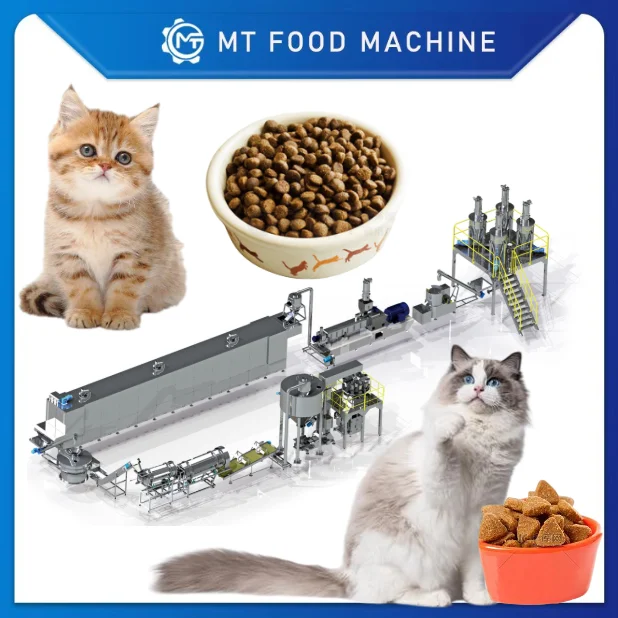
Screw Geometry Defined by Your Recipe — the MT135 twin-screw pet food extrusion line specifies screw element arrangement, barrel zones, and die orifice design to your raw material formulation and target kibble density before any production run begins.
Technical Specifications
| Parameter | Value |
|---|---|
| Model | MT135 |
| Product Type | Twin-Screw Pet Food Extrusion Line |
| Screw Configuration | Twin-screw, configurable element arrangement |
| Control System | PLC Controlled |
| Output Capacity | 2.5–3.0 t/h (basis not stated in source — confirm raw material formulation, moisture content, and kibble size) |
| Alternative Output Claim | up to 550 kg/h (basis not stated in source — confirm whether single-extruder station or full line, and raw material conditions) |
| Application Range | Cat, dog, fish, bird, and cattle feed |
| Assembly State | Complete line configuration (source value — verify against manufacturer catalog for included stations) |
| Certification | CE, ISO |
| After-Sales Support | Video technical support and online service |
Application Suitability
| Application | Material or Output |
|---|---|
| Dry kibble production for dogs and cats | Corn, wheat, rice, meat meal, bone meal, fish meal, vitamin premix blends |
| Floating and sinking aquatic pellets | Soybean meal, fish meal, starch binders, lipid coatings for catfish, tilapia, and shrimp |
| Avian nutrition pellets | Ground grains, seed meals, calcium supplements, micro-nutrient premixes |
| Cattle and livestock feed pellets | Forage meals, grain by-products, protein concentrates, mineral additives |
| Multi-species production on shared platform | Reconfigurable screw profile and die setup between species feed formats |
Why "Nominal Capacity" Fails on Real Formulations
A twin-screw pet food extrusion line rated at a headline tonnage on standard corn grits will behave differently the moment your recipe introduces fresh meat slurry, elevated fat content, or high-fiber inclusions. Throughput only matters when measured against your actual raw material. I have stood on factory floors watching lines stall because the screw shear profile was calibrated for a brochure formula, not the high-moisture, high-fat mix the buyer intended to run. The barrel temperature profile, moisture injection rate, and screw element geometry must all be recalculated when the formulation changes [NEED_CITE: impact of raw material moisture and fat content on extrusion throughput].
Barrel Zone Profiling and Starch Gelatinisation
The MT135 barrel is divided into independently controlled heating and cooling zones. Each zone maintains a specific temperature set-point managed through the PLC, allowing the operator to build a thermal gradient that matches the starch gelatinisation curve of the target grain blend. When running high-amylose rice flour, the feed and compression zones require lower thermal input to prevent premature gelatinisation that blocks the screw channel, while the metering zone demands higher energy to achieve full expansion at the die face. This zone-by-zone control is what separates consistent kibble density from batch-to-batch variation.
Screw Element Arrangement and Shear Control
Twin-screw extrusion relies on the intermeshing geometry of co-rotating screws to generate the mechanical shear that cooks and homogenises the dough. The MT135 platform supports interchangeable screw elements — kneading blocks, reverse-pitch conveying segments, and shear-intensive mixing discs — arranged in sequences that match the rheological demands of each formulation. A grain-free kibble recipe heavy in legume flour and chicken meal requires a different kneading block count and pitch angle than a standard corn-and-soy aquatic feed pellet [NEED_CITE: screw element configuration principles in twin-screw food extrusion]. Getting this arrangement wrong means under-cooked product with poor water stability or over-sheared material that collapses at the die.
Die Geometry, Expansion Ratio, and Kibble Density
The die plate sits at the discharge end of the barrel and determines the cross-sectional shape, size, and — critically — the expansion behaviour of the extrudate. Orifice diameter, land length, and face-cut versus die-cut selection all influence whether the kibble exits at a low density suitable for floating aquatic feed or a higher density required for slow-sinking shrimp pellets. On the MT135, die design is specified to the buyer’s target product rather than pulled from a generic catalogue. The relationship between die land length and expansion ratio is non-linear: a small change in land length can shift kibble bulk density enough to move product outside the specification the market expects.
Reading the Spec Sheet Against Your Production Reality
Output capacity figures on extruder spec sheets frequently omit the formulation basis. A claim of 2.5–3.0 t/h may hold on a dry corn-based mix at standard moisture but drop substantially when the recipe includes 20% fresh meat slurry with elevated fat and water content. The alternative figure of up to 550 kg/h suggests a different measurement basis — possibly a single-extruder station or a denser pellet format — and must be clarified against your target kibble size and formulation. The PLC control system records process parameters per batch, giving you traceability on screw speed, barrel temperature, and moisture injection rate so that each production run can be replicated or adjusted with data rather than guesswork.
The Cost of Running a Generic Screw Build
When screw configuration and die design are copied from a standard build without regard to the buyer’s raw material, the consequences surface during commissioning. Floating feed sinks because the expansion ratio falls short. Kibble density drifts outside specification, triggering rejection from retail buyers who measure bulk density on intake. High-fat formulations overwhelm the shear capacity of a screw profile designed for lean grain mixes, causing surging at the die and irregular pellet geometry [NEED_CITE: consequences of mismatched screw configuration in feed extrusion]. These are not adjustment issues — they require physical reconfiguration of screw elements and, in some cases, a replacement die plate.
Engineering Decisions That Hold Up Past Commissioning
The MT135 line is built around a configurable screw platform rather than a fixed geometry, meaning the screw element arrangement and L:D ratio are selected to your formulation before the machine ships. Screw configuration and die design are documented per project, so reorders and formulation changes have a reference baseline. The in-house testing workshop runs trial extrusion on your actual raw material before dispatch, catching density and expansion issues before they become on-site failures. PLC automation manages barrel temperature, screw speed, and moisture injection as an integrated logic set, reducing operator-dependent variation across shifts. Electrical schematics, voltage, and HMI language are confirmed to your destination market before production starts, preventing commissioning delays caused by mismatched frequency or unreadable interfaces.
Documentation & Verification
- Screw and die configuration record matched to your raw material and target kibble specification
- Trial run report on customer formulation validating expansion, density, and output before shipment
- Machine specification sheet with barrel zone layout, heating method, and sensor placement
- Electrical schematic with PLC program language, HMI language, and voltage confirmation
- CE declaration of conformity and ISO certificate for customs and regulatory clearance
Installation, Commissioning & Support
- Foundation plan and utility routing provided for the MT135 barrel, drive, and downstream dryer footprint
- Dedicated circuit specification for main drive motor and barrel heating zones confirmed to local voltage and frequency
- PLC program and HMI interface loaded in destination language before arrival on site
- On-site screw profile verification and first-run parameter tuning against your production formulation
- Operator training covering screw speed, barrel temperature, and moisture adjustment protocols
- Wear parts list with reorder codes for screw elements, die plates, and barrel liners
What to Prepare Before Requesting a Quote
To size the screw configuration and die geometry correctly, share your target formulation including primary protein sources, starch base, fat percentage, and moisture content at the mixer discharge. Specify the kibble shape, size range, and bulk density your market requires — floating aquatic pellet specifications differ fundamentally from dry dog kibble. Confirm your facility voltage, frequency, and preferred PLC interface language so that the electrical package and control documentation match your site conditions from day one.
Frequently Asked Questions
Q: How is screw configuration selected for different raw material formulations?
A: The screw element sequence — kneading blocks, conveying segments, and mixing discs — is arranged based on your formulation’s starch type, protein content, and fat level. High-protein grain-free recipes demand different shear intensity than standard corn-soy blends. Configuration is documented before shipment so the build is reproducible.
Q: What barrel temperature range does the MT135 support for starch gelatinisation?
A: Each barrel zone is independently heated and cooled through the PLC, covering the thermal range required for common pet food grains and legume flours. The specific profile is set during trial runs on your formulation to achieve target gelatinisation degree without over-cooking or blocking the screw channels.
Q: How is die design matched to floating versus sinking aquatic feed?
A: Orifice geometry and land length are calculated to achieve the expansion ratio that produces target pellet density. Floating pellets require higher expansion at the die face, while sinking shrimp pellets need restricted expansion and higher compression. Die selection is validated during the pre-shipment trial run.
Q: Can the MT135 run a trial on our specific raw material before shipment?
A: Yes. The in-house testing workshop conducts extrusion trials using your actual formulation, measuring expansion, density, and throughput against your product specification. A trial run report is issued before the line ships, confirming that the screw and die configuration performs on your material.
Q: How do screw speed and shear force affect product density across species?
A: Higher screw speed increases mechanical shear and thermal input, raising expansion and lowering kibble density. For dense cattle pellets, lower screw speed with compressive screw elements is used. The PLC records screw speed per batch, enabling consistent replication across production runs.