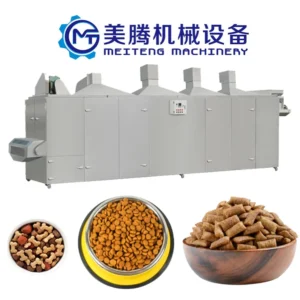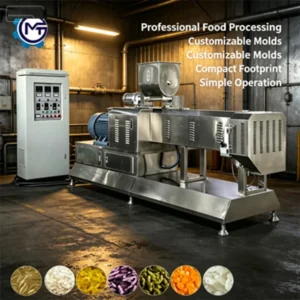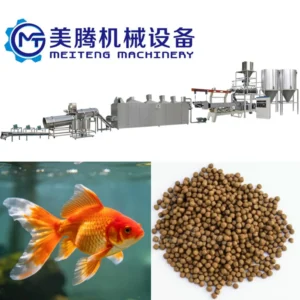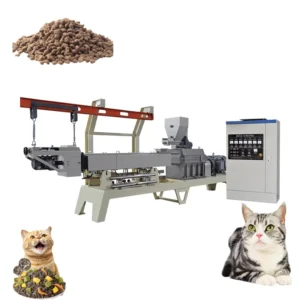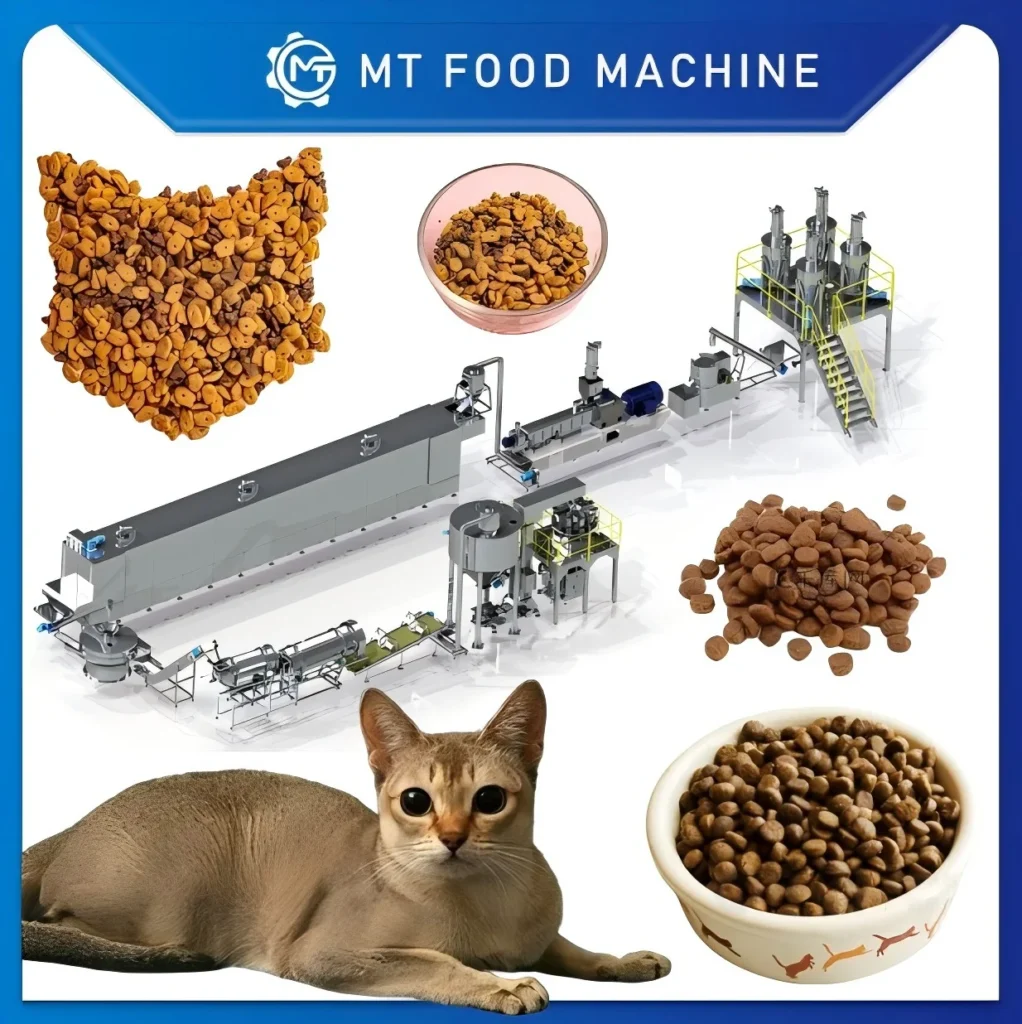
Process-Driven Engineering — the MT-70 twin-screw geometry and die profile are matched to your specific meat meal and grain formulation before the barrel is ever assembled.
Technical Specifications
| Parameter | Value |
|---|---|
| Model | MT-70 |
| Product Type | Multi-Species Pet Food Extrusion Line |
| Extruder Architecture | Twin-Screw |
| Control System | PLC Controlled |
| Output Capacity (Standard) | 200-250 kg/h (basis not stated in source — confirm raw material formulation, moisture content, and kibble size) |
| Output Capacity (Maximum) | Up to 3 tons per hour (basis not stated in source — confirm raw material, product format, and line configuration) |
| Line Stations | Batching, Extrusion, Drying, Coating, Cooling, Packing |
| Machine Certification | CE |
| Warranty | 1-year |
Application Suitability
| Application | Material or Output |
|---|---|
| Premium Dry Dog Food | High meat meal inclusion, corn, wheat, and poultry fat |
| Feline Kibble Production | Protein-dense recipes requiring controlled expansion and texture |
| Floating Aquatic Feed | Catfish and tilapia pellets requiring specific buoyancy |
| Functional Treats | Fortified biscuits and specialized dietary formats |
How Raw Material Variance Redefines PLC Controlled Pet Food Extrusion Line Specifications
A quoted output figure is only valid when paired with the specific moisture, fat, and starch content of the material being processed.
Many buyers sign contracts based on a headline throughput number, only to find the line fails to maintain density or shape once their local grain or protein source is introduced. I once watched a twin-screw line fail because a change in meat meal ash content collapsed the expansion rate completely. The MT-70 addresses this through a PLC controlled pet food extrusion line specifications framework that prioritizes screw geometry over nominal speed. By calculating the shear and heat profile required for your exact recipe, the system ensures the final kibble matches market expectations [NEED_CITE: raw material variance in extrusion processes].
Barrel Profiling and Thermal Management
The extrusion process relies on precise thermal gradients across the barrel zones. For the MT-70, the PLC control system governs the temperature profile and moisture injection at every stage of the screw path. This allows the operator to adjust the gelatinization point of the starch in real-time, ensuring that the product expands uniformly upon exiting the die. This level of control is what separates a stable production run from a batch that must be discarded due to inconsistent density.
Screw Configuration and Die Geometry
The twin-screw assembly is not a universal fit; it is a custom arrangement of mixing elements and conveying flights. By altering the pitch and placement of these elements, the MT-70 can handle anything from high-fat aquatic feed to dry, abrasive cereal grains. The die design further dictates the back-pressure and the final shape of the kibble. Matching this configuration to the buyer’s raw material is the only way to achieve the correct texture and sinking or floating characteristics required by the end market [NEED_CITE: twin-screw element configuration principles].
Decoding the Throughput Variables
The MT-70 is rated for 200-250 kg/h in standard configurations, but this value is entirely dependent on the recipe’s bulk density and the target kibble size. A high-fat, slow-cooling formula will move through the dryer and coater at a different rate than a standard corn-based dog food. The PLC architecture monitors the load on the main motor and the pressure at the die face, providing data that allows operators to fine-tune the feed rate. Furthermore, the line integration—from the batching scale to the rotary coater—ensures that no single station creates a bottleneck that would force the extruder to run below its optimized efficiency.
The Price of Generic Line Assembly
When stations are sourced from separate vendors, the drying capacity often fails to match the extruder’s actual output, leading to moisture retention and mold growth in the final package. A mismatched coating drum can also lead to uneven fat distribution, which affects palatability and shelf life. By utilizing a unified control architecture, the MT-70 prevents these downstream failures by synchronizing the speed and thermal output of every component in the production chain [NEED_CITE: line integration and throughput matching].
Why Procurement Requires Technical Verification
Sourcing a twin-screw line requires looking beyond the spec sheet to the actual testing and documentation provided. We ensure the MT-70 is viable for your project through several verification steps. Every screw configuration is recorded against your specific material profile. We conduct trial runs in our in-house testing workshop to prove the kibble density and texture before the machine ships. Our line layout calculations verify that the dryer and cooler can handle the specific thermal load of your product. Finally, the electrical schematics are confirmed against your facility’s local voltage and frequency standards to ensure a stable commissioning phase.
Documentation & Verification
- Screw and die configuration record specified to your meat meal and grain ratios.
- Trial run report on customer raw material confirming kibble density and expansion rate.
- Line layout and capacity calculation with throughput matching across all stations.
- Electrical schematic and voltage confirmation for target market compliance.
- Operation and maintenance manual detailing PLC parameter ranges and alarm codes.
Installation, Commissioning & Support
- Foundation planning for the MT-70 main motor vibration and high-load bearing points.
- Verification of PLC power supply requirements and dedicated circuit stability.
- On-site assembly of the twin-screw barrel sections and alignment of the die face.
- Parameter setting for barrel zones and screw speed during the initial trial runs.
- Training for operators on the HMI interface and emergency stop protocols.
- Provision of a wear parts list for screws and dies to ensure long-term readiness.
Sizing the Line to Your Facility
To provide an accurate configuration for the MT-70, we need to understand the specific parameters of your production environment. Please provide a sample of your primary raw materials and the target formulation for the kibble. Information regarding your available workshop floor space and ceiling height is essential for the dryer and cooling conveyor layout. Finally, specify the local industrial voltage and the preferred language for the PLC control system to ensure the machine is ready for immediate integration upon arrival.
Frequently Asked Questions
Q: How do you determine the correct screw geometry for my recipe?
A: We analyze the starch and protein content of your raw material to determine the required shear and pressure. The MT-70 screw elements are then arranged to provide the correct residence time and mixing intensity. This ensures the PLC controlled pet food extrusion line specifications align with your target product density and texture, preventing issues like under-cooking or material blockage.
Q: Can the MT-70 handle both floating and sinking feed formats?
A: Yes, the twin-screw configuration allows for precise control over expansion and density. By adjusting the barrel temperature profile and the die back-pressure through the PLC system, we can produce aquatic feed that either floats or sinks as required. This versatility is verified during the pre-shipment trial run on your specific formulation.
Q: What is the scope of the pre-shipment trial run?
A: We use your actual raw materials to run the MT-70 in our testing workshop. The resulting report covers the final kibble dimensions, moisture content, and expansion ratio. This process confirms that the mechanical configuration and the PLC parameters are correctly set before the equipment is dismantled for transport to your facility.
Q: How does the PLC system manage downstream stations?
A: The central control unit synchronizes the extruder feed rate with the dryer temperature and the cooling conveyor speed. This ensures that the product remains within the correct moisture and thermal limits throughout the entire process. It prevents bottlenecks and maintains consistency in the final coating application for the MT-70 line.