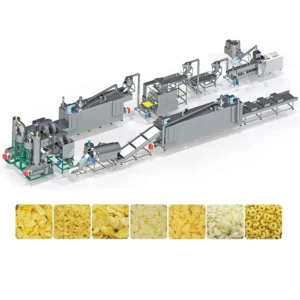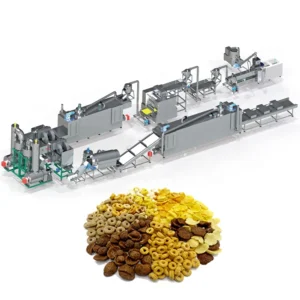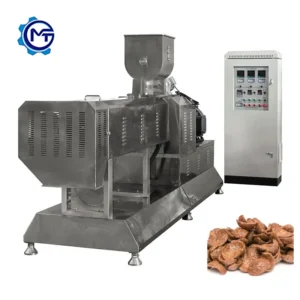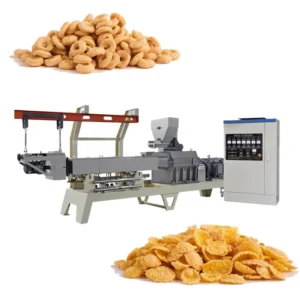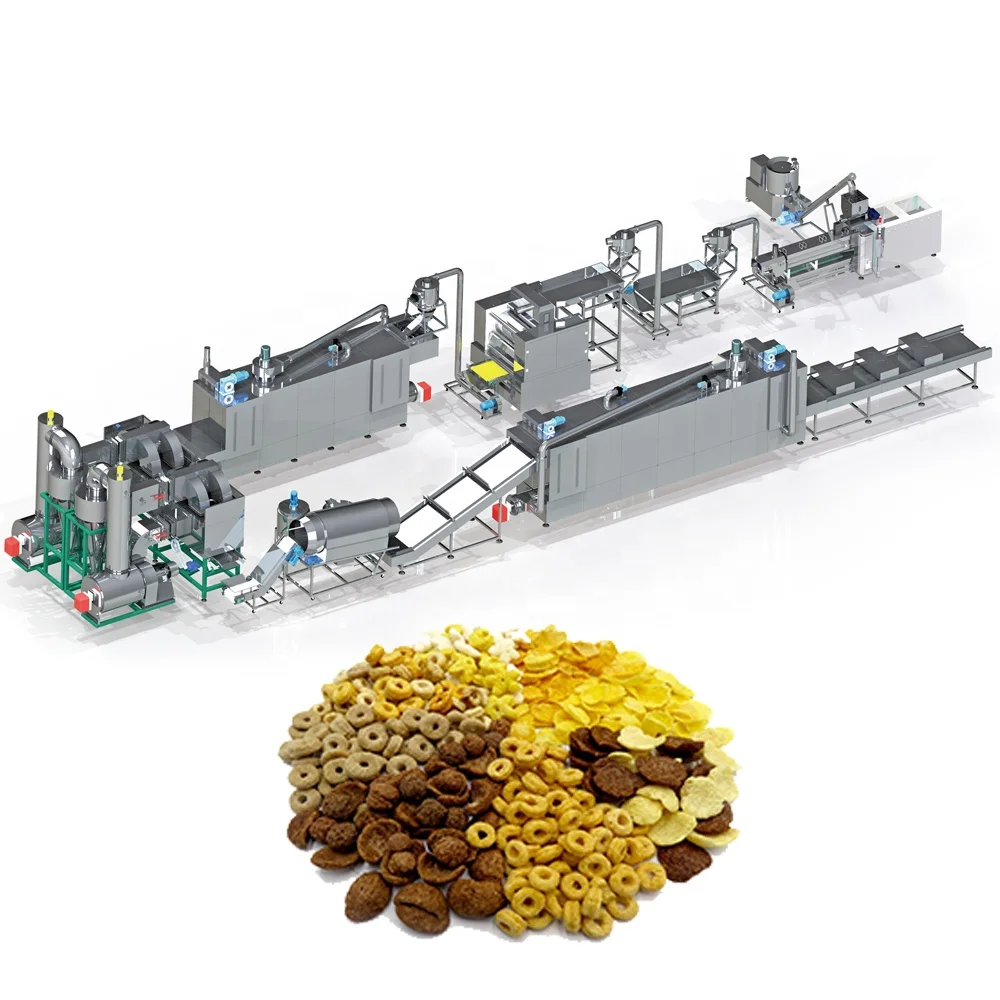
Precise screw configuration — Every co-rotating twin-screw segment is matched to your corn variety and target gelatinisation index before the line leaves our workshop.
Technical Specifications
| Parameter | Value |
|---|---|
| Product Type | Corn Flakes Production Line |
| Extruder Type | Co-rotating twin-screw |
| Extruder Model | MT-65 |
| Mixer Capacity | 10–30 kg per load (basis not stated in source) |
| Mixer Power | 4 kW |
| Mixer Tank Size | Ø600 × 500 mm |
| Mixer Dimensions | 1000 × 800 × 1200 mm |
| Screw Conveyor Power | 0.75 kW |
| Screw Conveyor Dimensions | 2700 × 500 × 2400 mm |
| Flaking Roller Dimensions | 510 × 310 × 1050 mm |
| Flaking Machine Size | 1550 × 1300 × 2000 mm |
| Flaking Machine Power | 16.12 kW |
| High-Temperature Oven Size | 4.5 × 1.4 × 1.8 m |
| Oven Power | 3.75 kW |
| Oven Heating Method | Gas-fired, dual-side baking |
| Sugar Spraying System Power | 28.75 kW |
| Sugar Spraying System Size | 4000 × 1900 × 1880 mm |
| Sugar Spraying Roller Size | Ø600 × 2700 mm |
| Voltage & Frequency | Configurable (e.g. 3ph 380V 50Hz, 3ph 415V 60Hz, 3ph 220V 60Hz) |
| Contact Material | Stainless steel on all food-contact surfaces |
| Line Configuration | Flour Mixer → Screw Elevator → Twin-Screw Extruder → Elevator → Dryer → Elevator → Coating Line → Vibrating Spreader → Elevator → Dryer → Cooling Conveyor |
| Certification | CE |
Application Suitability
| Application | Material or Output |
|---|---|
| Traditional breakfast corn flakes | Degerminated corn grits or whole corn flour |
| Multi-grain cereal flakes | Blends of corn, rice and oat flour |
| Fortified breakfast cereal | Grain flour mixed with vitamin and mineral premix |
| Sugar-coated or honey-coated flakes | Plain extruded flakes passed through sugar spraying line |
| Puffed snack variants | Reformulated dough on the same twin-screw extrusion platform |
Why Generic Screw Profiles Fail on Local Corn
A screw configuration copied from a reference build will produce flakes that either shatter during toasting or stay dense and chewy.
I spent five days on a production floor in Lahore because the client had switched to a locally milled, low-starch corn variety. The original screw profile delivered insufficient shear, gelatinisation dropped, and every flake that left the oven crumbled under its own weight. The root cause was never the oven or the press — it was the corn flakes extrusion line screw configuration that had been specified for a completely different raw material. When buyers request a quotation based only on nominal capacity, the screw profile is often an afterthought, yet it is the single most influential variable governing starch conversion, pellet density and the final crispness of the flake [NEED_CITE: twin-screw extrusion gelatinisation kinetics for varying amylose content].
Starch Gelatinisation Under Controlled Shear
The MT-65 co-rotating twin-screw extruder uses interchangeable screw elements so that conveying, kneading and shear zones can be rearranged for each grain blend. Corn flakes extrusion line screw configuration decisions start with the amylose-to-amylopectin ratio of the incoming flour; higher amylose demands longer residence time in the kneading blocks to reach full gelatinisation without excess moisture. Barrel heating zones work in tandem, keeping the dough above the gelatinisation threshold while mechanical shear completes the conversion.
Flaking Pressure and Thickness Uniformity
After extrusion the cooked pellets pass through the flaking unit where a 510 × 310 mm roller pair compresses them to the target thickness. Roller gap is adjustable and an integrated cooling circuit stabilises the roller surface temperature so that flakes release cleanly. If the gap is too wide the flake stays dense and under-toasts; if too narrow the structure fractures before it reaches the oven. Getting this window right is what separates a bowl-stable flake from one that turns to mush within minutes [NEED_CITE: flake thickness versus bowl life in breakfast cereal research].
How Key Parameters Shape the Final Flake
The 16.12 kW flaking motor delivers enough torque to maintain constant pressure across the full roller width, preventing edge-to-centre density variation. Gas-fired dual-side baking in the 4.5 m high-temperature oven ensures that radiant heat reaches both surfaces of the flake simultaneously, eliminating the pale underside that single-pass ovens often leave. The sugar spraying roller, sized Ø600 × 2700 mm with a 28.75 kW heating circuit, keeps syrup at a stable viscosity so that coating weight stays even across long production runs. Voltage is configurable from 380 V to 415 V at either 50 Hz or 60 Hz, which means the line can ship to markets with differing grid standards without rewiring on arrival. Every food-contact surface is stainless steel, meeting hygiene expectations for breakfast cereal lines and simplifying wash-down between flavour changes.
The Cost of Skipping a Trial Run
Buyers who approve a line without requesting a raw-material trial often discover texture problems only after installation. Flakes may emerge too brittle for packing, or coating adhesion may fail because the surface porosity does not match the syrup solids content. Rectifying these issues on-site means re-ordering screw elements, re-cutting dies and burning through weeks of production time. A pre-shipment trial on your exact corn flour eliminates most of that risk by locking the corn flakes extrusion line screw configuration before steel is cut [NEED_CITE: pre-shipment trial run benefits in food extrusion projects].
Engineering Reasons to Source This Line Here
Screw and die profiles are specified to the buyer’s flour analysis and target flake density rather than pulled from a catalogue default. An in-house testing workshop runs your raw material through the extruder so you can review the trial report before the line is crated. Because every station — mixing, extruding, flaking, drying, coating, cooling — is sourced under one supplier, throughput is balanced across the entire line instead of bottlenecked by a mismatched dryer or under-sized conveyor. PLC and MCC integration is confirmed against your control language preference, and electrical schematics are delivered with voltage and frequency already matched to the destination market. CE documentation accompanies each shipment, giving importers the conformity paperwork that customs and local inspectors require.
Documentation & Verification
- Screw and die configuration record tied to your specific corn flour batch analysis
- Trial run report on customer raw material executed in the testing workshop before crating
- Line layout and capacity calculation showing balanced throughput at every station
- Electrical schematic with confirmed voltage, frequency and control language for the destination grid
- CE declaration of conformity included with shipping documentation
- Operation and maintenance manual covering roller adjustment and screw element replacement
Installation, Commissioning & Support
- Foundation drawing provided showing load points for the 1550 × 1300 mm flaking unit
- Dedicated power circuit plan accounting for the 28.75 kW sugar spraying system and 3.75 kW oven
- Line arrives in modular sections for sequential assembly in limited-clearance workshops
- On-site commissioning includes screw profile fine-tuning on your actual corn flour
- Operator training covers roller gap adjustment and barrel temperature ramp-up procedure
- Wear parts list covers screw elements, die inserts and flaking roller sleeves for first replacement cycle
Preparing a Technical Inquiry
Share your corn flour specification sheet, including moisture content and starch profile, along with the target flake thickness and bowl-life expectation. Confirm the available plant voltage and whether the control interface should be in English or another operating language. If you already run upstream milling or downstream packing equipment, send the interface dimensions so the corn flakes extrusion line screw configuration and conveyor heights can be matched before quotation.
Frequently Asked Questions
Q: How does screw configuration change when blending rice flour with corn?
A: Rice flour gelatinises at a slightly lower temperature and produces less melt viscosity than corn, so the kneading block sequence is shortened and barrel set-points are adjusted downward. Without this change the dough over-cooks, leading to flakes that brown too fast in the oven and develop a bitter taste.
Q: What determines the final flake thickness and how is it adjusted?
A: Roller gap, pellet moisture at the flaking station and roller surface temperature all influence thickness. The operator adjusts the gap mechanically and monitors the cooling circuit to keep the roller surface consistent, typically targeting a range that keeps the flake intact through toasting yet thin enough to crisp fully.
Q: Why does the line use a dual-side gas oven rather than single-pass heating?
A: Dual-side exposure delivers radiant heat to both surfaces of the flake at once, producing uniform moisture loss and colour. Single-pass ovens tend to leave the underside paler and less crisp, which consumers notice as inconsistent texture in the bowl.
Q: Can the same extruder produce sugar-coated and plain flakes without major rebuilds?
A: Yes. The screw profile and die remain largely unchanged; the main adjustment happens at the sugar spraying station where syrup temperature and roller speed are set for the desired coating weight. A quick wash-down of the coating drum prevents cross-contamination between batches.
Q: How is actual line capacity verified before shipment?
A: The testing workshop runs your corn flour through the extruder, flaking unit and oven in sequence, recording throughput, moisture loss and flake density. The resulting trial report becomes the baseline for the capacity figure stated in the quotation, with raw material and moisture conditions clearly documented.