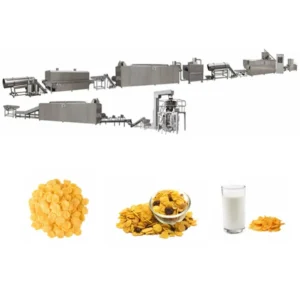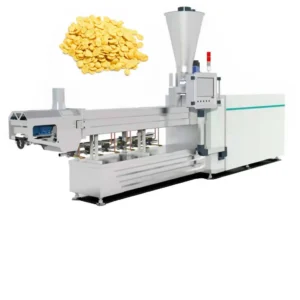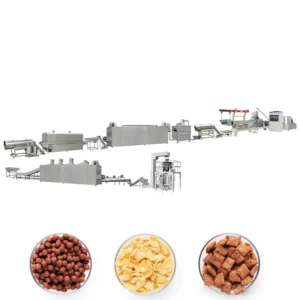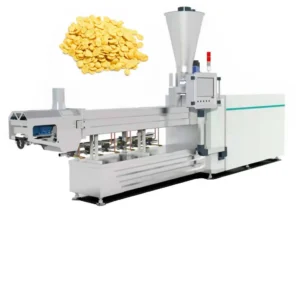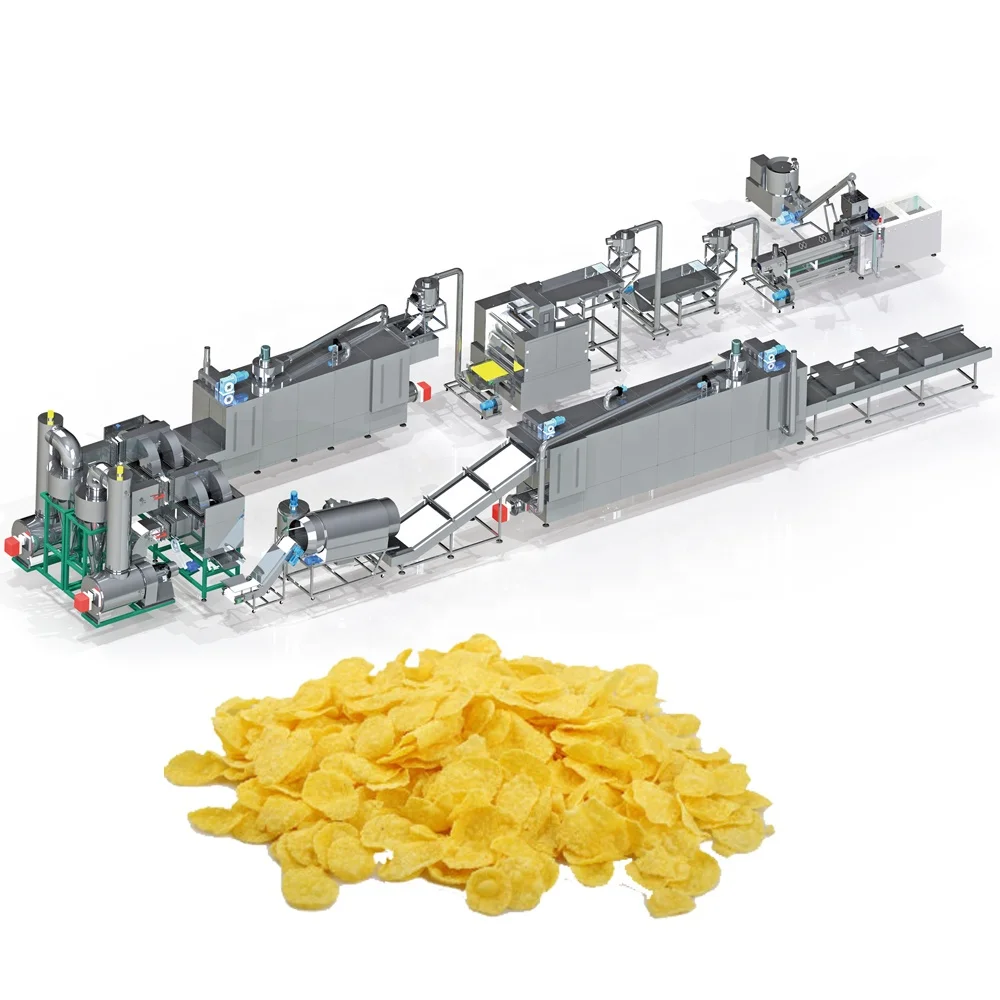
Matched Screw and Die Design — Every corn flakes line we build starts with the buyer’s actual grain blend and moisture profile, configured through our in-house testing workshop before a single component ships.
Technical Specifications
| Parameter | Value |
|---|---|
| Product Type | Corn Flakes Production Line / Breakfast Cereal Processing Line |
| Output Capacity | 750 kg/hr (basis not stated in source — confirm raw material, moisture content, and product format) |
| Screw Type | Twin-screw |
| Control System | Easy-to-operate interface (PLC / MCC configuration to be confirmed) |
| Product Range | Natural corn flakes, sugar-coated flakes, various shaped breakfast cereals |
| Line Stations | Mixing, extrusion, flaking, drying, coating, cooling, packing |
| Customizable Layout | Engineered drawings tailored to specific factory sizes |
| Voltage & Frequency | To be confirmed before commissioning |
| Motor | Heavy-duty drive (rated kW to be confirmed) |
| Standards | CE (since 2014), ISO |
Application Suitability
| Application | Material or Output |
|---|---|
| Natural corn flakes manufacturing | Degerminated corn grits, whole grain corn meal |
| Sugar-coated and flavoured flake variants | Base flakes with sucrose, honey, or malt syrup coating |
| Multi-grain and shaped breakfast cereals | Blends of corn, wheat, rice, and oat flours |
| Fortified cereal formats | Grain blends with added vitamin and mineral premixes |
What "Rated Capacity" Means for Your Grain Blend
A number on a spec sheet only holds if the extruder is configured for your actual raw material.
When a breakfast cereal twin-screw extrusion process is quoted at a nominal output, that figure often rests on idealised laboratory conditions with standard corn grits at a fixed moisture level. Switch to a whole wheat blend, introduce a higher fibre content, or alter the fat ratio, and the starch gelatinisation temperature shifts. The flakes come off the press flimsy, the bowl life drops, and the line never reaches the stated throughput. I have seen this exact scenario play out when a buyer’s pre-mixed formulation behaved nothing like the standard test material [NEED_CITE: starch gelatinisation behaviour across grain formulations].
Mapping Barrel Zones to Gelatinisation Behaviour
The barrel on a twin-screw extruder is divided into multiple temperature zones, each governing a different phase of the conditioning process. For corn flakes, the feed zone must hydrate the grits without premature gelatinisation, while the compression and metering zones apply the shear and heat needed to fully gelatinise the starch matrix. Corn flakes extrusion technology depends on this staged thermal profile — too much heat too early causes the dough to set before reaching the die, producing a dense, under-expanded pellet that will not flake properly downstream.
Die Geometry and Flake Density Control
The die plate determines the cross-section of the extrudate before it reaches the flaking rolls. Aperture diameter, land length, and face configuration all influence the expansion ratio and, ultimately, the thickness and density of the finished flake. A die designed for a round pellet destined for flaking will behave very differently from one intended for direct-expansion shaped cereal. Getting this specification wrong at the design stage means the entire breakfast cereal twin-screw extrusion process produces output that cannot meet the target bowl life and crunch retention [NEED_CITE: die land length effect on extrudate expansion].
Reading the Specification Sheet Beyond the Headline Number
The 750 kg/hr capacity figure listed for this Corn Flakes Production Line is a reference point that requires confirmation against your specific grain blend, moisture content, and target flake format. Equally important is the control system — the interface must allow operators to adjust barrel zone temperatures, screw speed, and feed rate independently, because a recipe that works for degerminated corn will need different parameters for a multi-grain blend. The twin-screw configuration is central here: it provides the mixing intensity and residence time distribution that single-screw designs cannot match when processing variable raw materials. Motor power and voltage must be confirmed against your facility’s electrical supply before production begins, as a mismatch at commissioning delays the entire project.
The Cost of a Mismatched Downstream Configuration
An extruder that is perfectly configured for your grain blend still fails if the flaking rolls, dryer, and coating drum are not sized to handle its output. When the dryer capacity falls short of the extrudate volume, moisture remains trapped inside the flake, and the product goes soft within days of packing. Similarly, a coating drum that cannot maintain an even syrup distribution at the line’s running speed produces flakes with inconsistent sweetness and clumping [NEED_CITE: moisture migration in packaged breakfast cereals].
Why Buyers Source This Line Here
Every station on this Corn Flakes Production Line is matched for throughput by a single supplier, eliminating the integration gaps that arise when extruders, dryers, and coaters come from separate vendors. The screw configuration and die design are specified to your raw material and target flake format, not copied from a generic build. Before shipment, your actual grain blend runs through our in-house testing workshop so the process parameters are validated on real product, not a laboratory substitute. The twin-screw expertise behind this line spans pet food, aquatic feed, snacks, cereals, and starch applications, which means the engineering team understands how different raw materials behave under shear and heat. From pre-sales consultation through on-site installation and commissioning, the same technical team follows the project.
Documentation & Verification
- Line layout and capacity calculation with throughput matched across mixing, extrusion, flaking, drying, and coating stations
- Screw and die configuration record specific to your grain blend and target flake density
- Trial run report on your raw material conducted in the testing workshop before dispatch
- Electrical schematic with voltage and frequency confirmed against your facility supply
- Operation and maintenance manual covering barrel zone settings and screw wear intervals
Installation, Commissioning & Support
- Foundation and floor space plan engineered to the customised layout of your Corn Flakes Production Line
- Dedicated power circuit specification based on the confirmed motor rating and voltage requirements
- Barrel zone temperature calibration and screw speed tuning during on-site commissioning
- Operator training covering die changeover procedures and cleaning between product changeovers
- Wear parts list including screw elements and die plates with recommended replacement intervals
Preparing Your Enquiry
To configure a line that holds its rated output on your specific formulation, we need to understand your grain blend composition and moisture targets, your daily production volume, the available floor space and ceiling height in your facility, and your local voltage and frequency standards. Let us know whether you plan to run a single flake format or multiple variants, and whether a trial run on your raw material in our testing workshop would help your team validate the product before the line ships.
Frequently Asked Questions
Q: How is screw configuration selected for different grain blends and moisture levels?
A: The screw elements are arranged based on the starch content, fibre level, and fat ratio of your specific blend. Higher fibre materials typically need a gentler shear profile and adjusted compression ratio to achieve full gelatinisation without degrading the grain structure. Moisture addition rate at the preconditioner is matched to the blend’s absorption characteristics before the material enters the barrel.
Q: What barrel temperature profile is needed for proper starch gelatinisation in corn flakes?
A: Corn flakes require a graduated profile that starts with moderate heat in the feed zone to hydrate the grits, then increases through the compression and metering zones to fully gelatinise the starch. The exact setpoints depend on your grain variety and particle size distribution, which is why we validate the profile during the trial run on your raw material.
Q: How does die design affect flake thickness, expansion, and final density?
A: The die aperture diameter and land length control how much the extrudate expands before it reaches the flaking rolls. A shorter land allows greater expansion, producing a lighter flake, while a longer land restricts expansion for a denser, crunchier product. Die face configuration is matched to the target flake shape.
Q: Can trial runs be performed on the buyer’s raw material before equipment shipment?
A: Yes. Our in-house testing workshop runs your actual grain blend through the configured extruder, flaking rolls, and dryer to validate the process parameters. You receive a trial run report documenting barrel temperatures, screw speed, moisture levels, and the physical properties of the finished flake before the line is packed for dispatch.
Q: How is extruder output matched to downstream flaking, drying, and coating capacity?
A: Each station is sized based on the confirmed extruder throughput at your specific moisture and product format. The dryer belt length and airflow are calculated to remove moisture from the flaked pellets at the line’s running speed, and the coating drum volume is matched to the syrup application rate required for your target flavour profile.