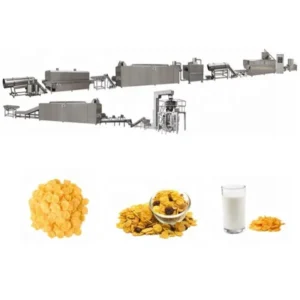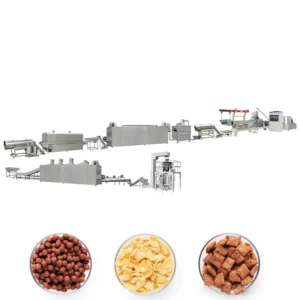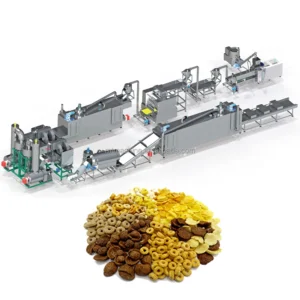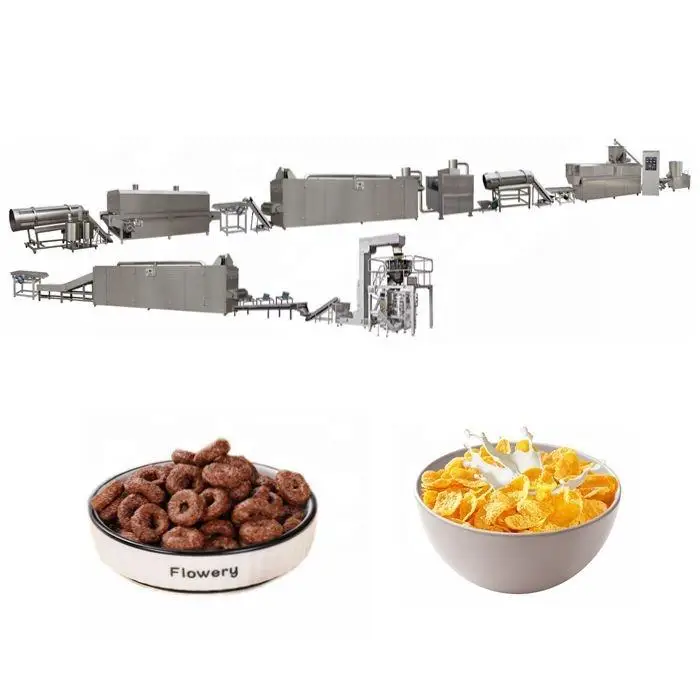
Precision Extrusion Engineering — Screw configuration and die geometry are specified to the buyer’s actual cereal formulation, not copied from a generic build, ensuring target flake density and roasting response from the first production run.
Technical Specifications
| Parameter | Value |
|---|---|
| Product Type | Twin-Screw Corn Flake Extrusion Production Line |
| Models Available | MT70, MT85, MT75 |
| Screw Configuration | Twin-screw |
| MT70 Installed Power | 160 kW |
| MT70 Power Consumption | 120 kW |
| MT70 Capacity | 150–200 kg/hr (basis not stated in source — confirm raw material formulation and moisture content) |
| MT70 Overall Dimensions | 41 × 1.5 × 2.2 m |
| MT75 Installed Power | 210 kW |
| MT75 Power Consumption | 150 kW |
| MT75 Capacity | 300–500 kg/hr (basis not stated in source — confirm raw material formulation and moisture content) |
| MT75 Overall Dimensions | 45 × 1.5 × 3.5 m |
| MT85 Installed Power | 190 kW |
| MT85 Power Consumption | 140 kW |
| MT85 Capacity | 300–400 kg/hr (basis not stated in source — confirm raw material formulation and moisture content) |
| MT85 Overall Dimensions | 43 × 1.5 × 3.2 m |
| Extruder Working Principle | Feeding system, extruding system, cutting system, heating system, gearing system, controlling system |
| Extruder Advantage | Automatic lubricating, cooling function; screw made by special tech for wear resistance |
| Flaking Machinery Control | PLC control system, hydraulic system for double rollers, double motors for separate roller driving, temperature pipe controlled by infrared sensor |
| Corn Flakes Dryer Heating Source | Gas, Electric |
| Corn Flakes Dryer Function | Pre-drying after extruding to avoid sticking in downstream process |
| Hot Air Roasting Oven | Vibrating pan with high temperature spraying tubes, conciliation burner in combustion chamber, two separate circulating fans, cyclone dust removal device |
| Coating System | Double tumble for sugar melting, elevator, coating drum, spraying nozzle |
| Control System | PLC |
| Standards | CE, ISO |
Application Suitability
| Application | Material or Output |
|---|---|
| Natural Corn Flake Production | Corn powder as primary base material |
| Sugar-Coated Corn Flake Production | Corn powder base with sugar coating application |
| Multi-Grain Cereal Processing | Rice, wheat, oat, barley blends |
| Extruded Cereal Shapes | Ball, tube, stick, ring, fruit loop, star, wheel, flower, heart |
| Industrial-Scale Breakfast Cereal | Continuous production from batching through packing |
What Generic Screw Configurations Do to Your Corn Flake Density
Flakes that sink in milk or shatter during sugar coating are almost always an extrusion problem, not a recipe problem.
When I worked the assembly floor, I watched a customer commission a line quoted on nominal capacity, only to find their degerminated corn flour couldn’t achieve proper starch gelatinisation with the default screw profile. The flakes came out hard, brittle, and the line ran at barely more than half its rated output. The twin-screw corn flake extruder specifications only matter when the screw elements and die geometry are matched to your specific grain blend and moisture window. A generic build might extrude something that looks like a corn flake on the surface, but the internal cell structure determines how it behaves in the roaster and how it holds up in the bowl [NEED_CITE: starch gelatinisation temperature thresholds for cereal extrusion].
Barrel Temperature Profiling for Controlled Gelatinisation
Starch gelatinisation in corn flake extrusion is not a single event but a progression managed across multiple barrel zones. The twin-screw configuration allows operators to build a temperature gradient that gradually transitions the raw corn blend from a dry powder mix into a cohesive, plasticised melt. Each zone contributes to moisture distribution and shear development, and getting the profile wrong at any point cascades through every downstream station. This is where corn flakes extrusion technology separates lines that run consistently from those that require constant operator intervention.
Die Design and the Expansion Ratio Question
The die opening geometry directly governs the expansion ratio of the extrudate as it exits the barrel and experiences the pressure drop. For corn flakes, the target is a controlled, moderate expansion — enough to create the internal porosity that produces crispness after roasting, but not so much that the piece puffs into a ball rather than flattening properly under the flaking rollers. Die design is formulation-specific; a blend high in oat or barley behaves differently under pressure than a pure corn base [NEED_CITE: die geometry effects on extrudate expansion in breakfast cereal production].
Reading the Power and Capacity Data Correctly
The installed power versus actual consumption gap across all three models reflects how twin-screw extruders operate below their maximum draw under normal conditions. The MT70, MT75, and MT85 differ in motor sizing and barrel volume, which maps to different throughput bands — but the meaningful capacity figure only emerges once your raw material formulation and target moisture content are confirmed. A high-fiber multi-grain blend absorbs energy differently than degerminated corn flour, and the screw speed required to maintain gelatinisation may shift the real output away from any nominal rating. The PLC control system maintains barrel temperature and screw speed consistency across batches, which is what makes the difference between a line that needs adjustment every twenty minutes and one that holds its parameters across an entire shift.
When the Extruder and the Flaking Station Fight Each Other
The flaking machinery uses a hydraulic double-roller system with separate motors for each roller and infrared temperature sensing on the temperature pipe. If the extrudate arrives at the flaking station with inconsistent moisture or temperature — which happens when the extruder barrel profile is not stabilised — the rollers compress unevenly. You end up with flakes that are too thick in the centre and too thin at the edges, or worse, flakes that stick to the rollers and tear. The infrared sensor can compensate within a narrow band, but it cannot fix a feedstock that was never conditioned properly upstream.
The Roasting Oven Is Where Bad Extrusion Becomes Visible
The hot air roasting oven uses a vibrating pan with high-temperature spraying tubes and a conciliation burner in the combustion chamber, supported by two separate circulating fans and a cyclone dust removal device. This station is designed to create controlled surface blistering — the characteristic micro-bubbles on a corn flake surface that signal proper crispness. If the extrusion produced a dense, under-gelatinised piece, no amount of roasting adjustment will produce that blistering. The piece will either remain tough or over-dry before the surface reacts. This is where the cost of a generic screw configuration finally becomes visible to the buyer, often after weeks of troubleshooting downstream [NEED_CITE: roasting parameters and surface blistering in cereal flake production].
Why the Testing Workshop Matters Before Shipment
Every line we configure goes through trial runs on the buyer’s actual raw material in our in-house testing workshop before it ships. This is not a demonstration — it is a parameter development session. We run your corn flour, your multi-grain blend, or your oat-base formulation through the twin-screw extruder, document the screw configuration that produces the correct expansion ratio, record the barrel temperature profile, and validate that the flake thickness and roasting response meet your product specification. The trial run report travels with the machine, so your commissioning team starts from a known baseline rather than spending the first production week guessing.
Documentation & Verification
- Screw and die configuration record matched to your specific cereal formulation
- Trial run report on customer-supplied raw material validating expansion and flake geometry
- Machine specification sheet with capacity confirmed against your actual formulation
- Line layout showing throughput matching across extrusion, flaking, drying and roasting
- Electrical schematic with voltage and frequency confirmed for your facility
- Operation and maintenance manual with wear parts list included
Installation, Commissioning & Support
- Customised line layout engineered to your factory footprint and utility connection points
- PLC control system configured to your preferred operator language before dispatch
- On-site commissioning with barrel temperature profile fine-tuning on your raw material
- Flaking roller pressure and gap calibration validated against your target flake thickness
- Operator training covering screw configuration changes for different cereal formulations
- Wear parts list with replacement screw and die element specifications documented
What We Need to Configure Your Line Accurately
To build a line specification that holds up in your production environment, we need your base material formulation — including the ratio of corn to any secondary grains like rice, oat, or barley — along with the target moisture content entering the extruder. Provide your daily production target and available shift structure so we can match the extruder model to your throughput band without oversizing or bottlenecking. Your facility voltage, frequency, and preferred control language should be confirmed early, as these affect the electrical cabinet build and PLC programming lead time.
Frequently Asked Questions
Q: How is screw configuration determined for different cereal formulations like corn, rice, oat, or multi-grain blends?
A: Screw element selection and sequencing depend on the starch composition, protein content, and fibre level of your blend. Higher fibre materials like oat require different shear profiles than pure corn to achieve proper gelatinisation without excessive wear. We develop the configuration during a trial run on your actual raw material and document it for consistent replication.
Q: What barrel temperature profile and moisture range produces optimal starch gelatinisation for corn flakes?
A: The optimal profile is formulation-dependent, but corn-based flakes typically require progressive heating across barrel zones with moisture conditioning before extrusion. Too low and the starch remains partially raw, producing hard flakes. Too high and the extrudate expands excessively, making it impossible to flake to the target thickness.
Q: How does die design affect flake expansion, density, and final bowl life in milk?
A: Die opening geometry controls the expansion ratio at the barrel exit. Moderate expansion creates the internal porosity needed for crispness and a proper bowl life — enough structure to resist immediate sogginess, but enough porosity for the roasting process to create surface blistering. We match the die design to your target product specification.
Q: Can the extrusion line be configured for both natural and sugar-coated corn flake production on the same system?
A: Yes. The line stations diverge after hot air roasting. For sugar-coated flakes, the process adds sugar spraying and sugar coating stations with a double tumble system for sugar melting, an elevator, coating drum, and spraying nozzle, followed by a secondary drying stage before cooling and packing.