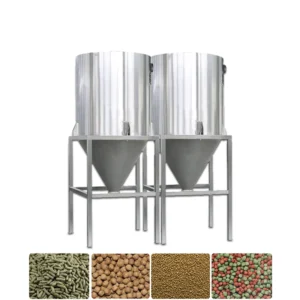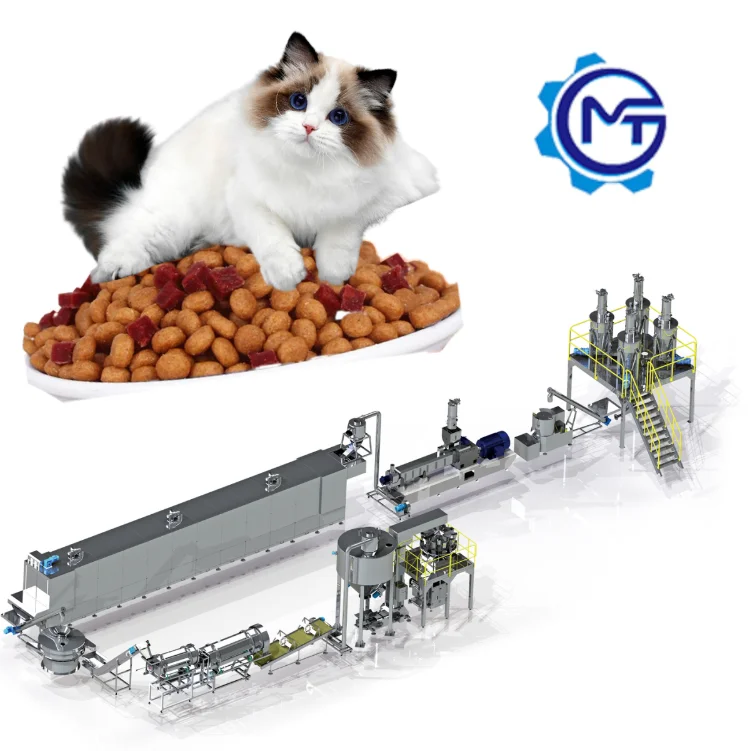
Custom Screw Profiling — Every MT70 barrel zone and screw element is matched to your declared meat meal ratio and target kibble density, not copied from a generic build.
Technical Specifications
| Parameter | Value |
|---|---|
| Model | MT70 |
| Product Type | Pet Food Extrusion Production Line |
| Output Capacity | 200-250 kg/h (basis not stated in source — confirm raw material formulation, moisture content and kibble size) |
| Voltage & Frequency | 380V 50HZ Three Phase |
| Rated Power | 45 kW |
| Screw Type | Twin-screw |
| Control System | PLC and MCC |
| Line Stations | Raw material mixing, extrusion, drying, packaging |
| Assembly State | Complete line from batching to packing |
| Certification | CE, ISO |
Application Suitability
| Application | Material or Output |
|---|---|
| Dry kibble for dogs and cats | Corn, rice, wheat blended with meat meal and fat |
| Semi-moist pet food | High-moisture dough formulations with humectants |
| Pet treats and bites | Specialty shapes requiring precise die geometry |
Why "250 kg/h" Means Nothing Without the Recipe
A rated capacity on a standard corn formula tells you nothing about what the machine will do when your recipe hits 40% meat meal.
I have stood on factory floors where a line performed perfectly during the factory test on simple starch blends, then choked or produced dense, unexpanded kibble the moment the customer loaded their actual formulation. The issue is never the motor or the throughput rating — it is the screw profile and barrel temperature map. High-protein, high-fat recipes behave completely differently inside the barrel than corn-based ones, and the twin-screw pet food extrusion technology MT70 addresses this by requiring your recipe details before the screw elements are ever assembled [NEED_CITE: raw material behaviour in twin-screw extrusion].
Screw Element Arrangement for Protein-Rich Formulations
The arrangement of conveying, kneading, and reverse-pitch elements along the screw shaft determines how much shear energy goes into your dough. When a recipe carries high meat meal content, standard kneading blocks designed for pure starch tend to over-work the protein matrix, resulting in a tough, poorly expanded kibble that pets reject. The twin-screw pet food extrusion technology MT70 platform allows engineers to resequence these elements so that shear is introduced gradually, giving the starch fraction enough residence time to gelatinise while the protein fraction is not over-crosslinked.
Barrel Temperature Zoning and Expansion Control
Each barrel zone can be independently heated or cooled, which matters more than most buyers realise at first. Starch gelatinisation and protein denaturation happen at different temperatures, and the gap between those two thresholds is where expansion is won or lost. On a high-fat recipe, the barrel zones near the die need careful management because fat acts as a lubricant, reducing friction and therefore reducing the thermal energy available for expansion. Getting this wrong means dense kibble that falls outside the density specification your market expects [NEED_CITE: starch gelatinisation temperature ranges in extrusion].
Reading the Spec Sheet Like an Engineer
The 45 kW motor on the MT70 provides the torque headroom needed for viscous, meat-heavy formulations that demand higher shear forces inside the barrel. The twin-screw configuration, as opposed to a single-screw design, gives operators independent control over conveying speed and shear intensity — a critical distinction when switching between dry kibble and semi-moist formats on the same line. The PLC and MCC control system stores barrel temperature profiles and screw speed recipes, so that once a formulation is dialled in, the exact parameter set can be recalled for the next production run without manual guesswork. Voltage at 380V 50Hz three-phase is standard, but destination markets with different grid specifications require confirmation before the electrical panel is built.
The Real Cost of a Generic Screw Build
When screw elements and die geometry are selected from a catalogue rather than matched to your formula, the consequences show up in ways that are expensive to reverse. Dense kibble that sinks when it should float, or that breaks apart during packaging, traces back to incorrect shear profiles. Retrofitting a new screw configuration after installation means weeks of lost production while elements are sourced and tested. Getting the die geometry wrong the first time also means buying multiple replacement dies before one delivers the correct expansion ratio [NEED_CITE: screw and die replacement lead times in food extrusion].
Why Source This Line From Meiteng
Meiteng runs an in-house testing workshop where your actual raw materials go through the MT70 before the line ships, so screw and die configuration is validated on your recipe, not on a factory-standard starch blend. The entire line from batching through extrusion to drying and packing is supplied as one coordinated package, which means throughput is matched at every station rather than bottlenecked at the dryer. Each line ships with a screw and die configuration record documenting exactly which elements are installed and why, so your maintenance team can reorder wear parts with precision. Electrical schematics and voltage confirmation are completed before production starts, preventing the commissioning delays that happen when a panel arrives wired for the wrong grid. On-site installation, operator training, and ongoing maintenance support follow commissioning.
Documentation & Verification
- Line layout and capacity calculation showing throughput match across every MT70 station
- Screw and die configuration record specific to your declared raw material and kibble size
- Electrical schematic with voltage and frequency confirmation for your destination grid
- Trial run report on your raw material conducted in the testing workshop before shipment
- CE declaration of conformity and ISO certificate for the complete extrusion line
- Wear parts list identifying screws, dies, and seals with part numbers for reordering
Installation, Commissioning & Support
- Floor space planning accounts for the full MT70 line footprint from mixer to packer
- Electrical connection requires a dedicated three-phase 380V 50Hz circuit rated for 45 kW
- Line arrives in modular sections for staged assembly matching your facility readiness
- First production run includes barrel temperature profiling and screw speed tuning on your recipe
- PLC and MCC interface training covers recipe storage, parameter recall, and fault diagnostics
- Spare screw elements and die inserts stocked against your specific configuration record
Before You Send an Inquiry
To configure the MT70 line for your production target, share your raw material list with approximate ratios, the kibble size range and shape you need, and your target hourly output on that specific formulation. Confirm your local voltage and frequency so the electrical panel is built correctly from the start. If you want to see how your recipe performs before committing, request a trial run in the testing workshop — bring or ship your actual ingredients for the most accurate result.
Frequently Asked Questions
Q: How is the screw configuration chosen for my specific pet food recipe and target kibble density?
A: Engineers review your raw material ratios — especially the starch-to-protein-to-fat balance — and select conveying, kneading, and reverse-pitch elements in a sequence that delivers the right shear and residence time. A trial run on your actual ingredients in the testing workshop confirms the configuration before the line ships.
Q: What barrel temperature profile is applied when the recipe has high meat meal and fat content?
A: Each barrel zone is set independently so starch gelatinisation completes before the protein matrix sets. High-fat recipes require lower shear zones near the die because fat reduces friction. The PLC stores these profiles so they can be recalled precisely on every production run.
Q: How does die geometry affect the expansion ratio and the final kibble shape?
A: Die opening diameter and land length control the pressure drop at the exit, which directly determines how much the extrudate expands. Longer land lengths produce denser kibble, while shorter ones allow greater puff. The die is matched to your target shape and density specification during the configuration phase.
Q: Can you run my actual raw materials through the MT70 before the line ships?
A: Yes. The in-house testing workshop is set up for trial runs using customer-supplied ingredients. This produces a trial run report documenting screw speed, barrel temperatures, moisture levels, and the resulting kibble density — so product development starts before installation, not after.