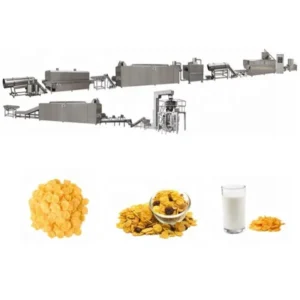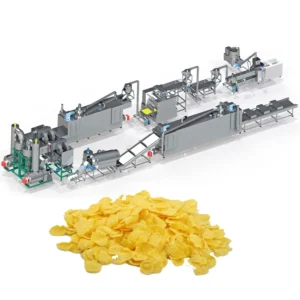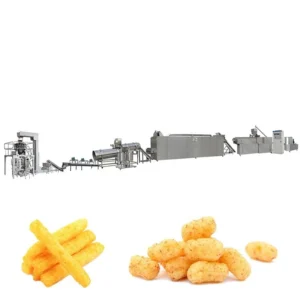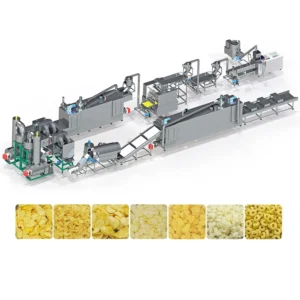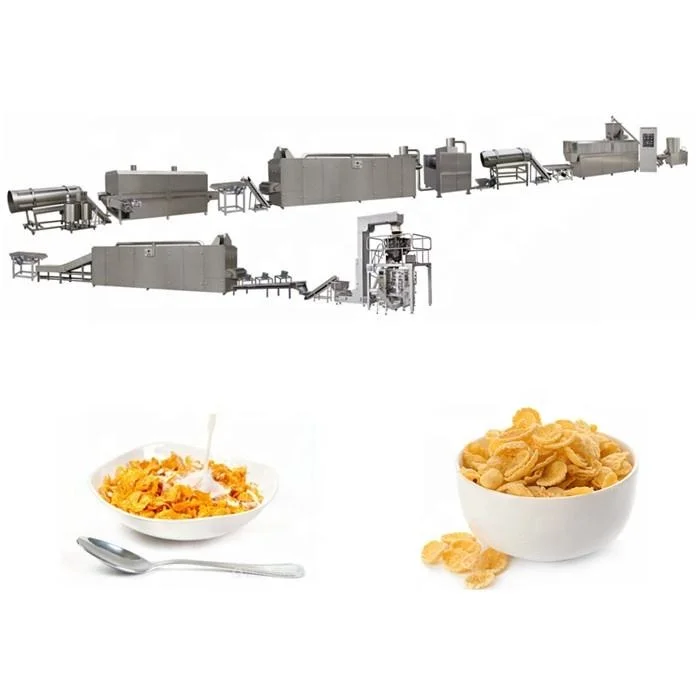
Precision-Matched Extrusion Geometry — screw configuration and die design are calibrated to your actual corn, oat, or multi-grain formulation rather than copied from a standard build, ensuring correct flake density and expansion behavior before the corn flakes extrusion production line specifications are finalized.
Technical Specifications
| Parameter | Value |
|---|---|
| Model | MT70 |
| Product Type | Corn Flakes Production Line |
| Screw Type | Twin Screw |
| Available Models in Series | MT70 / MT85 / MT75 |
| Installed Power (MT70) | 160 kW |
| Installed Power (MT85) | 190 kW |
| Installed Power (MT75) | 210 kW |
| Power Consumption (MT70) | 120 kW |
| Power Consumption (MT85) | 140 kW |
| Power Consumption (MT75) | 150 kW |
| Output Capacity (MT70) | 150–200 kg/hr (basis to be confirmed) |
| Output Capacity (MT85) | 300–400 kg/hr (basis to be confirmed) |
| Output Capacity (MT75) | 300–500 kg/hr (basis to be confirmed) |
| Overall Dimensions (MT70) | 41 × 1.5 × 2.2 m |
| Overall Dimensions (MT85) | 43 × 1.5 × 3.2 m |
| Overall Dimensions (MT75) | 45 × 1.5 × 3.5 m |
| Control System | PLC and MCC |
| Flaking Machinery | Hydraulic double-roller system, double motors for separate roller driving, infrared sensor temperature control |
| Dryer Heating Source | Gas / Electric |
| Roasting Oven | Hot air roasting, vibrating pan, high temperature spraying tubes, conciliation burner, two separate circulating fans, cyclone dust removal device |
| Coating System | Double tumble for sugar melting, elevator, coating drum, spraying nozzle |
| Screw Material | Special wear-resistant technology |
| Lubrication | Automatic lubricating and cooling function |
| Standards | CE; ISO |
Application Suitability
| Application | Material or Output |
|---|---|
| Natural corn flakes | Corn grits or corn powder, toasted to target crispness |
| Sugar-coated corn flakes | Corn base flakes with sugar syrup glazing |
| Multi-grain breakfast cereals | Oat, wheat, barley, rice powder blends |
| Shaped cereal snacks | Ball, tube, stick, ring, fruit loop, star, wheel, flower, heart via die change |
| Fortified breakfast cereal | Grain powder blended with vitamin and mineral premix |
What "Rated Capacity" Actually Means on a Corn Flake Line
Capacity is only real when measured against your specific raw material, moisture content, and target flake density — not against a catalog number.
I once watched a breakfast cereal line in West Africa fail commissioning because the extruder was configured for fine corn flour while the local supplier delivered coarse degerminated grits at lower moisture. The flakes came off the roller uneven, blistered in the roasting oven, and the entire first batch was scrapped. The rated output meant nothing because the screw profile and barrel temperature zones had never been adjusted for that material. When evaluating corn flakes extrusion production line specifications, the question is not how many kilograms per hour the machine can move — it is whether those kilograms meet your flake thickness and texture specification on the grain you actually source [NEED_CITE: raw material variability in African and South Asian grain supply chains].
How Screw Configuration Dictates Flake Behavior
The twin-screw extruder on the MT70 series is not a fixed geometry. Screw element arrangement — conveying, kneading, and reverse-pitch sections — is configured after reviewing your raw material particle size, starch content, and target gelatinisation degree. A corn formulation high in hard endosperm needs a different shear profile than an oat-heavy blend, and the corn flakes extrusion production line specifications must reflect this before metal is cut. The barrel temperature profile across multiple heating zones is then mapped to match the screw layout, controlling where gelatinisation initiates and how expansion is managed before the material reaches the flaking rollers.
Barrel Zones, Shear Control, and the Path to Uniform Flakes
Each barrel section on the twin-screw extruder operates under independent temperature control, allowing the process engineer to build a gradient that moves the dough from partial hydration through full gelatinisation and into a controlled-density extrudate. Too much shear in the final metering zone and the starch matrix tears, producing flakes that shatter during roasting. Too little and the material arrives at the flaking rollers under-gelatinised, yielding a dense, chewy product that does not meet market expectations for crispness. The hydraulic double-roller flaking station then compresses the extrudate at a calibrated gap, with infrared sensor temperature control maintaining roller surface conditions so flake thickness remains consistent across the full web width [NEED_CITE: starch gelatinisation and flaking consistency in twin-screw cereal processing].
Reading the Specs That Matter
The installed power across the MT70, MT85, and MT75 models — ranging from 160 kW to 210 kW — reflects the thermal and mechanical energy required to gelatinise starch at production scale. Power consumption figures are lower than installed capacity, indicating headroom for startup surges and material variation. The roasting oven specification includes a conciliation burner and two separate circulating fans, which together manage surface blistering and moisture removal simultaneously — a balance that determines whether the finished flake snaps cleanly or crumbles. The cyclone dust removal device on the roasting oven is not optional in practice; fine particulate from flake edges accumulates rapidly and, if not extracted, recirculates and scorches onto product surfaces. The automatic lubricating and cooling function on the screw shafts extends service intervals and prevents bearing contamination in the food-contact zone.
The Cost of Mismatched Stations
A flaking roller set that cannot keep pace with extruder output creates a material backlog that cools and skins over before compression, producing laminated flakes that delaminate during roasting. Similarly, a roasting oven undersized for the dryer output forces the line to slow down, negating whatever capacity advantage the extruder offered. These are not theoretical concerns. I have seen installations where the sugar coating drum could not tumble fast enough to match upstream flow, leaving flakes sitting in a stationary syrup pool and clumping into rejects. The throughput match between every station must be verified in the line layout calculation, not assumed from individual machine nameplates [NEED_CITE: throughput matching principles in multi-station food processing lines].
Why Procurement Here Works Differently
The screw configuration and die design for the MT70 series are specified to your raw material formulation before production begins, not selected from a generic catalog. An in-house testing workshop allows trial runs on your actual grain blend, with barrel temperature curves and roller gap settings recalibrated based on the results before the line ships. Every station from batching through coating is supplied as one coordinated system, so the flaking machinery capacity, dryer throughput, and roasting oven volume are calculated against the same extruder output figure. PLC and MCC controls are configured with your local voltage, frequency, and operator language confirmed in writing before assembly starts. Documentation includes the screw and die configuration record, the trial run report on your raw material, and the line layout with capacity calculation showing matched throughput at each station.
Documentation & Verification
- Line layout and capacity calculation showing station-by-station throughput match for your target output
- Screw and die configuration record specific to your grain formulation and flake density target
- Trial run report using your raw material in the testing workshop before shipment
- Electrical schematic with voltage, frequency, and PLC language confirmed to your factory standard
- Factory test record documenting flake thickness, expansion ratio, and roasting consistency
- CE declaration of conformity and ISO certificate for export documentation
Installation, Commissioning & Support
- Foundation planning accounts for the 41 m line footprint and vibrating pan dynamic loads
- Dedicated power circuit sized for the 120 kW operating draw on the MT70 configuration
- PLC and HMI commissioned in your operator language with MCC panel labeled to local code
- First-run parameter setting covers barrel temperature profile, roller gap, and roasting oven airflow
- Operator training on screw element inspection, hydraulic roller adjustment, and cyclone maintenance
- Wear parts list identifies screw segments, die plates, and roller surfaces with replacement intervals
What We Need From You to Configure the Line
Provide your raw material specification — grain type, particle size, moisture content, and any premix additions — so the screw configuration can be modeled before quoting. Confirm your local voltage, frequency, and preferred PLC display language to prevent commissioning delays. Share your target daily output and available workshop dimensions so the line layout can be drafted with correct station spacing and utility routing. If you produce both natural and sugar-coated variants, indicate the changeover frequency so the coating system can be sized accordingly.
Frequently Asked Questions
Q: How is output capacity verified against my specific raw material and moisture content?
A: Capacity is confirmed through a trial run in the testing workshop using your actual grain blend. Barrel temperature profiles, screw speed, and moisture addition rates are adjusted during the run, and the resulting flake thickness, expansion, and roasting behavior are documented in a report before the line ships.
Q: How is screw configuration selected for corn versus oat versus multi-grain blends?
A: Each grain type has different starch gelatinisation temperatures and fiber content that affect shear requirements. The screw element arrangement — kneading blocks, conveying sections, reverse-pitch zones — is configured based on your formulation, and the die geometry is matched to the target flake or shape density.
Q: What electrical and control details are confirmed before production begins?
A: Voltage, frequency, plug type, and PLC display language are confirmed in writing against your factory electrical standard. The electrical schematic is included in the documentation package, and the MCC panel is labeled in your preferred language before dispatch.
Q: How is dryer and roasting oven capacity matched to extruder output?
A: The line layout calculation specifies throughput at every station, not just the extruder. The dryer residence time, roasting oven volume, and circulating fan capacity are sized so that material flows continuously without backlog or cooling between stations.
Q: What trial run is performed before the line ships?
A: Your raw material is run through the extruder, flaking rollers, and roasting oven in the testing workshop. The trial run report documents screw configuration, barrel temperatures, roller gap settings, flake dimensions, and surface blistering quality — all specific to your formulation.