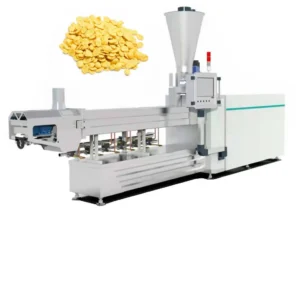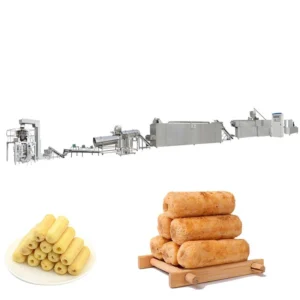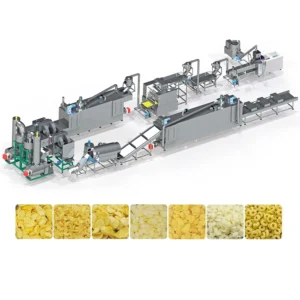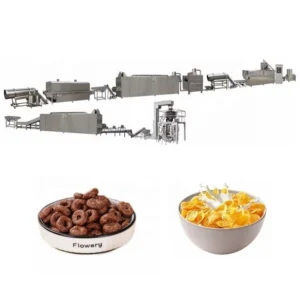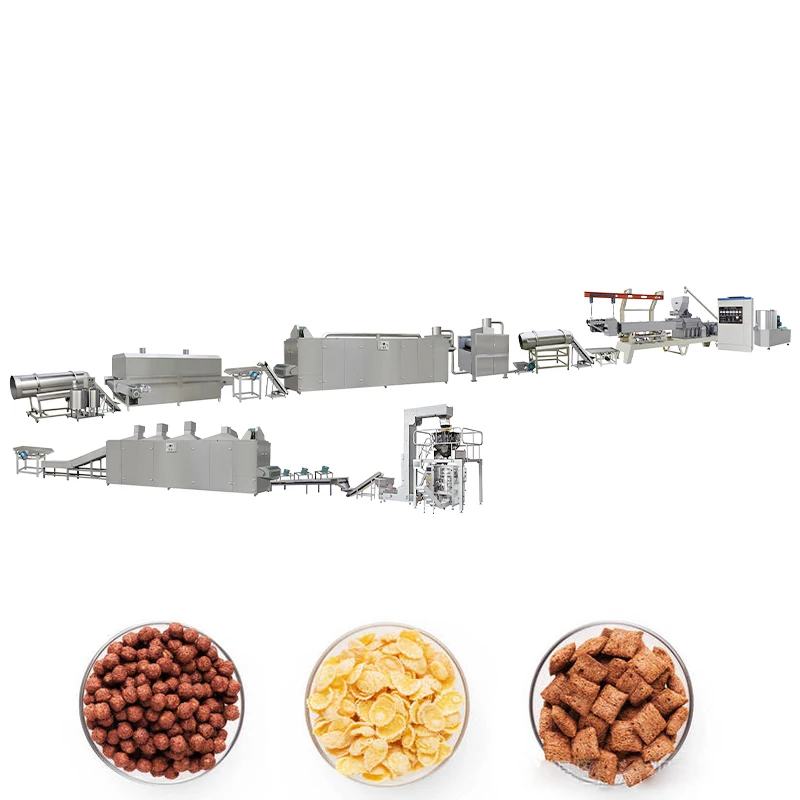
Extrusion Technology Matched to Raw Material — Every corn flakes extrusion production line technology configuration begins with starch gelatinisation testing on your actual cereal blend, not a generic screw build copied from a standard template.
Technical Specifications
| Parameter | Value |
|---|---|
| Product Type | Corn Flakes Breakfast Cereal Extrusion Production Line |
| Model Variants | MT-65 / MT-70 / MT-85 / MT-75 |
| Extruder Type | Twin-screw |
| Control System | PLC with real-time data storage, monitoring, alarm and reminder functions; button start |
| Extruder Design Method | 3D software design, analogue simulation, computer-automated testing |
| Installed Power (MT-65) | 84 kW |
| Real Power (MT-65) | 59 kW |
| Output Capacity (MT-65) | 120–150 kg/h (basis not stated in source — confirm raw material type, moisture content and flake thickness) |
| Overall Dimensions (MT-65) | 21000 × 1200 × 2200 mm |
| Installed Power (MT-70) | 132 kW |
| Real Power (MT-70) | 92 kW |
| Output Capacity (MT-70) | 200–250 kg/h (basis not stated in source — confirm raw material type, moisture content and flake thickness) |
| Overall Dimensions (MT-70) | 23000 × 1500 × 2200 mm |
| Installed Power (MT-85) | 239 kW |
| Real Power (MT-85) | 167 kW |
| Output Capacity (MT-85) | 300–400 kg/h (basis not stated in source — confirm raw material type, moisture content and flake thickness) |
| Overall Dimensions (MT-85) | 28000 × 3500 × 4300 mm |
| Installed Power (MT-75) | 186 kW |
| Real Power (MT-75) | 140 kW |
| Output Capacity (MT-75) | 400–500 kg/h (basis not stated in source — confirm raw material type, moisture content and flake thickness) |
| Overall Dimensions (MT-75) | 24000 × 1500 × 2800 mm |
| Flaking Machine Roller Material | Cast iron |
| Flaking Machine Shaft Material | 45# steel |
| Flaking Machine Frame | Carbon steel |
| Flaking Machine Gap | Adjustable (controls flake thickness) |
| Flaking Machine Cooling | Water cooling system |
| Hot Air Roaster Max Temperature | 400 °C |
| Hot Air Roaster Heating Source | Electric or gas |
| Dryer Configuration | Three, five or seven layers available |
| Dryer Heating Method | Electric or gas |
| Dryer Mesh Belt Speed | Adjustable |
| Sugar Spraying System Total Power | 28.75 kW |
| Sugar Spraying System Roller Size | Ø600 × 2700 mm (approx.) |
| Packing Machine Options | 420 / 520 / 620 / 720 vertical automatic with combination head weigher |
| Standards | CE (declared), ISO (referenced) |
Application Suitability
| Application | Material or Output |
|---|---|
| Traditional corn flakes | Degerminated corn grits or corn flour, plain or sugar-coated |
| Maize flakes with multigrain blends | Corn blended with rice, millet or wheat flour |
| Fortified breakfast cereal flakes | Cereal base with added vitamin and mineral premix |
| Oat and barley flakes | Oat groats or pearled barley processed through adjusted screw profile |
| Vegan breakfast cereal variants | Plant-based formulations without dairy-derived coating ingredients |
Why Generic Screw Configurations Produce the Wrong Flake Density
A screw configuration must match your cereal blend’s starch profile, not a default template.
I watched a line ship out with a standard corn flour screw setup, only for the buyer to run degerminated corn grits at a different moisture level. The flakes came out dense and hard — no expansion, no blistering on the surface, just flat discs that sank straight to the bottom of the milk bowl. The problem was never the extruder itself; it was that nobody had checked the starch gelatinisation behaviour of the actual raw material before locking in the screw elements and barrel temperature zones [NEED_CITE: starch gelatinisation temperature ranges across cereal types]. Getting corn flakes extrusion production line technology right starts with understanding what your specific grain blend does under heat and shear, not what a catalogue says a standard build should do.
Screw Element Arrangement and Starch Gelatinisation Control
The twin-screw extruder uses 3D-designed screw elements validated through analogue simulation and computer-automated testing before manufacture. This means the conveying, kneading and shearing zones are arranged to match how your particular cereal blend absorbs moisture and responds to thermal input. Corn flakes extrusion production line technology depends on hitting the correct degree of starch gelatinisation — too little and the pellet will not expand properly during roasting, too much and the dough becomes gummy and sticks to the flaking rollers. The PLC control system logs barrel temperature data in real time, so operators can reproduce the exact thermal profile from one batch to the next.
Die Geometry, Pellet Shape and Flake Expansion Behaviour
Die design determines the pellet cross-section that enters the flaking machine, and that geometry directly influences how the flake expands when it hits the hot air roaster at up to 400 °C. A round die produces a different blister pattern than an oval or slotted die, and each pattern changes how milk penetrates the flake during bowl life [NEED_CITE: die geometry effects on breakfast cereal flake expansion]. The hot air roaster’s high-pressure blower creates instant surface puffing, and the bubble formation on the flake surface is a direct consequence of the moisture trapped inside the pellet at the moment of roasting. Getting die selection right is a matter of matching pellet shape to the flake thickness your market expects.
Reading the Specification Sheet for Process Impact
The flaking machine uses cast iron rollers with an adjustable gap and water cooling, which together control how uniformly the extruded pellet is pressed into a flake of consistent thickness. Roller surface temperature affects whether the flake sticks or releases cleanly, and the water cooling circuit prevents heat build-up during sustained runs. Dryer configuration — three, five or seven layers — determines residence time and moisture removal rate before the roaster, which in turn affects how much expansion the flake achieves at the toasting stage. Installed power figures across the MT-65 through MT-75 models range from 84 kW to 239 kW, but real operating power consumption is considerably lower at 59 kW to 167 kW, reflecting the actual energy drawn during steady-state extrusion rather than peak motor start-up loads.
The Hidden Cost of Skipping the Raw Material Trial
When a line ships without a trial run on the buyer’s actual formulation, product development begins after installation — on the factory floor, with production time burning. I have seen situations where the flaking gap was set for a standard corn grits pellet, but the buyer’s blend included oat flour that changed the dough elasticity entirely. The flakes cracked at the edges instead of holding a clean disc shape [NEED_CITE: effect of oat beta-glucan on extruded cereal dough rheology]. Every hour spent adjusting screw speed, barrel moisture and flaker gap on-site is an hour of lost output, and the wear parts consume faster when the process is not stabilised from the first run.
Why Sourcing from This Facility Works for Extrusion Lines
Screw configuration and die design are specified to the buyer’s raw material and target flake density rather than pulled from a generic build library. An in-house machine testing workshop allows trial runs on your cereal formulation before the line ships, so starch gelatinisation parameters and flake expansion behaviour are confirmed in advance. Complete line stations from mixing through extrusion, flaking, roasting, drying and packing sit under one supplier, meaning throughput is matched across every station instead of bottlenecking at the dryer or roaster. Pre-sales consultation covers line layout, utility planning and electrical schematic confirmation for the target market’s voltage and frequency. Documentation includes the screw and die configuration record so you know exactly what element arrangement was validated against your material.
Documentation & Verification
- Screw and die configuration record matched to your cereal blend and target flake density
- Trial run report on customer raw material conducted in testing workshop before dispatch
- Line layout and capacity calculation showing throughput matching across all stations
- Electrical schematic with voltage and frequency confirmation for target market
- Operation and maintenance manual covering extruder, flaker, roaster and dryer settings
- Wear parts list with recommended replacement intervals for screw elements and die plates
Installation, Commissioning & Support
- Foundation requirements based on the MT-85 footprint of 28000 × 3500 × 4300 mm including dryer and roaster clearance
- Dedicated electrical circuits sized for real power draw from 59 kW (MT-65) to 167 kW (MT-85)
- PLC control interface configured to operator language before commissioning begins
- First-run parameter setting covering barrel temperature zones, screw speed and flaker gap adjustment
- Operator training on PLC alarm response, mesh belt speed tuning and sugar spraying system operation
- Spare screw elements and die plates included with initial shipment for first replacement cycle
What We Need to Configure Your Line
Provide the specific cereal formulation you intend to run — whether degerminated corn grits, corn flour, or a multigrain blend with oat, barley or rice — along with your target flake thickness and bowl-life expectations. Share your facility’s available floor space and ceiling height so the dryer layer count and line layout can be planned around your building constraints. Confirm the local voltage, frequency and preferred control language so the electrical schematic and PLC interface are ready before the line arrives.
Frequently Asked Questions
Q: How is screw configuration selected for different cereal blends and target flake densities?
A: The screw element arrangement — conveying, kneading and shearing zones — is designed based on your raw material’s starch content, protein level and particle size. We run analogue simulation and computer-automated testing to validate the configuration, then confirm it with a trial run on your actual formulation in the testing workshop before finalising the build.
Q: What barrel temperature profile is needed for proper starch gelatinisation in corn versus oat flakes?
A: Corn and oat have different gelatinisation temperature ranges and moisture absorption rates. The PLC control system manages individual barrel heating zones so each section can be set independently, and real-time data logging lets operators reproduce the exact profile across batches once the correct settings are established for your specific blend.
Q: How does die design affect pellet shape and final flake expansion after roasting?
A: Die geometry determines the pellet cross-section entering the flaking machine, which influences how the flake blisters and puffs in the hot air roaster at up to 400 °C. We match die shape to your target flake thickness and surface texture, validating expansion behaviour during the pre-shipment trial run.
Q: Can a trial run be performed on my exact raw material before the line ships?
A: Yes. The in-house testing workshop runs your actual cereal formulation through the configured extruder, flaker and roaster setup. You receive a trial run report documenting starch gelatinisation degree, flake density, expansion ratio and surface blistering pattern, so adjustments are made before the equipment leaves the factory.
Q: How do moisture and steam settings influence expansion ratio and bowl life?
A: Moisture content at the extruder barrel affects how much water is trapped inside the pellet when it enters the hot air roaster. Higher trapped moisture drives greater expansion and more surface blistering, which improves crispness but can reduce bowl life if overdone. The adjustable dryer mesh belt speed and layer count let you fine-tune moisture removal before the roasting stage.