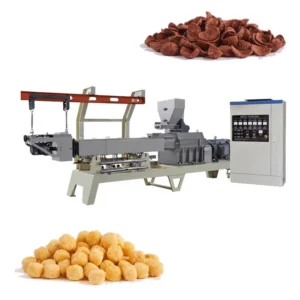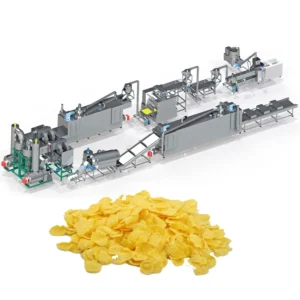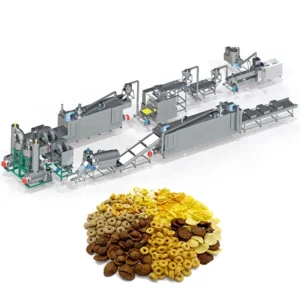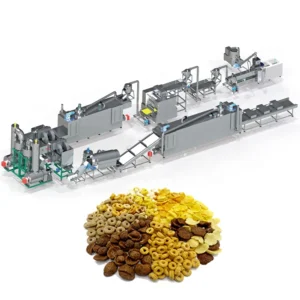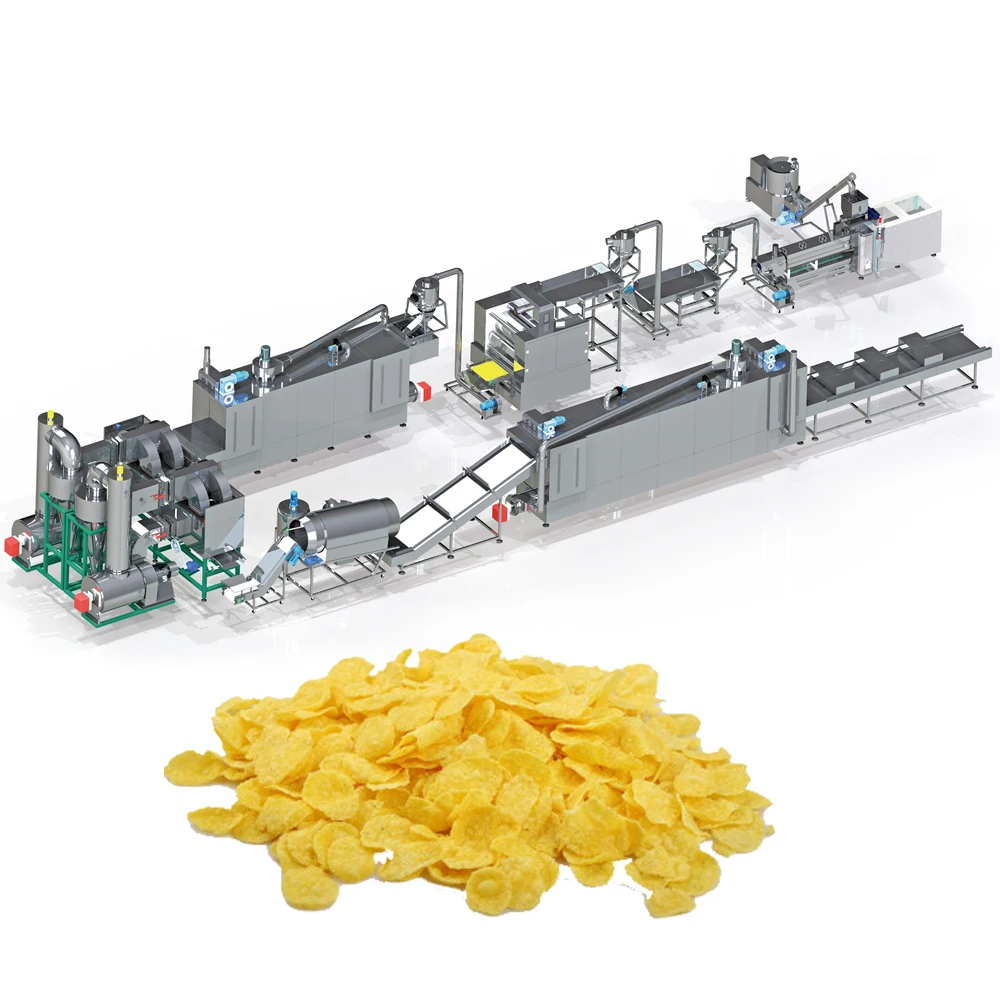
Extrusion Expertise Applied to Your Recipe — Screw configuration and barrel temperature profile are matched to the buyer’s actual raw material blend before the corn flakes extrusion production line ships, not left to on-site guesswork.
Technical Specifications
| Parameter | Value |
|---|---|
| Product Type | Corn Flakes Production Line with Twin Screw Extruder |
| Model | MT-65 / MT-70 / MT-75 / MT-85 |
| Screw Type | Co-rotating twin screw |
| Self-Cleaning | Yes |
| Output Capacity (MT-65) | 120–150 kg/h (basis not stated in source — confirm raw material, moisture, flake thickness) |
| Output Capacity (MT-70) | 200–250 kg/h (basis not stated in source) |
| Output Capacity (MT-75) | 300–400 kg/h (basis not stated in source) |
| Output Capacity (MT-85) | 400–500 kg/h (basis not stated in source) |
| Installed Power (MT-65) | 84 kW |
| Real Power (MT-65) | 59 kW |
| Installed Power (MT-85) | 239 kW |
| Real Power (MT-85) | 167 kW |
| Gearbox Lubrication | Oil forced automatic lubrication system |
| Cutting System | Non-stop cutting system |
| Control System | Separate controller box (PLC/MCC available) |
| Flake Press Roller Size | 510 × 310 × 1050 mm |
| Flake Press Power | 16.12 kW |
| Flake Press Features | Cooling system, adjustable roller distance |
| Mixer Capacity | 10–30 kg/load |
| Mixer Power | 4 kW |
| High-Temperature Oven Heating | Gas-fired, both-side baking system |
| High-Temperature Oven Power | 3.75 kW |
| Sugar Spraying System Power | 28.75 kW |
| Voltage & Frequency | Configurable to target market (confirm before production) |
| Standards | CE, ISO |
| Warranty | 1 year complete warranty, lifetime maintenance service |
Application Suitability
| Application | Material or Output |
|---|---|
| Corn flakes breakfast cereal | Corn grits, corn flour at controlled moisture for consistent flake density |
| Multi-grain flaked cereals | Oat, wheat and rice blends requiring adjusted barrel temperature profile |
| Fortified breakfast cereals | Grain base with added vitamin and mineral premix blended before extrusion |
| Sweetened cereal flakes | Plain flakes coated via sugar spraying system with adjustable roller drum |
Why "Rated Capacity" Means Nothing Without Your Recipe on the Table
A breakfast cereal twin screw extruder quoted at a nominal throughput number only tells half the story. Real output depends on your raw material blend, moisture content and target flake thickness — not just the motor plate.
I once watched a breakfast cereal producer in the Pearl River Delta run a trial on standard corn flour with no issues. When they switched to their actual recipe — heavy on oat with a completely different starch gelatinisation temperature — the flakes came out hard and shattered on the press roller. An entire batch was written off before anyone touched the screw combination or barrel zone temperatures. That is the gap between a quoted number and a working line. The corn flakes extrusion production line must be validated on what you actually intend to feed into the hopper [NEED_CITE: starch gelatinisation temperature variation across grain types].
How Screw Geometry Dictates Your Flake Texture
The co-rotating twin screw extruder in this line uses sectional screw modules that can be rearranged for transport, mixing, de-gassing, cooking and forming stages. Each module type controls how long material stays in a given barrel zone and how much mechanical shear it receives. For a high-corn recipe, a shorter residence time with moderate shear may be sufficient. Shift toward oat-heavy or multi-grain blends and the screw configuration needs to extend the cooking zone to reach the correct gelatinisation point without over-shearing the starch matrix.
Barrel Temperature Profiling Across Grain Types
The barrel is divided into independently heated zones, and the temperature curve across those zones determines whether your material reaches the right viscosity before it exits the die. Corn flour, oat flour and wheat flour each demand a different thermal path. A flat temperature profile that works for one grain will undercook or overcook another, and the difference shows up as inconsistent flake density after pressing. The corn flakes extrusion production line addresses this by allowing zone-by-zone adjustment so the thermal curve can be tuned during the trial run [NEED_CITE: barrel zone temperature control in twin-screw food extrusion].
Reading the Spec Sheet Like a Process Engineer
The L:D ratio of the twin screw extruder defines how much barrel length is available relative to screw diameter — longer barrels allow more residence time and finer control over the cooking stages. Installed power figures (84 kW on the MT-65, scaling to 239 kW on the MT-85) indicate the mechanical energy available for shear and mixing, but real power consumption is typically lower — 59 kW and 167 kW respectively — reflecting the actual load during normal operation. The flake press roller distance is adjustable and paired with a cooling system, which directly controls final flake thickness and prevents sticking on the roller surface. The gas-fired oven uses a both-side baking system, meaning the flake bed is heated from above and below simultaneously for even moisture reduction across the full belt width.
What Happens When the Line Is Not Balanced
An extruder running at full output feeding a flake press that cannot keep up creates a material backlog that cools and hardens before pressing. Downstream, an oven that is too short for the line speed leaves flakes with residual moisture, causing them to go soft in the bag. These bottlenecks are not always obvious from individual machine specs — they only surface when the stations are evaluated together as a system. Mismatched throughput between stages is one of the most common reasons a newly installed cereal line fails to meet its quoted capacity [NEED_CITE: production line throughput balancing in food extrusion].
Why Sourcing the Complete Line Matters Here
Every station in this corn flakes extrusion production line — mixer, screw conveyor, twin screw extruder, flake press, high-temperature oven, sugar spraying system — is configured under a single supplier so throughput is matched across stages. The screw configuration and die design are specified to the buyer’s raw material rather than pulled from a generic build. An in-house testing workshop allows trial runs on actual customer recipes before the equipment ships. The oil forced automatic lubrication system on the gearbox reduces unplanned downtime during continuous production runs. Pre-sales consultation covers line layout and capacity calculation so floor space and utility planning are resolved before installation begins.
Documentation & Verification
- Line layout with throughput calculation at each station for your target output
- Screw and die configuration record matched to your grain blend and flake spec
- Trial run report on your raw material verifying flake texture before dispatch
- Electrical schematic with voltage and frequency confirmed for your market
- CE declaration of conformity and ISO certificate in electronic edition
- Wear parts list with screw module and die replacement specifications
Installation, Commissioning & Support
- Foundation plan accounts for the MT-85 overall length of 28,000 mm and operating vibration
- Electrical hookup requires dedicated circuit matching confirmed voltage and frequency
- Separate controller box is positioned per the line layout for operator access
- First production run includes barrel temperature profiling on your grain recipe
- Operator training covers screw module changeover between different cereal formulations
- Spare screw segments and die plates stocked for first scheduled replacement
Before You Send an Inquiry
To move from a general enquiry to a specific line configuration, the useful starting points are your raw material blend and ratios, your target flake thickness and density, and the voltage and frequency standard at your facility. If your recipe includes non-standard grains or a significant proportion of oat or fibre, that needs to be flagged early so the screw configuration and barrel profile can be designed around those ingredients from the start.
Frequently Asked Questions
Q: How is extruder screw configuration matched to my raw material?
A: The co-rotating twin screw uses sectional modules selected for your specific grain blend. For corn-dominant recipes, the module arrangement favours shorter residence time. For oat or multi-grain blends with different gelatinisation temperatures, additional cooking zones are added. The configuration is documented and verified during the in-house trial run on your actual raw material before shipment.
Q: How is output capacity verified before the line ships?
A: The testing workshop runs your raw material through the configured line and documents actual throughput, flake texture and density. This trial run report is shared before dispatch so any screw or barrel adjustments are completed at the factory rather than during on-site commissioning.
Q: What voltage and control language options are available?
A: Voltage and frequency are confirmed during the specification stage to match your local electrical standard. The control system is supplied with a separate controller box, and the HMI language is set to your operator’s preference before production begins to avoid delays at commissioning.
Q: How does the flake press affect final product quality?
A: The flake press features an adjustable roller distance that sets flake thickness, paired with a cooling system that prevents material from sticking to the roller surface. Correct gap setting ensures consistent flake density and a shaping rate that matches the extruder output without creating a bottleneck.
Q: How is throughput balanced between extruder, press and oven?
A: Each station is sized and configured as part of a single line proposal so that the flake press capacity and oven belt length match the extruder output. Throughput calculation at every stage is included in the line layout document to confirm no downstream bottleneck exists before the equipment is built.