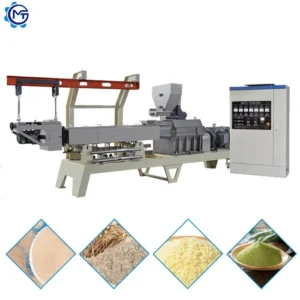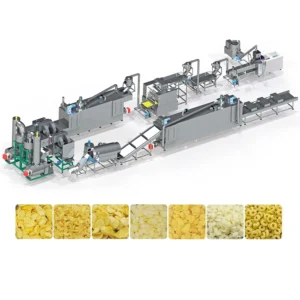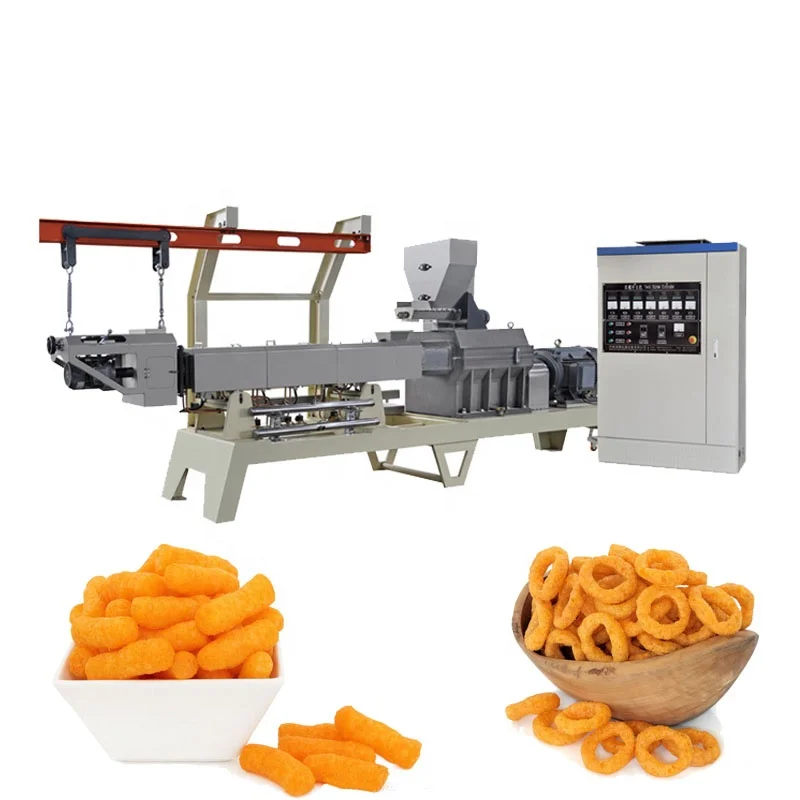
Engineered Extrusion Parameters — Every screw element and die orifice on this line is matched to your specific cereal formulation before the machine leaves our Jinan workshop.
Technical Specifications
| Parameter | Value |
|---|---|
| Model | MT75 |
| Product Type | Twin Screw Corn Flakes Extrusion Production Line |
| Screw Type | Twin-screw |
| Installed Power | 210 kW |
| Power Consumption | 150 kW |
| Output Capacity | 300–500 kg/h (basis not stated in source — confirm raw material, moisture content, flake thickness) |
| Overall Dimensions | 45 × 1.5 × 3.5 m |
| Control System | PLC and MCC control (stated for flaking machinery); extruder control system not separately specified (source value — verify against manufacturer catalog) |
| Screw Material | Special alloy with anti-grinding treatment |
| Automatic Lubrication | Yes, with cooling function |
| Dryer Heating Source | Gas or Electric (buyer selectable) |
| Flaking Machinery | Hydraulic double rollers, double motors, infrared sensor temperature control |
| Hot Air Roasting Oven | Vibrating pan, conciliation burner, dual circulating fans, cyclone dust removal |
| Coating System | Double tumble sugar melting, elevator, coating drum, spraying nozzle |
| Line Stations (Natural) | Mixing → Extruding → Flaking → Drying → Hot Air Roasting → Cooling → Packing |
| Line Stations (Sugar-Coated) | Mixing → Extruding → Flaking → Drying → Hot Air Roasting → Sugar Spraying → Coating → Drying → Cooling → Packing |
| Final Product Shapes | Ball, tube, stick, ring, fruit loop, star, wheel, flower, heart |
| Raw Materials | Corn, rice, wheat, oat, barley powder |
| Voltage & Frequency | Customized to buyer’s local standard |
| Certification | CE, ISO 9001 |
Application Suitability
| Application | Material or Output |
|---|---|
| Natural corn flakes production | Corn grits and corn flour blends |
| Sugar-coated breakfast cereal | Corn, rice, and multi-grain formulations with syrup coating |
| Multi-grain cereal flakes | Wheat, oat, and barley powder blends |
| Inflated puff crispy rice | Rice flour and rice grits |
| Instant porridge cereal | Pre-gelatinised oat and corn meal |
Why a Generic Screw Build Ruins Your Corn Flake Batch
The density and crispness of a finished corn flake are decided inside the extruder barrel — and a screw configuration copied from a different product will leave you with flakes that either shatter under the roller or refuse to crisp in the roaster.
The corn flakes extrusion machine screw configuration die design must be engineered around your exact flour blend and target flake density, not borrowed from a catalogue.
I remember a Middle Eastern client who ran a trial with our standard corn grits recipe and the output looked perfect. When they switched to their own pre-gelatinised starch formulation, the expansion collapsed entirely and an entire batch was written off. That failure happened because the shear profile and moisture window that works for pure corn do not transfer to a starch-heavy blend. [NEED_CITE: starch gelatinisation behaviour in twin-screw extrusion at varying moisture levels]
Barrel Temperature Profile and Starch Gelatinisation
The degree of starch gelatinisation inside the barrel governs everything that happens downstream. If the corn flakes extrusion machine screw configuration die design delivers insufficient heat and shear, the starch granules only partially gelatinise, and the dough sheet tears when it passes through the flaking rollers. Too much shear, and the dough becomes over-plasticised, producing flakes that fuse together in the roaster instead of separating into individual pieces. The barrel sections must be zoned so that moisture injection and temperature ramp work together to hit the gelatinisation window for your specific cereal blend.
Die Geometry and Expansion Control
The die orifice diameter and land length control the pressure drop at the exit, which directly sets the initial expansion ratio of the extrudate. A wider die with a shorter land produces a softer, more expanded rope that flattens easily but may lack structural integrity. A narrower die with a longer land creates a denser rope that survives the flaking rollers intact but requires precise roasting to achieve the target crispness. Matching die geometry to your target flake thickness is not optional — it is the variable that separates cereal that crunches in milk from cereal that dissolves into mush. [NEED_CITE: die land length influence on extrudate density in cereal processing]
Reading the Specs That Actually Matter
The MT75 runs at 210 kW installed power with a 150 kW operational draw, placing it in a capacity band where thermal management inside the barrel is critical. The twin-screw configuration provides the shear intensity needed to fully gelatinise high-amylose corn grits, something a single-screw unit at this scale would struggle to achieve without excessive residence time. The hydraulic double-roller flaking station uses infrared temperature monitoring to maintain consistent flake thickness, because even minor thickness variation leads to uneven blistering in the hot air roasting oven. The roaster itself employs dual circulating fans and a cyclone dust removal device, which keeps the hot air velocity uniform across the vibrating pan — this is what produces the surface blistering that defines a quality corn flake. The PLC and MCC control architecture allows operators to lock in barrel zone temperatures, screw speed, and moisture dosing as saved recipes, ensuring batch-to-batch repeatability once the correct corn flakes extrusion machine screw configuration die design parameters are established.
The Hidden Cost of Mismatched Line Stations
When an extruder is supplied without matching dryer or roaster capacity, the entire line throttles back to the slowest station. You end up running the twin-screw at reduced feed rates, which changes the shear and residence time inside the barrel, pushing starch gelatinisation outside its optimal window. The result is flake density that drifts from batch to batch, and a roaster that either cannot keep up or runs half-empty, wasting thermal energy. [NEED_CITE: throughput imbalance effects on cereal extrusion line consistency]
Why Source This Line From Jinan
Every station on this line — from the batching mixer through the extruder, flaker, dryer, roaster, and coating drum — is built under one supplier, so throughput is calculated across every stage rather than patched together from separate vendors. The screw elements and die plates are configured specifically to your raw material formulation, not pulled from a generic shelf build. Before shipment, your actual cereal blend runs through our in-house testing workshop so expansion ratio and flake density are verified on real product, not theoretical calculations. The flaking station, roaster, and coating system are capacity-matched to the MT75 output so no single station becomes a bottleneck. Electrical schematics and voltage specifications are confirmed to your local grid standard before production begins, eliminating commissioning delays caused by mismatched power supply. [NEED_CITE: CE machinery directive requirements for food extrusion equipment]
Documentation & Verification
- Screw and die configuration record matched to your cereal flour blend
- Factory trial run report on your actual raw material confirming expansion and density
- Line layout and capacity calculation showing matched throughput across all stations
- Electrical schematic with voltage and frequency confirmed to your local standard
- Operation and maintenance manual with wear parts list for screw elements and die plates
Installation, Commissioning & Support
- Foundation plan provided based on the 45 × 1.5 × 3.5 m line footprint and load distribution
- Dedicated power circuit specified for the 210 kW installed load and local voltage standard
- Twin-screw barrel alignment verified on-site after transport and reassembly
- PLC parameters loaded with trial-run recipe data from your raw material test
- Operator training covers barrel zone temperature adjustment and screw speed tuning
- Wear parts inventory including replacement screw elements and die plates supplied at commissioning
Before You Request a Quote
To size the screw elements and die plates correctly, we need to know your cereal flour composition, target moisture content at the extruder feed, and the flake thickness your market expects. Share your workshop dimensions and ceiling height so the line layout can be drafted to fit your space, and confirm your local voltage, frequency, and preferred control panel language. If you have an existing upstream mixer or downstream packing system you plan to integrate, specify the connection points so throughput can be matched at the interface.
Frequently Asked Questions
Q: How do screw configuration and die design affect corn flake density and crispness after roasting?
A: The screw element arrangement controls shear intensity and residence time, which set the degree of starch gelatinisation. The die orifice and land length govern the pressure drop and initial expansion. Together, these determine the dough density entering the flaking rollers and the final crispness achieved during hot air roasting.
Q: What barrel temperature profile and moisture range produce optimal starch gelatinisation for cereal flakes?
A: The optimal window depends on your specific cereal blend, particularly the amylose-to-amylopectin ratio. Barrel zones are typically ramped progressively, with moisture injected at a controlled rate to achieve the gelatinisation threshold without over-plasticising the dough mass before it reaches the die.
Q: How is extruder throughput matched to flaker, dryer, and roaster capacity to avoid line bottlenecks?
A: Each station is rated against the extruder output based on your target flake thickness and moisture reduction requirement. The hydraulic flaker, dryer belt speed, and roaster pan residence time are all calculated so no single station constrains the line or forces the extruder to run below its designed feed rate.
Q: Can the extrusion parameters be re-tuned if we switch from corn to oat or multi-grain formulations?
A: Yes. The twin-screw elements are modular and can be rearranged to adjust shear profile and residence time. Die plates can be swapped to match the different expansion behaviour of oat or barley flour. New parameters are documented as saved recipes in the PLC for quick changeover.
Q: What does the in-house trial run test, and how are expansion and density measured before shipment?
A: Your actual raw material is run through the extruder in our testing workshop. Expansion ratio is measured at the die exit, and flake density is checked after rolling and roasting. Results are recorded in a trial report that travels with the machine, giving your team a verified starting recipe at commissioning.