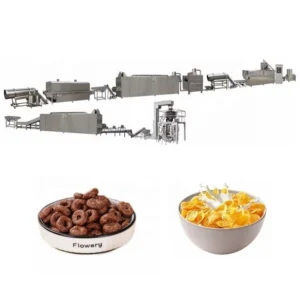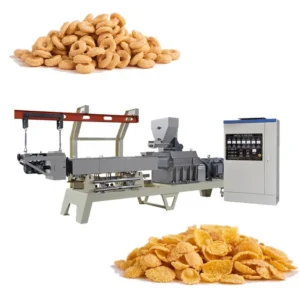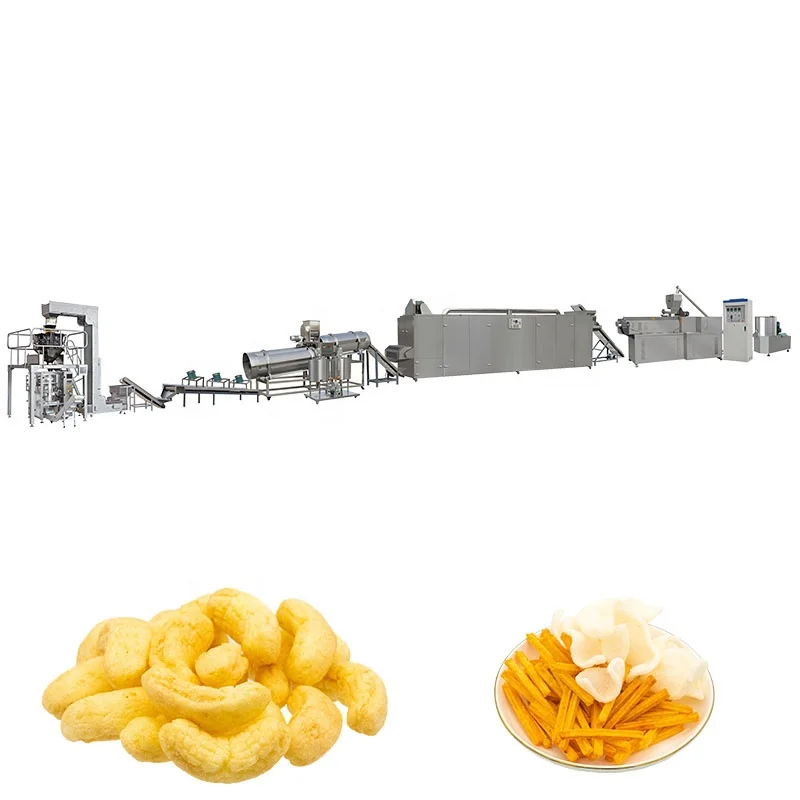
Extrusion Configuration Expertise — Every screw profile and die geometry on the MT-75 line is specified to your grain blend and target flake density rather than copied from a generic build.
Technical Specifications
| Parameter | Value |
|---|---|
| Model | MT-75 Twin Screw Extruder |
| Product Type | Twin Screw Extruder Corn Flake Production Line |
| Screw Configuration | Twin screw, profile matched to raw material and target flake density |
| Output Capacity | 200–300 kg/hr (basis not stated in source — confirm raw material formulation, moisture content and flake thickness before quotation) |
| Heating Source (Dryer) | Gas or electric, selectable per facility utility availability |
| Flaking Drive | Double motors for separate roller driving; hydraulic system for double rollers |
| Flaking Temperature Control | Infrared sensor for even temperature pipe control |
| Roasting Oven | Hot air roasting with conciliation burner, two separate circulating fans, cyclone dust removal device |
| Coating System | Double tumble for sugar melting, elevator, coating drum, spraying nozzle |
| Control System | PLC-controlled flaking machinery; MCC integration across the full line |
| Line Assembly | Complete line: Mixing → Extruding → Flaking → Drying → Hot Air Roasting → Cooling → Packing; sugar-coated variant adds Sugar Spraying → Sugar Coating → Drying stages |
| Voltage | 220V/380V (verify against full line requirement and local facility supply) |
| Standards | CE certified; ISO certified |
| Warranty | 1 Year |
| Machinery Test Report | Provided |
| Video Outgoing-Inspection | Provided |
Application Suitability
| Application | Material or Output |
|---|---|
| Natural corn flake production | Corn grits processed through extrusion, flaking, drying and hot air roasting |
| Sugar-coated corn flakes | Corn base with sugar spraying, tumble coating and secondary drying stages |
| Mixed grain breakfast flakes | Blends of rice, wheat, oat and barley with adjusted screw configuration |
| Multi-format cereal snacks | Various shapes achievable on the same extrusion platform with die changes |
Why the Wrong Screw Profile Ruins Your Corn Flake Density Before the Line Even Starts
Corn flake density is decided inside the barrel, not at the flaking rollers.
When a production line ships with a generic screw and die setup, the extrudate arrives at the flaker with the wrong expansion and moisture profile. The flakes then either sink in milk because they are too dense, or they fracture during roasting because the surface structure never developed the characteristic bubble pattern. I have seen cereal manufacturers spend weeks adjusting downstream drying temperatures to compensate for a problem that originated in the screw configuration. The real fix requires matching the screw element arrangement, barrel temperature zones and die geometry to the specific grain formulation — corn behaves differently from rice or oat under shear, and each demands its own profile. [NEED_CITE: starch gelatinisation temperature ranges by cereal grain type]
How Screw Configuration Controls Starch Gelatinisation
Twin-screw extrusion gives the process engineer independent control over shear intensity, residence time and barrel temperature across multiple zones. For corn flake production, the corn flake extrusion technology twin screw setup must achieve partial starch gelatinisation inside the barrel while keeping the extrudate cohesive enough to hold together through the flaking rollers. The screw element arrangement — mixing blocks, conveying elements and reverse-screw sections — is selected based on whether the raw material is pure corn grits or a blend containing rice, wheat or oat. Each grain has a different gelatinisation onset temperature and water absorption rate, so a profile that works on corn will under-process oat and over-process rice.
Barrel Temperature Profiling and Moisture Balance Across Zones
The barrel is divided into independently heated zones, and the temperature profile must rise gradually to allow water to penetrate the starch granules before shear forces break them apart. Too aggressive a ramp causes surface gelatinisation while the core remains raw, producing flakes with hard spots after roasting. The moisture content at the preconditioner and the steam injection rate at the extruder feed point work together with barrel temperatures to set the final extrudate texture. In practice, a corn flake extrusion technology twin screw system requires the operator to balance these variables against the specific corn variety and milling grade. [NEED_CITE: preconditioning moisture targets for twin-screw cereal extrusion]
Reading the Specification Sheet Against Your Actual Raw Material
The MT-75 is rated at 200–300 kg/hr, but that figure carries no raw material basis in the source documentation and must be confirmed against your specific formulation, moisture content and target flake thickness before it can be treated as a production commitment. The hydraulic double-roller flaking station uses separate motor drives for each roller, which allows differential speed adjustment to control flake compression. The infrared sensor on the flaking machinery maintains consistent roller temperature so that thickness does not drift as the rollers heat up during a long production run. The hot air roasting oven uses a conciliation burner with two circulating fans and a cyclone dust removal device — the conciliation burner modulates flame intensity to prevent scorching while the cyclone captures fine particulate before it can settle back onto the product.
What Happens When Extrusion Parameters Are Not Matched to Your Formulation
A line configured for one grain type and then run on a different formulation without screw adjustment produces flakes that fail market expectations. The extrudate may expand too much, creating thin flakes that shatter during the roasting stage, or too little, creating dense flakes that remain chewy instead of crisp. The flaking rollers then cannot compress the material evenly, and the roasting oven cannot correct a texture problem that was already locked in upstream. I have visited plants where the roasting temperature was pushed beyond the recipe limit in an attempt to fix density issues that should have been addressed at the screw configuration stage. [NEED_CITE: cereal flake texture defects traced to extrusion mismatch]
Why This Line Configuration Stands Up to Technical Scrutiny
Every station from the mixer through to packing is throughput-matched so that no single machine bottlenecks the line — the extruder output, dryer capacity, flaker throughput and roaster belt speed are calculated together rather than assembled from separate vendor catalogues. The screw configuration and die design are specified to your raw material and target flake density, not pulled from a standard library. Before shipment, the line runs a trial on your actual raw material in the in-house testing workshop, producing real flakes that you can evaluate for density, surface bubble pattern and crispness. The PLC-controlled flaking station integrates with MCC panels across every downstream station, giving the operator one interface for the full sequence. Both the natural and sugar-coated variants run on the same extrusion platform, requiring only the addition of the sugar spraying, coating and secondary drying modules.
Documentation & Verification
- Screw and die configuration record specified to your grain blend and target flake density
- Trial run report on your actual corn formulation conducted in the testing workshop before dispatch
- Line layout drawing showing throughput matching across extruder, flaker, dryer and roaster
- Electrical schematic with voltage and frequency confirmation against your facility supply
- CE declaration of conformity and ISO certificate included with shipment documentation
- Operation and maintenance manual covering PLC parameter adjustment and roller calibration
Installation, Commissioning & Support
- Foundation plan showing floor load requirements for the hydraulic flaking station and roasting oven footprint
- Dedicated circuit sizing for the double-motor flaking drive and hot air roasting oven heater elements
- Complete line arrives in modular sections for sequential assembly from mixer through packing
- On-site commissioning includes PLC parameter tuning on your corn formulation and target flake thickness
- Operator training covers screw element replacement, roller gap adjustment and roasting temperature profiling
- Wear parts package with spare screw elements, die plates and roller surfaces supplied at commissioning
What to Include in Your Enquiry
To specify the corn flake extrusion technology twin screw configuration correctly, send the grain blend you intend to run — whether pure corn grits or a mix with rice, wheat, oat or barley — along with your target flake thickness and the milk-bowl density your market expects. Confirm the voltage and frequency available at your facility, because the heating source selection for the dryer and roaster depends on it. If you are considering both natural and sugar-coated variants, state which products you plan to run in the first production cycle so that the sugar spraying and coating modules can be phased in accordingly.
Frequently Asked Questions
Q: How is screw configuration determined for different grain formulations such as corn versus rice?
A: Each grain has a distinct starch gelatinisation temperature and water absorption rate. The screw element arrangement — mixing blocks, conveying flights and reverse sections — is selected to match these properties. Corn requires higher shear and a longer residence profile than rice. The configuration is documented before production and validated during the in-house trial run on your raw material.
Q: What barrel temperature profile is needed for proper starch gelatinisation in corn flakes?
A: The barrel zones ramp gradually so moisture penetrates starch granules before shear forces act. The exact profile depends on corn variety, milling grade and preconditioner moisture. Too steep a ramp causes surface gelatinisation with a raw core. The PLC records the zone temperatures from your trial run so the profile can be reproduced on your production floor.
Q: How does the hot air roasting stage create the characteristic surface bubbles?
A: The roasting oven uses a conciliation burner with two circulating fans to deliver controlled hot air across the flake bed. Moisture trapped inside the partially gelatinised flake flashes into steam during roasting, forming the surface bubble pattern. The cyclone dust removal device captures fine particulate so it does not resettle on the product.
Q: Can the same line produce both natural and sugar-coated corn flakes?
A: Yes. The base line runs the natural sequence from extrusion through flaking, drying and roasting. The sugar-coated variant adds sugar spraying, tumble coating and secondary drying modules after the roaster. The extrusion and flaking setup remains the same; only the downstream coating stages are activated for the sugar-coated product.
Q: Is a trial run performed on the buyer’s actual raw material before shipment?
A: Yes. The trial run uses your grain formulation in the testing workshop and produces actual corn flakes for evaluation. The trial report includes extrudate density, flake thickness measurements, surface bubble assessment and the screw configuration record used. This lets you approve product quality before the line ships rather than discovering formulation issues after installation.