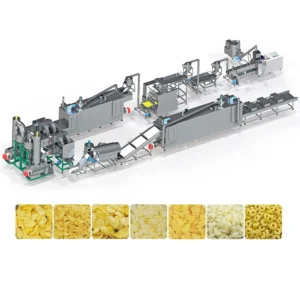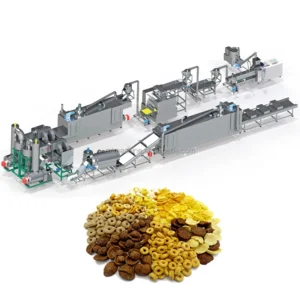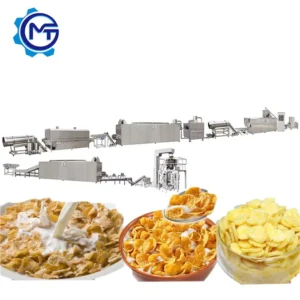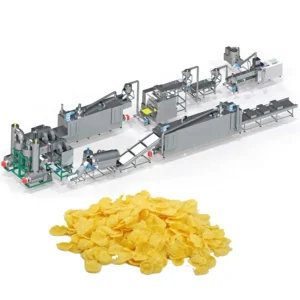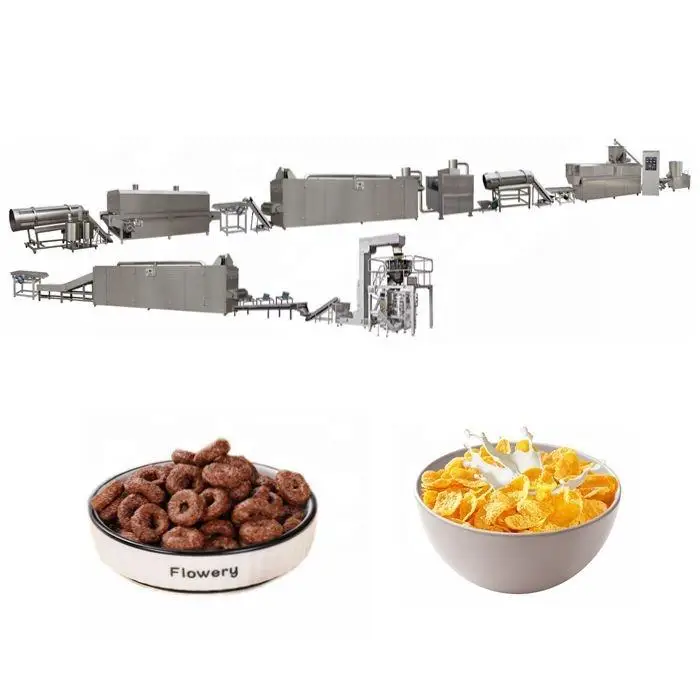
Screw Geometry Matched to Blend — screw elements and die geometry configured against your cereal formulation, not copied from a standard build.
Technical Specifications
| Parameter | Value |
|---|---|
| Product Type | Corn Flake Extrusion Production Line |
| Available Models | MT70 / MT85 / MT75 |
| Extruder Type | Twin Screw |
| Installed Power | 160 kW (MT70) / 190 kW (MT85) / 210 kW (MT75) |
| Operating Power Consumption | 120 kW (MT70) / 140 kW (MT85) / 150 kW (MT75) |
| Capacity | 150–200 kg/h (MT70) / 300–400 kg/h (MT85) / 300–500 kg/h (MT75) (basis not stated in source) |
| Overall Dimensions (L×W×H) | 41 × 1.5 × 2.2 m (MT70) / 43 × 1.5 × 3.2 m (MT85) / 45 × 1.5 × 3.5 m (MT75) |
| Control System | PLC |
| Flaking Station | Hydraulic double-roller system with dual independent motors and infrared temperature feedback |
| Dryer Heating Source | Gas / Electric (configurable) |
| Roasting Oven | Vibrating pan with conciliation burner, dual circulating fans, cyclone dust removal |
| Coating System | Double-tumble sugar melter, elevator, coating drum, spray nozzles |
| Final Product Shapes | Natural flakes, coated flakes, ball, tube, stick, ring, fruit loop, star, wheel, flower, heart |
| Certifications | CE, ISO |
Application Suitability
| Application | Material or Output |
|---|---|
| Natural corn flakes for breakfast cereal packs | Corn powder base, plain or lightly salted |
| Sugar-coated corn flakes | Corn or multi-grain base with sugar glaze |
| Multi-grain breakfast cereals | Blends of corn, rice, wheat, oat and barley powder |
| Fortified breakfast cereals | Cereal base with vitamin and mineral premix incorporated |
| Extruded cereal snack shapes | Corn, rice or wheat powder formed into rings, stars, loops and other die-cut shapes |
Why the Quoted Capacity Rarely Matches Your Actual Cereal Blend
Capacity figures on a corn flake extruder spec sheet assume a specific moisture level, flake thickness and grain formulation — change any one of those, and the real throughput shifts.
A line rated at a certain output on pure corn grits can behave very differently when the buyer switches to a high-fibre multi-grain blend. Starch gelatinisation requires a precise combination of barrel heat, moisture and shear; when the raw material changes, the expansion ratio drops and the extruder struggles to hold the same throughput. I have watched operators push the feed rate trying to chase the nameplate number, only to end up with under-cooked pellets that shatter during flaking. A corn flake extrusion technology setup only delivers its stated performance when screw configuration, die geometry and barrel temperature profile are all aligned to the actual formulation running through the machine [NEED_CITE: starch gelatinisation behaviour across different cereal grain blends].
How Screw Elements Control Gelatinisation in Corn Flake Extrusion
The twin-screw configuration in a corn flake extruder production line allows operators to rearrange conveying, kneading and reverse elements along the shaft. Each arrangement changes how long the material stays inside the barrel and how much mechanical shear it absorbs. For a pure corn formulation, a shorter residence time with moderate shear is often enough to reach full gelatinisation. When the blend includes oat or barley — grains with different starch structures and fibre content — the screw profile usually needs additional kneading blocks to develop the same level of cook.
Barrel Temperature Profile and Its Effect on Flake Density
The barrel is divided into multiple heating zones, each independently controlled. The feed zone stays relatively cool to prevent premature swelling, while the metering and die zones run hotter to drive moisture into the starch granules. Getting this gradient wrong shows up quickly at the flaking station: if the pellet surface is too dry, it cracks under roller pressure instead of flattening into a smooth flake. Process engineers evaluating corn flake extrusion technology should map each zone against the specific cereal blend, because a five-degree shift at the die face can move the flake density outside the range the market expects [NEED_CITE: barrel temperature influence on extruded cereal pellet expansion].
Reading the Power and Dimension Specs
Installed power across the three models ranges from 160 kW to 210 kW, with operating consumption roughly 70–75 % of that figure. The difference between installed and operating power reflects peak start-up loads and the headroom needed when a denser formulation passes through the extruder. Line length extends from 41 m to 45 m, which is a useful planning input for workshop layout: the flaking, drying, roasting and cooling stations account for most of that footprint. The PLC control system coordinates all stations, and voltage as well as frequency must be confirmed before production begins so that every motor, heater and sensor matches the buyer’s local supply. The hydraulic flaking station uses independent dual motors on each roller, which means roller speed and gap can be adjusted separately to control flake thickness without stopping the line.
The Hidden Cost of a Mismatched Dryer and Roasting Oven
When the dryer and roasting oven are sized for a different throughput than the extruder, the bottleneck simply moves downstream. An undersized dryer leaves pellets too moist for clean flaking; an oven running at full load to keep up with a faster extruder produces uneven blistering and inconsistent crispness across the batch. Buyers who quote each station separately often discover during commissioning that the line cannot run at a steady rate without product backing up at one point or starving another [NEED_CITE: throughput matching across extrusion line stations].
Why the Line Is Sourced from One Supplier
Every station in this corn flake extruder production line — mixing, extruding, flaking, drying, roasting, coating and packing — is specified by the same engineering team, so throughput is balanced from the start rather than patched together after separate purchases. Screw elements and die plates are selected after reviewing the buyer’s actual cereal blend and target flake density. The testing workshop runs trial production on the customer’s raw material before shipment, generating a report that covers expansion, flake thickness and roasting behaviour. Electrical schematics are drawn with the destination voltage and frequency already confirmed. Documentation includes the full line layout, capacity calculation, screw and die configuration record and CE declaration of conformity.
Documentation & Verification
- Line layout and capacity calculation matched to your cereal blend and target flake density
- Screw and die configuration record documenting element arrangement for your formulation
- Factory trial run report on your raw material covering expansion, flake thickness and roast behaviour
- Electrical schematic with voltage and frequency locked to your local supply standard
- Operation and maintenance manual with wear parts list for screws, dies and roller surfaces
Installation, Commissioning & Support
- Foundation and utility plan based on the chosen model’s overall dimensions and 160–210 kW installed power range
- Dedicated electrical circuit sized to the confirmed voltage and frequency before machine arrival
- PLC control language and HMI labels verified during pre-shipment testing to match operator preference
- First-run commissioning with barrel temperature and screw speed calibrated to your cereal formulation
- On-site operator training covering screw changeover, flaking gap adjustment and roasting oven tuning
- Wear parts inventory recommendation for screws, dies and flaking roller surfaces based on production schedule
What We Need to Configure Your Line
To move from a general catalogue spec to a configuration that matches your workshop, share your cereal formulation including grain ratios and any premix additions, the target daily or hourly output, and the available floor space with ceiling height. Confirm the local voltage, frequency and whether the PLC interface should be in English or another language. If you already operate upstream milling or downstream packing equipment, tell us the interface points so the line layout connects cleanly.
Frequently Asked Questions
Q: How is extruder capacity verified on my specific cereal blend?
A: We run your actual raw material in our testing workshop before shipment. The trial covers the full process — extrusion, flaking, drying and roasting — and produces a report showing expansion ratio, flake density and throughput at the tested moisture level. Any capacity figure we quote references that trial result rather than a generic catalogue value.
Q: How are screw and die geometry selected for my target flake density?
A: We review your grain ratios, moisture target and desired flake thickness, then arrange screw conveying and kneading elements to achieve the required gelatinisation level. The die plate aperture is matched to the pellet size that feeds the flaking rollers cleanly. A configuration record documents every element position for future reference.
Q: What barrel temperature profile should I expect for corn versus multi-grain?
A: Pure corn typically runs with a moderate gradient, while blends containing oat or barley need higher die-zone temperatures and longer residence time to fully gelatinise the different starch structures. The exact profile is finalised during the pre-shipment trial and recorded so your operators can replicate it on site.
Q: Is a pre-shipment trial run available, and what does it cover?
A: Yes. We run your raw material through the extruder, flaker, dryer and roasting oven in our testing workshop. The resulting report documents flake thickness, density, expansion behaviour and roasting response, giving you a baseline to match when the line is installed at your factory.
Q: How are voltage, frequency and control language confirmed before installation?
A: These details are locked during the specification confirmation stage, before production begins. The electrical schematic, motor ratings and PLC interface language are all set to your local requirements, so commissioning starts with the correct supply and the operators can read every screen prompt in their preferred language.