Screw Profile Matched to Your Corn Formulation — Every barrel zone and die land is specified against your corn variety, particle size, and moisture rather than copied from a generic cereal build.
Technical Specifications
| Parameter | Value |
|---|---|
| Model | MT75 |
| Product Type | Corn Flakes Breakfast Cereal Production Line |
| Installed Power | 210 kW |
| Power Consumption | 150 kW |
| Output Capacity | 300–500 kg/h (basis not stated in source — confirm raw material, moisture, product format) |
| Overall Dimensions (L×W×H) | 45 × 1.5 × 3.5 m |
| Screw Type | Twin Screw |
| Control System | PLC with MCC |
| Flaking Drive | Double motors for separate roller driving; hydraulic system |
| Flaking Temperature Control | Infrared sensor |
| Roasting Oven | Hot air with vibrating pan, conciliation burner, dual circulating fans, cyclone dust removal |
| Coating System | Double tumble sugar melting, elevator, coating drum, spraying nozzle |
| Heating Source (Dryer) | Gas or Electric |
| Lubrication | Automatic lubricating and cooling |
| Certifications | CE, ISO |
Application Suitability
| Application | Material or Output |
|---|---|
| Natural corn flakes | Corn, rice, wheat, oat, barley powder |
| Sugar-coated corn flakes | Corn-based pellets with sugar glazing |
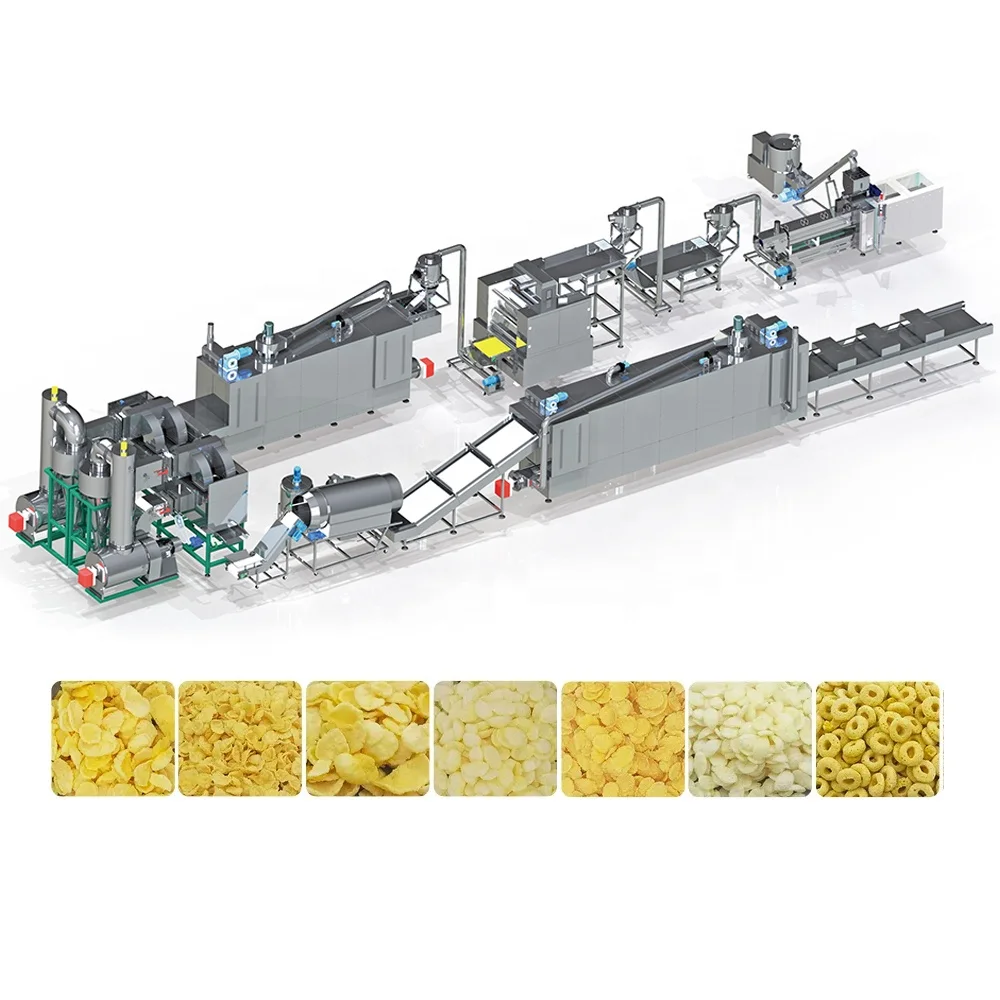
| Puffed cereal shapes | Ball, tube, stick, ring, fruit loop, star, wheel, flower, heart via die change |
Why Copied Screw Configurations Sink Corn Flakes Before They Reach the Bowl
Generic screw builds produce flakes that shatter or stay dense because the starch gelatinisation profile was never matched to the buyer’s actual corn formulation.
When the screw elements and barrel temperature zones come from a standard cereal template rather than being calculated for your specific corn grits and target flake thickness, the extrudate leaves the die with inconsistent moisture distribution. That inconsistency carries through flaking and roasting — some pellets over-expand and crumble, others stay hard enough to sink in milk. The corn flakes extrusion production line technology you specify at the extruder stage determines every downstream result [NEED_CITE: starch gelatinisation thresholds for corn-based extrusion at varying moisture levels].
I spent years in the Yangtze Delta region commissioning extrusion lines, and the calls I dreaded most involved corn flakes. One producer ran high-moisture corn flour without adjusting the screw configuration, and the output came out thick and hard — every flake sank straight to the bottom of the milk bowl. The entire line sat idle while replacement screws were machined. After that, I learned to check raw material moisture and starch content before anything else.
Barrel Temperature Zones and Starch Gelatinisation Control
The twin-screw extruder processes corn-based formulations through multiple barrel heating zones, each set independently to manage how starch granules absorb moisture and gelatinise under shear. Corn requires a different thermal profile than wheat or oat — too low and the starch remains raw, producing a gritty texture; too high and the melt becomes unstable at the die face. The corn flakes extrusion production line technology relies on this zone-by-zone control to deliver consistent pellet density before the material ever reaches the flaking rollers.
Die Geometry and Its Effect on Flake Structure
Die land length and orifice diameter determine the expansion ratio of the extrudate as it exits the barrel. For corn flakes, the target is a controlled, moderate expansion that produces a pellet flat enough to flake without splitting. Die design is specified against your target flake thickness and the corn variety’s expansion characteristics. A die chosen for puffed cereal shapes would produce pellets that expand too aggressively for the flaking station, resulting in uneven sheets that roast inconsistently [NEED_CITE: die land length influence on extrudate expansion in twin-screw processing].
Reading the Specification Sheet Against Your Production Target
The MT75 twin-screw platform operates at 210 kW installed power with 150 kW typical consumption, driving the screw shafts through a dedicated gearbox. The line stretches approximately 45 metres from batching through packing, which means your facility needs clear linear floor space plus access for maintenance on both sides. The flaking station uses hydraulic double-roller pressure with dual-motor independent drive and infrared temperature monitoring — this combination maintains consistent sheet thickness across the full roller width, which directly affects how evenly the flakes roast. The roasting oven employs a conciliation burner with dual circulating fans and cyclone dust removal, giving you separate control over surface blistering temperature and moisture removal rate. PLC control across extrusion, flaking, and roasting stations ensures that once you establish the correct parameter set, every production run executes the same thermal and mechanical profile.
The Hidden Cost of Undersized Supporting Stations
An extruder running at its rated output means nothing if the dryer cannot remove moisture fast enough or the roasting oven lacks the airflow to develop proper surface blistering. When these stations are sourced separately or sized on paper capacity rather than actual throughput, the bottleneck appears only after installation — and it forces you to slow the entire line to match the weakest station. I have seen corn flakes lines where the flaking rollers could not keep pace with the extruder output, leaving hot pellets sitting in the hopper and fusing together before they could be pressed [NEED_CITE: throughput matching across extrusion line stations to prevent bottlenecks]. The result is wasted raw material, inconsistent flake quality, and production targets that remain unmet.
Why This Line Holds Up Under Real Production Conditions
Complete lines from mixing through packing under one supplier mean throughput is matched at every station rather than assembled from mismatched vendors. Screw configuration and die design are specified against your corn formulation — particle size, moisture content, and starch profile — not pulled from a generic cereal template. The in-house testing workshop runs trial production on your actual raw material before shipment, so extrusion behaviour, flake density, and roasting outcome are validated before the equipment leaves the factory. The hot-air roasting oven with its dual circulating fans and cyclone dust removal is integrated into the same PLC control architecture as the extruder and flaking station, so temperature profiles remain coordinated across the corn flakes extrusion production line technology rather than being adjusted manually at each stage. Pre-sales consultation covers line layout against your factory dimensions, and voltage and frequency are confirmed for your site before production begins.
Documentation & Verification
- Screw and die configuration record matched to your corn variety and target flake thickness
- Trial run report documenting extrusion behaviour and flake density on your raw material
- Electrical schematic with confirmed voltage, frequency, and PLC control language for your site
- Line layout drawing with capacity calculation across mixing, extrusion, flaking, and roasting stations
- CE declaration of conformity and ISO certificate for the complete production line
Installation, Commissioning & Support
- Foundation plan reflecting the 45-metre line length and hydraulic flaking station load requirements
- Power supply verification for 210 kW installed capacity and dedicated circuits for roasting oven heating
- PLC and MCC commissioning with parameter loading for your specific corn formulation and flake target
- Operator training on screw configuration changes for switching between natural and sugar-coated formats
- Wear parts inventory covering screws, dies, and flaking roller surfaces for first replacement cycle
- Automatic lubrication system setup and maintenance schedule for twin-screw gearbox and bearings
What to Include With Your Inquiry
Provide your corn variety, typical particle size distribution, and incoming moisture content so the screw configuration can be specified from the start. Share your target flake thickness and whether the line needs to cover both natural and sugar-coated formats, as this affects coating station sizing. Confirm your facility voltage, frequency, and preferred PLC operating language to avoid commissioning delays.
Frequently Asked Questions
Q: How is screw configuration matched to a specific corn variety for flakes?
A: The screw element sequence, kneading block arrangement, and die land dimensions are selected based on your corn’s starch content, particle size, and moisture level. This determines how much shear and heat the material receives in each barrel zone, which directly controls the gelatinisation degree and pellet structure entering the flaking station.
Q: What barrel temperature profile works for corn flakes versus other cereal shapes?
A: Corn flakes require a moderate thermal profile that achieves partial gelatinisation without aggressive expansion at the die. Puffed shapes like fruit loops or balls need higher barrel temperatures and different screw elements to produce greater expansion. The temperature zones are adjusted along with screw configuration when switching between formats.
Q: How does the trial run validate performance before shipment?
A: Your raw material is run through the extruder, flaking station, and roasting oven in the testing workshop. The trial documents pellet density, flake thickness consistency, and roasted flake crispness against your target specifications. Any screw or die adjustments needed are completed before the line is packed for dispatch.
Q: How do flaking roller settings affect final corn flake quality?
A: The hydraulic double-roller system controls gap width and pressure independently, while infrared sensors monitor roller surface temperature. These parameters together determine sheet thickness uniformity, which affects how evenly each flake roasts and ultimately its density and crispness in the bowl.