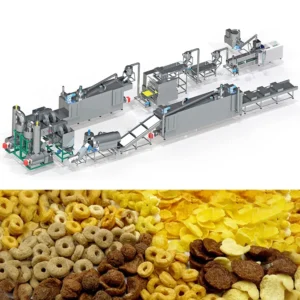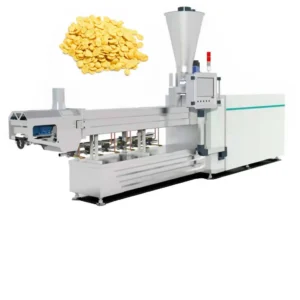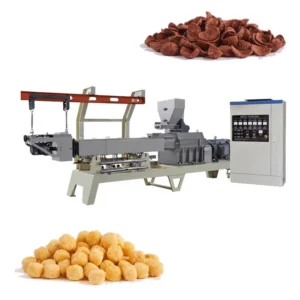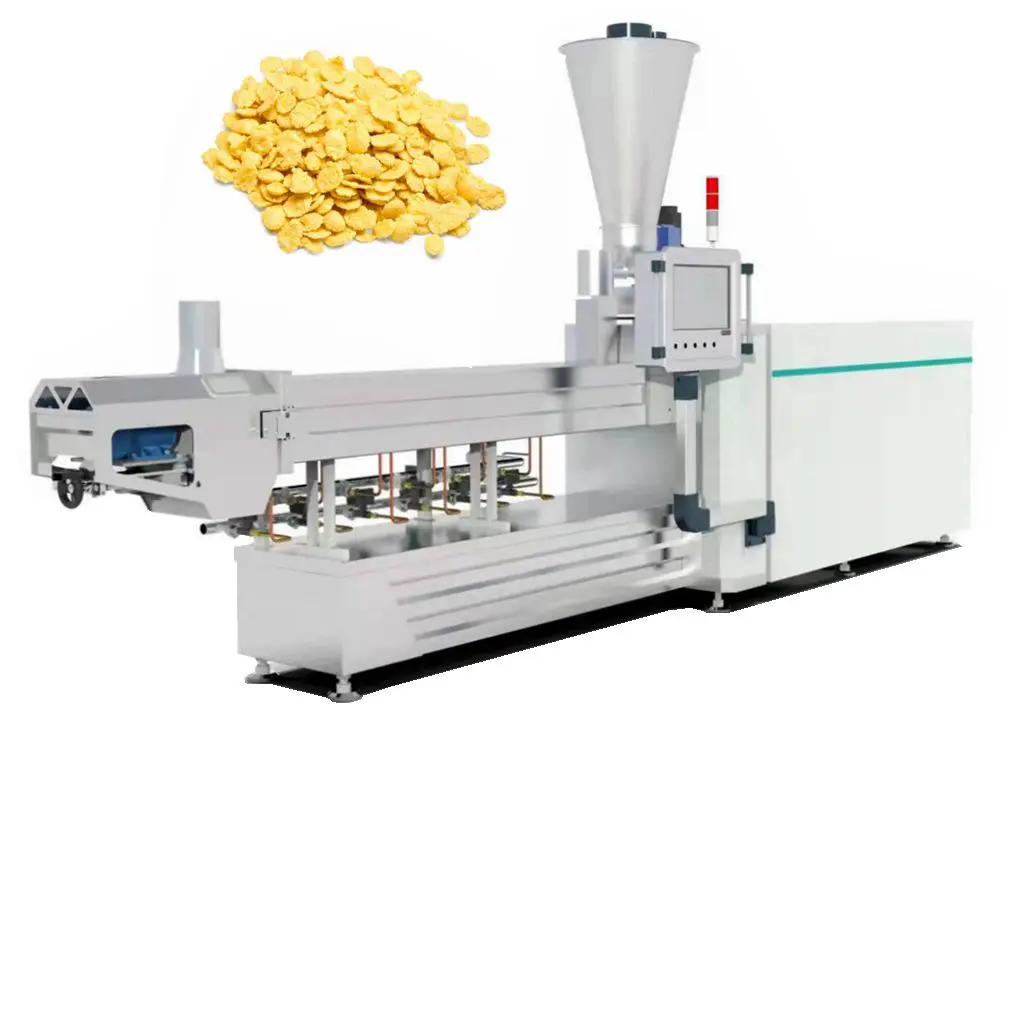
Screw Geometry Matched to Grain — die design and barrel zones tuned to your actual corn or multi-grain blend before the line ships, not after.
Technical Specifications
| Parameter | Value |
|---|---|
| Model | MT75 |
| Product Type | Corn Flakes Breakfast Cereal Production Line |
| Extruder Type | Twin Screw |
| Installed Power | 210 kW (MT75 line) |
| Power Consumption | 150 kW (MT75 line) |
| Output Capacity | 300–500 kg/hr (basis not stated in source — confirm raw material, moisture content, and product format) |
| Overall Dimensions (L×W×H) | 45 × 1.5 × 3.5 m (MT75 line) |
| Control System | PLC and MCC |
| Flaking Unit | Hydraulic double rollers, separate double motors, infrared temperature sensor |
| Dryer Heating Source | Gas or Electric |
| Roasting Oven | Hot air with conciliation burner, dual circulating fans, cyclone dust removal, vibrating pan |
| Coating System | Double tumble sugar melting, elevator, coating drum, spraying nozzle |
| Raw Materials | Corn, rice, wheat, oat, barley powder |
| Final Products | Natural corn flakes, sugar-coated flakes, multiple shapes via die change |
| Standards | CE, ISO |
Application Suitability
| Application | Material or Output |
|---|---|
| Natural corn flake production | Corn grits or corn flour at controlled moisture |
| Sugar-coated breakfast cereal | Extruded corn or multi-grain flakes with sugar syrup coating |
| Multi-grain flake cereal | Blends of rice, wheat, oat, and barley powder |
| Shaped extruded cereal pieces | Ball, tube, ring, star, wheel, and fruit loop formats via die swap |
Why "300 kg/hr" Means Nothing Without the Grain Spec
Capacity only holds when screw configuration, moisture, and die geometry match your exact raw material.
I spent years on the shop floor in Jinan watching lines perform perfectly during factory tests, then lose half their throughput the moment they hit a buyer’s actual grain supply. One buyer ordered a cereal line based on a quoted output figure, but the corn flour particle size at their plant was noticeably coarser than what we had used during testing. The flakes came out dense, expansion dropped, and the line could not hold its rated pace. We had to rework the screw combination and adjust moisture conditioning on-site to recover the capacity [NEED_CITE: twin-screw extrusion response to feed particle size variation]. When the corn flakes extrusion production line is configured around a generic grain profile rather than your specific blend, every downstream station — flaking, drying, roasting — compensates for problems that should never have existed.
How Screw Profile and Barrel Heat Shape the Flake
The twin-screw extruder on this line is built around the principle that starch gelatinisation must happen at a precise moisture and temperature window. The screw configuration determines shear intensity and residence time inside the barrel, while the barrel temperature profile — controlled across multiple heating zones — governs how completely the starch granules rupture. For corn, that window is narrow. Too little shear and the starch remains raw, producing flakes that shatter in the bowl. Too much heat and the dough over-gelatinises, sticking to the flaking rollers. The corn flakes extrusion production line addresses this by specifying screw element arrangement and die geometry to the buyer’s grain formulation before production begins.
Die Design and Moisture Control Define Final Density
Density is what separates a corn flake that floats in milk from one that sinks to the bottom in seconds. The die orifice diameter, combined with the moisture content at the extruder exit, determines how much the dough expands as it leaves the barrel. A wider die with higher moisture produces a lighter, more expanded pellet that flakes into a crispier final product. A narrower die at lower moisture yields a denser pellet suited to multi-grain formulations where oat or barley content reduces overall expansion potential. On this corn flakes extrusion production line, the die is selected after trial runs on the buyer’s actual raw material, not chosen from a standard catalogue [NEED_CITE: die geometry influence on extrudate expansion in cereal processing].
Reading the Specs That Actually Matter
The 210 kW installed power and 150 kW running consumption tell you the thermal and mechanical headroom available across the barrel zones and the twin-screw drive. For a corn-based formulation, that power envelope supports the high barrel temperatures and sustained shear needed for full gelatinisation without stalling under load. The hydraulic flaking unit with infrared temperature monitoring matters because roller surface temperature directly affects how cleanly the extrudate sheets into flakes — uneven heat causes one edge to stick while the other crumbles. The PLC control coordinating the flaking unit and downstream stations keeps roller gap, conveyor speed, and dryer temperature locked to the same recipe, reducing batch-to-batch drift that operators cannot correct manually.
The Hidden Cost of a Mismatched Dryer or Roaster
When extruder output is quoted without confirming that the dryer and roasting oven can handle the same volume, the bottleneck simply moves downstream. A flaking unit that runs faster than the dryer can process creates a backlog of wet pellets that stick together and tear during roasting. A roasting oven that is too small forces the operator to slow the entire corn flakes extrusion production line to prevent scorching. I have seen installations where the extruder was capable but the hot air roaster could not maintain uniform temperature across a full load, leaving some flakes under-toasted while others burned [NEED_CITE: thermal uniformity requirements in cereal roasting ovens]. The result is a line that technically works but never reaches the throughput the buyer planned around.
Why Sourcing the Full Line from One Build Matters
Throughput matching across every station — mixing, extruding, flaking, drying, roasting, coating, cooling, packing — is only possible when one supplier engineers the entire sequence. Screw configuration and die design are specified to your grain blend and target flake density rather than copied from a generic template. The in-house testing workshop allows trial runs on your actual raw material before the line ships, so product development happens on our floor, not yours. Hot air roasting with dual circulating fans and cyclone dust removal is integrated into the line layout rather than added as an afterthought. PLC and MCC control across all stations means one operator interface manages the full recipe from batching through packing.
Documentation & Verification
- Line layout drawing with station-by-station capacity calculation for your target output
- Screw and die configuration record matched to your grain blend and moisture spec
- Trial run report on your raw material produced in the testing workshop before shipment
- Electrical schematic with voltage, frequency, and control language confirmed before production
- CE declaration of conformity and ISO certificate included with shipping documentation
Installation, Commissioning & Support
- Foundation plan based on the 45 × 1.5 × 3.5 m line footprint and your workshop ceiling height
- Power distribution schedule for the 210 kW installed load with dedicated circuit requirements
- Assembly and alignment of hydraulic flaking rollers with infrared sensor calibration on-site
- First-run parameter setting for barrel zones, screw speed, and moisture dosing on your grain supply
- Operator training covering PLC recipe management, die changeover, and roller gap adjustment
- Wear parts list including screw elements, die inserts, and flaking roller sleeves with reorder codes
What We Need to Quote Your Line Accurately
Send us the grain types you plan to run, the particle size or mesh spec of your flour or grits, and your target daily output in finished flake weight. Confirm your workshop dimensions and ceiling clearance so the layout fits without modification. Specify your local voltage and frequency, the control language your operators prefer, and whether your existing packing equipment will integrate or if you need the full line through to bagging. If you can ship a sample of your raw material, we will run a trial in the testing workshop and include the results with the proposal.
Frequently Asked Questions
Q: How is extrusion capacity verified before the line ships?
A: We run your actual raw material through the twin-screw extruder in our in-house testing workshop, recording throughput, moisture at the die, and flake density. The trial run report documents the output achieved under those specific conditions, so the capacity figure you receive is tied to your grain blend — not a generic benchmark.
Q: How do you match screw configuration to my grain formulation?
A: Screw element arrangement — conveying, kneading, and reverse-flight sections — is selected based on your grain’s starch content, fat level, and particle size. We adjust the configuration during the trial run until expansion, texture, and density meet your target flake specification, then lock that build into your machine record.
Q: What barrel temperature profile does the line use for corn versus multi-grain?
A: Corn typically runs with a progressive temperature ramp across the barrel zones to achieve full gelatinisation before the die. Multi-grain blends containing oat or barley often need a flatter profile with lower peak temperatures because the higher fibre and fat content changes heat transfer. Both profiles are programmable through the PLC.
Q: Can I test my own raw material before committing to the full line?
A: Yes. We ask buyers to ship a representative sample of their grain supply to our testing workshop. We run it through the extruder, flaking unit, and a bench-scale roaster, then share the trial report showing throughput, flake thickness, bowl-life observation, and recommended screw and die configuration.
Q: How is throughput balanced between the extruder, flaking unit, and roaster?
A: Each station is sized during the layout phase so that its maximum processing rate meets or exceeds the extruder output at your confirmed recipe. The PLC coordinates conveyor speeds and station cycle times, preventing wet pellet accumulation before the dryer and ensuring the roasting oven receives a steady, uniform load.