Precision-Configured Screw Geometry — Every wet extrusion run starts with matching screw elements and die orifices to the buyer’s actual aquatic feed formulation rather than relying on generic builds.
Technical Specifications
| Parameter | Value |
|---|---|
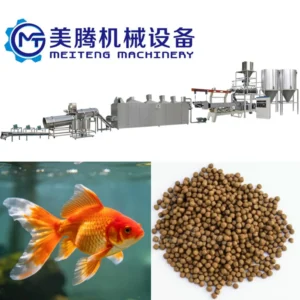
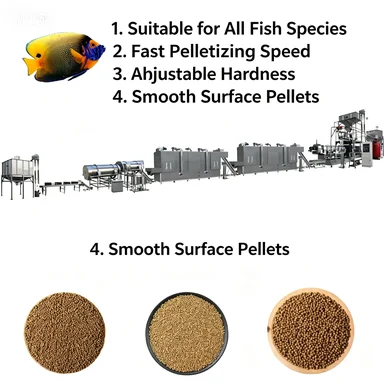
| Product Type | Twin Screw Aquatic Feed Extrusion Production Line |
| Process Type | Wet extrusion with steam/water injection |
| Output Capacity | 500 kg/h based on floating fish feed pellets — confirm raw material formulation and moisture content |
| Pellet Size Range | 0.5 mm – 12 mm |
| Screw Type | Co-rotating twin screw |
| Control System | PLC-controlled with automated parameter regulation |
| Main Structure Material | Stainless steel |
| Automation Level | Fully automatic continuous production |
| Line Stations | Feeding, mixing, extruding, pelletizing |
| Feed Types Produced | Floating and sinking aquatic feed pellets |
| Voltage & Frequency | Configurable to buyer’s site standard (basis to be confirmed) |
| Motor Power | To be verified against manufacturer catalog (basis to be confirmed) |
| Overall Dimensions | To be verified against manufacturer catalog (basis to be confirmed) |
| Barrel Zones | To be verified against manufacturer catalog (basis to be confirmed) |
| L:D Ratio | To be verified against manufacturer catalog (basis to be confirmed) |
| Screw Diameter | To be verified against manufacturer catalog (basis to be confirmed) |
| Die Configuration | Matched to target pellet size and density (basis to be confirmed) |
Application Suitability
| Application | Material or Output |
|---|---|
| Floating pellet production for surface-feeding species | Catfish and tilapia formulations using fish meal, corn, soybean meal, and starch binders |
| Sinking pellet production for bottom-feeding species | Shrimp and carp diets with high-protein, low-starch raw material blends |
| Growth-stage pellet diversification | 0.5 mm starter crumbles through 12 mm grower pellets on a single line |
| Formulation switching | Alternating between floating and sinking recipes without hardware changeover beyond screw and die adjustment |
Why Pellets Sink When They Should Float: The Barrel Profile Question
Buoyancy is determined inside the barrel, not at the die face.
A twin screw extrusion aquatic feed production line can produce floating pellets all morning and sinking pellets by afternoon — on the same raw materials — if the barrel temperature zones and moisture injection rates are adjusted correctly. I once saw a Southeast Asian tilapia plant run a perfect trial at the factory, then ship the line overseas only to find every batch sinking on arrival. The local fish meal had a different fat content than the trial material, and nobody had re-profiled the barrel zones or adjusted the steam injection accordingly [NEED_CITE: raw material variability effects on extrusion density]. The screw configuration that worked on a standard corn-and-soy blend could not generate sufficient starch gelatinisation to trap enough air in the denser formulation. That plant spent weeks adjusting parameters on-site before achieving stable float rates.
Shear, Gelatinisation, and the Role of Co-Rotating Screws
Co-rotating twin screws generate intense mechanical shear across a narrow gap between intermeshing elements. This shear breaks down starch granules more thoroughly than single-screw designs, raising the degree of gelatinisation that directly governs how much air the extrudate can trap during expansion. The twin screw extrusion aquatic feed production line relies on this mechanism to produce the low-density, buoyant structure required for floating pellets. When sinking pellets are the target, the screw profile is adjusted to reduce shear and allow denser compaction before the material exits the die.
Barrel Temperature Zoning and Moisture Injection Strategy
Wet extrusion introduces steam or water directly into the barrel through injection ports positioned along multiple temperature zones. Each zone can be independently heated, creating a thermal gradient that controls how quickly the starch gelatinises as material travels from the feed inlet to the die face. A gradual temperature rise promotes thorough cooking and maximum expansion for floating feed. A sharper, shorter thermal profile keeps the melt denser for sinking pellets. The PLC system stores separate recipes for each formulation, so operators can switch between floating and sinking production by recalling the appropriate barrel zone and moisture parameters [NEED_CITE: PLC recipe management in food extrusion systems].
Interpreting the Specifications That Matter
The pellet size range of 0.5 mm to 12 mm reflects the die orifice selection and cutter speed pairing rather than a single fixed geometry. Smaller starter crumbles for fry require fine dies and high cutting frequency, while grower pellets for market-size fish use larger orifices and slower cuts. The twin-screw configuration matters here because co-rotating elements maintain uniform pressure across the die face — a critical factor when running small-diameter dies where even minor pressure variation produces inconsistent pellet lengths. Wet extrusion with steam injection adds moisture that must be driven off downstream in the dryer, so the line throughput depends on matching dryer capacity to the moisture load leaving the extruder. The PLC system regulates screw speed, feed rate, and barrel temperature simultaneously, keeping the expansion ratio within the narrow band that separates a floating pellet from one that sinks on contact with water.
The Cost of Skipping the Trial Run
When an extrusion line ships without a documented trial on the buyer’s actual raw material, the first weeks of production become an expensive experiment. Screw elements that perform well on a generic corn-starch blend may fail to generate the shear profile needed for a high-fishmeal formulation, producing pellets with uneven density or surface cracking [NEED_CITE: extrusion screw configuration and raw material matching]. Die orifices sized for one species’ growth stage may not accommodate a buyer’s full product range without swapping plates. Without pre-shipment verification, these issues surface only after installation, when engineers are on-site and production deadlines are already slipping.
Why Source This Line Here
Every line configuration starts with the buyer’s raw material formulation and target pellet specification rather than a catalog default. The screw configuration and die design record is documented per order, matched to the specific fish meal, grain, and binder ratios the buyer will actually run. An in-house testing workshop conducts trial runs on customer-supplied raw material before the line ships, generating a test report that confirms pellet density, expansion ratio, and buoyancy against the buyer’s acceptance criteria. Twin-screw expertise spans aquatic feed alongside pet food, snacks, and cereal applications, meaning the process knowledge transfers across formulation categories. Complete line documentation — from barrel zone profiles to PLC parameter sheets — accompanies every shipment for immediate commissioning reference.
Documentation & Verification
- Screw and die configuration record matched to your aquatic feed formulation
- Barrel zone temperature profile and PLC parameter sheet for floating and sinking settings
- Trial run report on your raw material before dispatch
- Line layout and throughput calculation across all stations
- CE declaration of conformity and ISO certificate
- Operation and maintenance manual with wear parts list
Installation, Commissioning & Support
- Foundation planning based on the line’s PLC cabinet weight and extruder footprint
- Dedicated power circuit sized for the wet extrusion motor and barrel heater zones
- Assembly sequence from separate line stations through full mechanical alignment
- First-run parameter tuning using your raw material to verify pellet density
- Operator training on PLC recipe recall for switching floating and sinking profiles
- Wear parts supply including replacement screw elements and die plates
What to Include in Your Inquiry
Share your raw material formulation — the specific fish meal source, grain ratios, binder type, and target moisture content — along with whether you need floating pellets, sinking pellets, or both. Specify your local voltage standard and frequency, and confirm the control language your operators will need. If you have existing upstream milling or downstream drying and coating equipment, note the connection points so the line layout accounts for your current infrastructure.
Frequently Asked Questions
Q: How is the screw configuration adjusted to produce floating versus sinking pellets?
A: Floating pellets require screw elements arranged to maximise shear and starch gelatinisation, trapping air during expansion. Sinking pellets use a configuration that reduces shear and increases compaction density. The barrel element sequence and kneading block angles are changed accordingly, and the PLC recipe stores the corresponding screw speed and temperature settings for each type.
Q: What barrel temperature profile supports proper starch gelatinisation in aquatic feed?
A: A multi-zone gradient typically starts with moderate heat near the feed inlet and increases progressively toward the die. Wet extrusion adds steam at specific injection points to raise moisture content, which lowers the gelatinisation temperature. The exact profile depends on the starch source and protein content of the buyer’s formulation, which is why we verify it during the pre-shipment trial run.
Q: How is pellet density and buoyancy verified during the trial run?
A: Sample pellets are collected at steady-state production and tested for bulk density and water displacement. Floating pellets must remain on the water surface for a specified duration, while sinking pellets must descend within the required timeframe. Results are documented in the trial run report alongside the PLC parameters that produced them.
Q: What die configurations are available for different pellet diameters and growth stages?
A: Die plates with varying orifice diameters and hole counts are available to cover the 0.5 mm to 12 mm range. Cutter speed is synchronised with extrudate exit velocity to control pellet length. Multiple die plates allow a single line to produce starter crumbles for fry and larger pellets for grow-out stages.
Q: How does the PLC system handle different feed formulations?
A: The PLC stores separate recipes for each formulation, including screw speed, barrel zone temperatures, moisture injection rates, and feeder ratios. Operators recall the appropriate recipe when switching between floating and sinking production, ensuring consistent pellet properties across batches without manual parameter entry.