Formulation-matched screw geometry — Every barrel zone and die land is specified against the buyer’s actual fish meal ratio and target buoyancy, validated by a pre-shipment trial run on the customer’s own raw blend.
Technical Specifications
| Parameter | Value |
|---|---|
| Product Type | Twin Screw Aquatic Fish Feed Extrusion Production Line |
| Screw Type | Twin screw, wet extrusion with preconditioner |
| Material Contact Parts | Food grade 304 stainless steel |
| Machine Body | Food grade 304 stainless steel |
| Control System | Intelligent PLC automatic control |
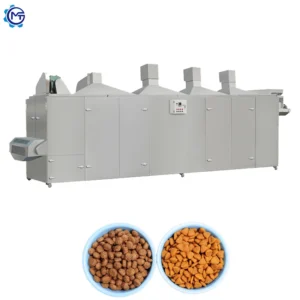
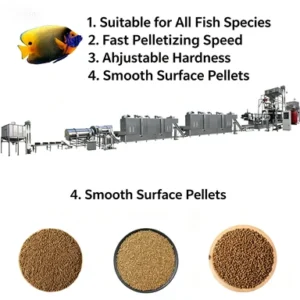
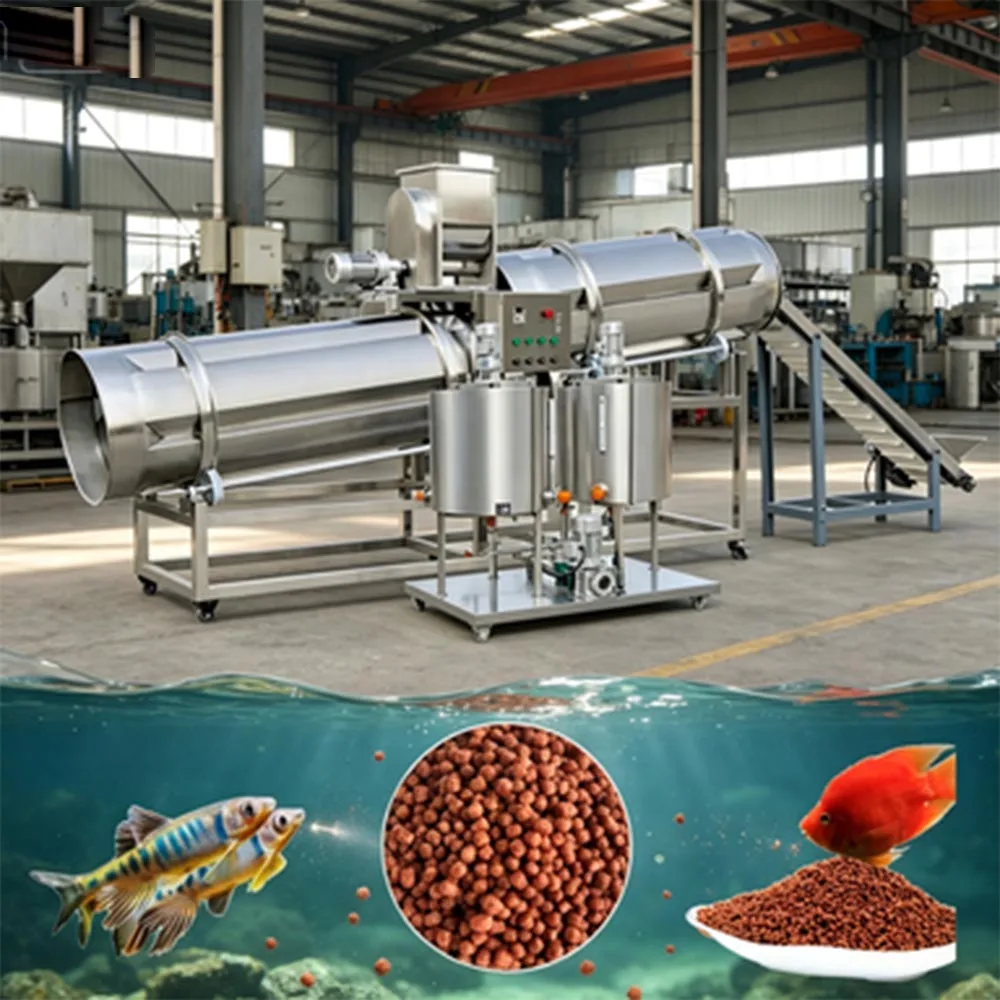
| Line Stations | Raw material mixer, extruder, dryer, seasoning coating machine, vibrating sieve, conveyor equipment |
| Output Products | Floating and sinking fish feed pellets |
| Pellet Adjustability | Size, hardness, buoyancy configurable per breeding requirements |
| Automation Level | Full continuous automatic production (mixing through extrusion, drying, seasoning, screening, discharging) |
| Operation Interface | Humanized operation interface with simple parameter adjustment |
| Maintenance Design | Convenient daily cleaning, regular maintenance, quick replacement of vulnerable parts |
| Energy Design | Optimized energy saving transmission structure and heating system |
| Output Capacity | Large stable processing capacity for medium to large scale industrial production (basis not stated in source — confirm raw material formulation, pellet size, and moisture content) |
| Standards | CE, ISO certified facility |
Application Suitability
| Application | Material or Output |
|---|---|
| Floating aquatic feed for koi and goldfish | Fish meal, corn powder, soybean meal, compound additives at controlled moisture |
| Sinking pellets for bottom-feeding freshwater fish | High-protein blends with adjusted starch ratio for negative buoyancy |
| Tropical ornamental fish nutrition pellets | Vitamin-fortified compound mixes requiring gentle shear to preserve nutrient integrity |
| Medium to large scale commercial aquaculture feed | Bulk fish meal and soybean meal blends processed for consistent pellet density across long runs |
Why Generic Screw Profiles Sink Your Floating Feed
Floating feed that sinks, or sinking pellets that drift to the surface, almost always traces back to a screw and die combination that was copied from a standard build rather than calculated for the buyer’s raw material.
I remember a batch meant for catfish growers that looked perfect during our internal trial on standard corn starch. The buyer’s formula carried thirty percent fresh meat slurry, and the screw profile we used simply could not build enough shear to gelatinise that blend. The pellets hit water and dropped straight to the tank floor. That single failure reshaped how I approach every aquatic feed inquiry — the formulation must drive the hardware, never the reverse. Aquaculture producers who receive feed that does not hold the expected buoyancy face rejected shipments and damaged distributor trust. The twin screw fish feed extrusion technology discussion therefore starts with the recipe, not the brochure capacity [NEED_CITE: aquaculture feed buoyancy specification standards by species].
Shear, Moisture and the Gelatinisation Window
The wet twin screw configuration introduces steam and water directly into the barrel through a preconditioner, raising the moisture content of the mix before it enters the first kneading zone. Starch granules in corn powder or wheat flour need both thermal energy and mechanical shear to rupture and form the elastic matrix that traps steam bubbles at the die face. When twin screw fish feed extrusion technology is applied correctly, the operator adjusts barrel zone temperatures and screw speed together, holding the melt inside a narrow gelatinisation window that produces uniform cell structure and predictable pellet density.
Buoyancy Control Through Die Land and Cut-Off Geometry
Floating pellets demand rapid expansion the moment the melt exits the die, while sinking pellets require restricted expansion and higher internal density. The die plate is therefore selected based on the open area ratio, the land length, and the number of orifices relative to throughput. A shorter land allows sudden pressure release and maximum expansion for floating grades; a longer land dampens expansion for slow-sinking or bottom-feed grades. The rotating face cutter then severs each strand at a set frequency, and the knife speed directly determines pellet length. Matching die geometry to cut-off speed is where twin screw fish feed extrusion technology separates consistent production from constant manual intervention [NEED_CITE: die land length influence on extruded pellet expansion ratio].
Reading the Barrel Temperature Profile
The barrel is divided into multiple heating and cooling zones, each independently controlled by the PLC. The feed zone typically runs cooler to prevent premature gelatinisation that would cause surging, while the metering and high-shear zones are held at higher set-points to complete starch conversion. Thermocouples feed real-time data back to the controller, and the system modulates steam injection accordingly. An operator watching a floating pellet trial will look for a stable amperage draw on the main motor — fluctuating load signals inconsistent fill or moisture variation, both of which collapse buoyancy. The barrel profile is not a fixed recipe but a living parameter set that shifts when the buyer changes fish meal suppliers or adjusts fat content.
The Price of a Mismatched Line Configuration
An extruder that runs beautifully at trial but feeds into an undersized dryer creates a bottleneck where wet pellets pile up, stick together, and spoil before moisture is brought down to safe storage levels. Coating drums that cannot keep pace leave seasoning unevenly distributed, and aquaculture buyers reject feed that shows inconsistent oil coverage because it signals poor palatability to the fish. Electrical mismatches are another silent cost — a line wired for 50 Hz that lands in a 60 Hz market runs the main motor overspeed, overheats the gearbox, and voids the warranty before the first tonne is produced. These failures are entirely preventable when throughput, utility supply, and downstream capacity are calculated as one system rather than ordered station by station [NEED_CITE: industrial extrusion line throughput matching principles].
Why Procurement Starts with a Conversation About Your Recipe
The testing workshop runs the buyer’s actual raw blend before the line is crated, producing a trial report that records screw configuration, barrel profile, die specification, moisture at each zone, and the measured buoyancy of the output pellets. Every production line is laid out so that the mixer batch cycle, the extruder throughput, the dryer residence time, and the coating drum volume are balanced to the same hourly mass flow, eliminating the station-to-station starvation that plagues lines assembled from separate vendors. Screw and die configurations are documented and archived so that repeat orders or product changeovers can reference a proven starting point rather than beginning from scratch. The PLC interface is configured in the operator’s language, and voltage, frequency, and plug standards are confirmed against the destination grid before the electrical panel is wired. All food-contact surfaces are 304 stainless steel, meeting the hygiene expectations of feed buyers who audit supplier facilities before approving vendor lists.
Documentation & Verification
- Trial run report recorded on the buyer’s specific fish meal and starch formulation before shipment
- Screw and die configuration record detailing element arrangement matched to target pellet buoyancy
- Electrical schematic with voltage and frequency confirmed against destination market grid standard
- CE declaration of conformity covering the complete extrusion line assembly
- Line layout drawing showing throughput-matched station spacing and utility connection points
- Operation and maintenance manual translated to the buyer’s preferred working language
Installation, Commissioning & Support
- Foundation plan sized to the twin screw extruder mass and dynamic vibration load of the main drive
- Dedicated power circuit specified for PLC-controlled motor start-up and barrel heater peak draw
- Modular line stations shipped in sequence so dryer and coating drum arrive aligned with extruder output height
- First-run commissioning includes barrel temperature mapping and screw speed tuning on the buyer’s raw material
- Operator training covers PLC parameter adjustment for switching between floating and sinking pellet grades
- Wear parts list identifying screw elements, die plates, and cutter blades with recommended replacement intervals
What We Need From You to Build a Quotation
Send the raw material formulation with percentage breakdown of protein source, starch carrier, fat level, and any functional additives, because the screw profile and die selection depend entirely on that blend. State the target pellet diameter range, the required buoyancy behaviour, and the daily tonnage you need the line to sustain across a standard shift. Include the factory floor dimensions and the local voltage and frequency supply so the electrical panel and motor ratings can be locked before production begins.
Frequently Asked Questions
Q: How does screw configuration affect floating versus sinking pellet density?
A: The arrangement of kneading blocks, reverse elements, and conveying segments inside the barrel determines shear intensity and residence time. A configuration with more kneading blocks and tighter reverse elements builds higher internal pressure, producing greater expansion at the die face for floating pellets. Reducing shear segments and opening the die land restricts expansion, yielding the denser structure needed for sinking feed.
Q: What role do barrel temperature and moisture play in starch gelatinisation during wet extrusion?
A: Steam injected through the preconditioner raises the moisture content of the mix before it enters the barrel. Each heating zone then brings the starch granules past their gelatinisation threshold, rupturing the crystalline structure so the melt can trap steam and expand uniformly at the die. Precise PLC control of both temperature and moisture prevents under-cooked pellets that shatter in water or over-cooked melt that collapses on cooling.
Q: How is die design chosen for a specific raw material and pellet size?
A: The open area ratio, orifice diameter, and land length are calculated based on the viscosity of the cooked melt, which itself depends on the protein-to-starch ratio in the formulation. High-protein blends flow differently than high-starch mixes, so the die must be matched to maintain consistent strand velocity. Orifice diameter sets the pellet cross-section, while land length controls expansion degree and surface finish.
Q: Can you run a trial on our raw material before the line ships?
A: Yes. The in-house testing workshop processes the buyer’s actual formulation through the specified screw and die combination, producing a documented trial report. This report records buoyancy test results, pellet dimensions, moisture content at each stage, and the exact screw configuration used. Any adjustments needed to meet the target specification are made before the extruder is disassembled for crating.