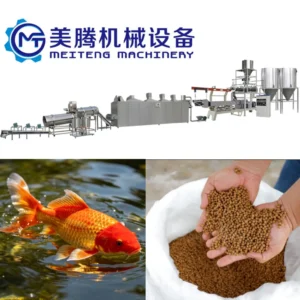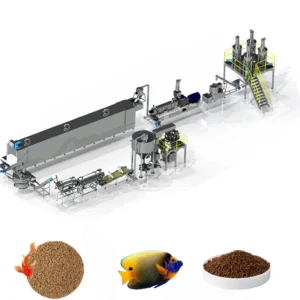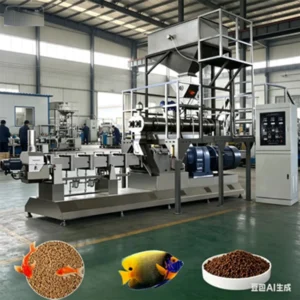
Screw Configuration Matched to Your Raw Material — Each twin screw aquatic feed extrusion line is configured with screw elements, die geometry, and barrel zones dialed in on your actual formulation before the machine leaves the factory.
Technical Specifications
| Parameter | Value |
|---|---|
| Product Type | Twin Screw Aquatic Feed Extrusion Line |
| Screw Type | Twin Screw |
| Control System | PLC Automatic Control System |
| Contact Material | Food Grade 304 Stainless Steel |
| Pellet Types | Floating and Sinking Fish Feed Pellets |
| Adjustable Parameters | Pellet Size, Hardness, Buoyancy |
| Line Stations | Raw Material Mixer, Extruder, Dryer, Seasoning Coating Machine, Vibrating Sieve, Conveyor Equipment |
| Operation Mode | Full Continuous Automatic Production |
| Assembly State | Complete Matched Production Configuration |
| Output Capacity | Large stable processing capacity (basis not stated in source — confirm raw material, pellet size, moisture content) |
| Standards | CE, ISO |
Application Suitability
| Application | Material or Output |
|---|---|
| Commercial koi and goldfish feed production | Fish meal, soybean meal, corn powder, compound additives |
| Tropical ornamental fish pellet manufacturing | Starch-based blends with protein concentrates |
| Freshwater aquaculture floating feed | Soybean meal, corn flour, fish meal at varying ratios |
| Sinking pellet production for bottom-feeding species | High-protein formulations with adjusted gelatinisation targets |
| Medium to large scale feed milling operations | Compound formulations requiring buoyancy control across product SKUs |
Why Floating Pellets Sink When the Screw Profile Is Wrong
Buoyancy is determined inside the barrel, not at the die.
I learned this the hard way on a Southeast Asian aquaculture project. We ran trial material based on corn starch, and the expansion looked correct. When the customer switched to their production fish meal formulation, the pellets sank. The screw profile that worked for pure starch could not generate enough shear and residence time to gelatinise a high-protein, high-fat mix. The barrel temperature zones were calibrated for a different thermal load entirely [NEED_CITE: starch gelatinisation thresholds across protein-starch ratios]. Getting twin screw aquatic feed extrusion line specifications right means defining the screw element sequence, compression ratio, and temperature profile against your actual formulation — not a reference recipe.
How Screw Element Sequencing Controls Pellet Density
The arrangement of conveying, kneading, and reverse elements along the screw shaft determines how much mechanical energy transfers into your raw material. For floating pellets, the sequence must build sufficient pressure and shear to fully gelatinise the starch fraction, trapping steam inside the pellet matrix as it exits the die. A configuration that rushes material through without enough residence time produces under-expanded pellets that absorb water and sink. Every twin screw aquatic feed extrusion line we build gets its element stack specified against the buyer’s target buoyancy and protein-to-starch ratio.
Barrel Temperature Zoning and Moisture Balance
Each barrel section has independent heating and cooling, allowing the temperature profile to follow the material through its phase transitions. Starch gelatinisation in aquatic feed typically requires barrel wall temperatures that maintain the product mass above the gelatinisation point while avoiding surface burning that blocks die openings [NEED_CITE: barrel temperature profiles for aquatic feed extrusion]. Moisture injection points along the barrel let operators fine-tune the water content zone by zone, which directly affects expansion ratio and final pellet density. This level of control is what separates consistent floating feed from batches that vary between production runs.
Reading the Specs That Actually Matter for Pellet Quality
The PLC automatic control system monitors motor load, barrel temperature at each zone, and feed rate in real time, which matters because aquatic feed formulations shift between batches as raw material composition varies seasonally. Food grade 304 stainless steel contact surfaces prevent iron contamination that accelerates lipid oxidation in fish meal-based pellets — a shelf life issue, not just a hygiene one. The matched line configuration from mixer through dryer to coating drum ensures that throughput does not bottleneck at any single station. A dryer that cannot handle the extruder’s output moisture load forces operators to slow the entire line, which is a capacity loss disguised as a drying problem.
What Happens When the Configuration Is Copied Instead of Specified
A generic screw build might produce acceptable pellets on a test formula but fail on your production mix. Floating feed that sinks after a few seconds in water is unsellable to aquaculture operations where surface feeding behaviour is expected. Die openings that are too large or too small for your target pellet diameter create waste that must be reprocessed or discarded. A dryer or seasoning drum undersized relative to the extruder output means your line runs below its real capacity every shift [NEED_CITE: throughput matching between extrusion and downstream stations]. These are not defects in the machine — they are defects in the specification process.
Why Procurement Starts With Your Formulation
We run your actual raw material in the testing workshop before the line ships, recording screw speed, barrel temperatures, moisture levels, and die pressure that produce the target pellet specification. The screw and die configuration record travels with the machine so your operators know the validated starting parameters. Every station — mixer, extruder, dryer, coating drum, sieve — is sized so that throughput matches across the full line rather than assembling from separate vendors with mismatched capacities. The electrical schematic and voltage are confirmed against your facility’s supply before production begins, avoiding commissioning delays caused by wrong motor ratings or control language.
Documentation & Verification
- Screw and die configuration record matched to your raw material and buoyancy target
- Trial run report on customer formulation conducted before shipment
- Line layout with capacity calculation showing matched throughput at every station
- Electrical schematic with voltage and frequency confirmed for your market
- CE declaration of conformity and ISO certificate for customs and regulatory clearance
- Operation and maintenance manual with wear parts list for screw elements and dies
Installation, Commissioning & Support
- Foundation and utility layout provided based on the matched line footprint and PLC cabinet placement
- Power supply verification against confirmed voltage and frequency before extruder motor energisation
- On-site barrel assembly and screw element sequencing verified against the configuration record
- First-run commissioning using your raw material to validate pellet density and buoyancy on site
- Operator training covering PLC parameter adjustment for formulation changes between floating and sinking runs
- Wear parts inventory plan for screw elements, die plates, and dryer screen panels
Before You Request a Quote
To configure the screw profile and line capacity correctly, we need your target pellet specifications — floating or sinking, diameter range, and protein-to-starch ratio in your formulation. Share your local voltage and frequency so the motor and PLC are specified for your grid, and let us know whether you need a trial run on your raw material before shipment.
Frequently Asked Questions
Q: How is screw configuration determined for my specific raw material and target pellet buoyancy?
A: We map the kneading, conveying, and reverse element sequence based on your formulation’s protein and starch content. Floating pellets need higher shear and longer residence time for full gelatinisation, while sinking pellets use a reduced compression profile. The configuration is validated on your actual material in the testing workshop before the machine ships.
Q: What barrel temperature profile and moisture levels are required for proper starch gelatinisation?
A: Each barrel zone is set independently to follow the material through its thermal transitions. Starch gelatinisation in aquatic feed requires maintaining product temperature above the threshold specific to your starch source while controlling moisture injection zone by zone. The PLC records the validated profile from your trial run as the baseline for production.
Q: Can I run a trial with my raw material before shipment to verify pellet density and expansion?
A: Yes. Our testing workshop runs your actual formulation through the configured extruder, measuring pellet density, buoyancy duration, and expansion ratio. The trial run report documents the screw speed, temperature profile, and moisture settings that achieved your target specification, and these parameters ship with the machine.
Q: How do you match dryer and coating capacity to the extruder output to avoid bottlenecking?
A: Every station is calculated against the extruder’s moisture output and pellet throughput. The dryer is sized to handle the specific moisture removal load at your target production rate, and the coating drum volume matches the seasoning application rate. This prevents any single station from limiting the line’s actual capacity.