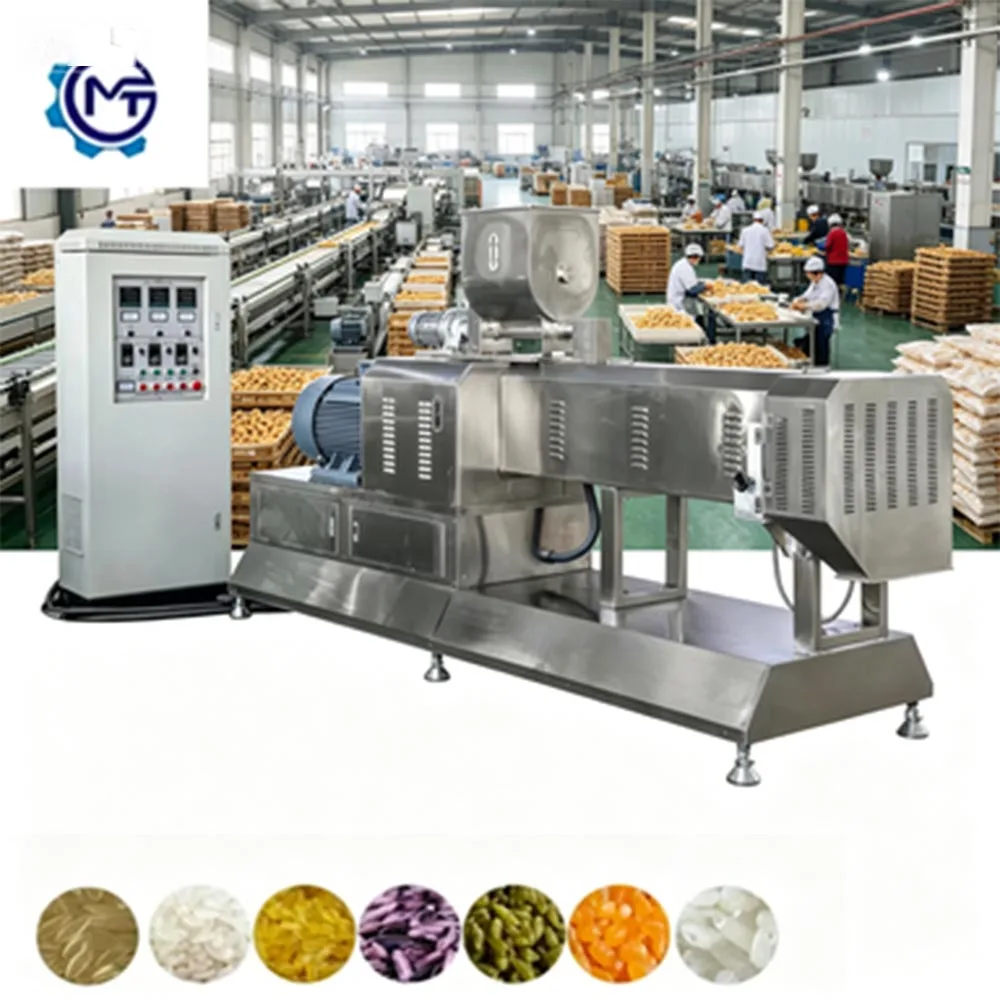
Extrusion Technology Angle — screw configuration and barrel zone profiling matched to your aquatic raw material formulation to control pellet density, buoyancy, and starch gelatinisation rather than relying on generic builds.
Technical Specifications
| Parameter | Value |
|---|---|
| Product Type | Twin Screw Fish Feed Extruder Production Line |
| Screw Type | Twin screw |
| Control System | Intelligent PLC automatic control system |
| Contact Material | Food grade 304 stainless steel |
| Machine Body | Food grade 304 stainless steel |
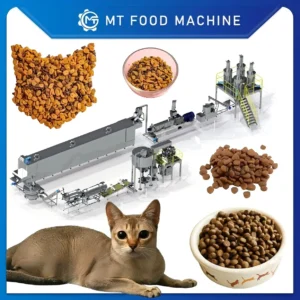
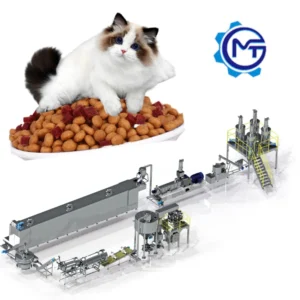
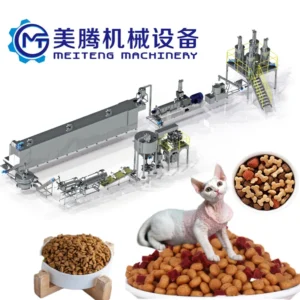
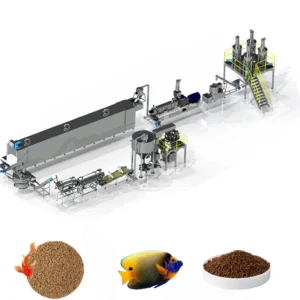
| Line Stations | Raw material mixer, extruder, dryer, seasoning coating machine, vibrating sieve, conveyor equipment |
| Production Mode | Full continuous automatic production |
| Pellet Adjustability | Size, hardness, buoyancy adjustable per breeding requirements |
| Feed Type Output | Floating and sinking fish feed pellets |
| Operation Interface | Humanized operation interface |
| Maintenance Design | Convenient daily cleaning, quick replacement of vulnerable parts |
Application Suitability
| Application | Material or Output |
|---|---|
| Koi and goldfish floating pellets | Fish meal, soybean meal, corn powder, compound additives |
| Tropical fish sinking granules | High-protein aquatic formulations requiring controlled density |
| Freshwater aquaculture feed | Compound feed with varying starch and lipid ratios |
| Medium to large scale commercial production | Long-time uninterrupted operation environments |
Why Generic Screw Configurations Sink Floating Feed
Floating or sinking behaviour is determined by the extrusion process, not just the recipe.
I have seen aquaculture producers run the exact same raw material formulation through two different twin screw fish feed extruder extrusion technology setups — one producing pellets that stayed on the surface for hours, the other sinking within minutes. The difference was not the ingredients. It was the screw element arrangement, the barrel temperature profile, and the die geometry. When suppliers copy a generic screw configuration from a different application or a different manufacturer’s build, the shear energy, residence time, and expansion ratio all shift. The pellet looks right coming off the die, passes visual inspection, but fails the buoyancy test the market actually demands [NEED_CITE: buoyancy and density specifications in commercial aquaculture feed standards]. That failure often surfaces only after the line is installed and running on the buyer’s own raw material, when rework and downtime have already started accumulating.
Barrel Temperature Profiling and Starch Gelatinisation
The barrel on a twin-screw extruder is divided into multiple heating and cooling zones, and each zone serves a distinct function in the gelatinisation sequence. Moisture and thermal energy must penetrate the starch granules progressively — too fast and the outer layer gelatinises while the core remains raw, too slow and the material degrades before reaching the die. Precise barrel zone control allows the operator to match the thermal profile to the specific starch content and particle size distribution of the incoming raw material blend.
Shear, Moisture, and the Expansion Window
Starch gelatinisation inside the barrel requires the combination of heat, moisture, and mechanical shear to break down crystalline structures within the granule. The twin screw fish feed extruder extrusion technology approach manages all three simultaneously. Moisture is typically introduced as steam or liquid at the preconditioner or directly into the barrel, while screw element geometry dictates how much mechanical energy converts to heat through viscous dissipation. Getting the expansion window right — where the pellet expands to the target density and holds a smooth, uniform surface — depends on holding all three variables within a narrow band specific to each formulation [NEED_CITE: starch gelatinisation parameters in twin-screw food extrusion].
Reading the Spec Sheet Against Your Formulation
The L:D ratio of the barrel determines how long material stays inside the extruder, which directly affects how completely starch gelatinises and how uniformly moisture distributes before the die. A longer barrel gives more residence time, useful for high-starch formulations that need extended thermal exposure, while shorter barrels suit protein-dense mixes that degrade under prolonged heat. The screw element arrangement — conveying elements, kneading blocks, reverse elements — controls the shear profile and the pressure build-up approaching the die. Die orifice diameter and length-to-diameter ratio of each hole govern the expansion ratio as superheated moisture flashes off at the die face. The PLC control system ties these mechanical realities to operator-adjustable parameters, letting you fine-tune screw speed, zone temperatures, and feed rate to hold consistent pellet density across production runs.
The Cost of Skipping Configuration Matching
When the screw and die configuration is not matched to the buyer’s actual raw material, the problems compound downstream. Floating pellets that sink mean the aquaculture farmer cannot observe feeding behaviour, leading to overfeeding and water quality deterioration. Sinking pellets that float waste feed at the surface where bottom-feeding species cannot reach them. Pellets with uneven density break apart during conveying and transport, generating fines that reduce feed conversion efficiency. Every one of these failures traces back to a screw configuration that was specified generically rather than engineered for the formulation actually running through the barrel [NEED_CITE: feed pellet integrity and aquaculture feed conversion outcomes].
Why Procurement Decisions Land Here
Complete line throughput matching from the mixer through extrusion, drying, seasoning, and screening ensures no single station bottlenecks the extruder. Screw configuration and die geometry are specified against the buyer’s raw material data and target pellet specification, not pulled from a catalogue of generic builds. The in-house testing workshop runs trial production on the customer’s actual raw material before shipment, generating a trial run report that documents pellet density, buoyancy, and surface quality. Twin-screw extrusion expertise covers the full range of aquatic feed applications — floating and sinking formats across species with different nutritional and behavioural requirements. Pre-sales consultation covers the process engineering questions that determine whether the line will run correctly from day one.
Documentation & Verification
- Line layout showing throughput matching between extruder, dryer, and screening stations
- Screw and die configuration record tied to your raw material formulation and target pellet density
- Electrical schematic with voltage and frequency confirmation for your site utility supply
- Trial run report on your raw material documenting buoyancy, density, and surface finish
- Machine specification sheet detailing barrel zones, L:D ratio, and screw element arrangement
- CE declaration of conformity and ISO certificate for export compliance
Installation, Commissioning & Support
- Foundation and floor space planning matched to the full line footprint including dryer and cooling conveyors
- Dedicated electrical circuit sizing based on total connected load of extruder, dryer, and seasoning stations
- Machine delivered in modular sections for site assembly, with barrel and screw installation supervised on-site
- First-run commissioning includes barrel zone temperature calibration and screw speed tuning on your raw material
- Operator training covers PLC parameter adjustment for switching between floating and sinking pellet production
- Wear parts list specifying screw elements, die plates, and seals with reorder part numbers
Before You Send the Inquiry
Provide your raw material formulation — the protein source, starch base, lipid content, and any compound additives — along with the target pellet diameter and whether you need floating, sinking, or both formats. Confirm your site voltage and frequency, the language you need for the PLC interface, and whether you want a trial run on your material before the equipment ships. These details determine the screw configuration, die selection, and dryer capacity that make the difference between a line that runs and one that needs rework after installation.
Frequently Asked Questions
Q: How is screw configuration and die design selected for floating versus sinking fish feed pellets?
A: Floating pellets require higher expansion at the die, achieved through specific kneading block arrangements and die geometries that maximise moisture flash-off. Sinking pellets use screw configurations that compress the material more densely with lower expansion ratios. Both depend on matching the configuration to your raw material’s starch and protein behaviour under heat and shear.
Q: What barrel temperature profile and moisture range achieve full starch gelatinisation on my raw material?
A: The profile depends on your starch source, particle size, and lipid content. High-starch formulations typically need progressive heating across multiple barrel zones with moisture preconditioning. The exact temperature and moisture targets are confirmed during the trial run on your actual raw material before the equipment ships.
Q: Can a trial run on my specific raw material formulation be conducted before shipment?
A: Yes. The in-house testing workshop runs your raw material through the configured extruder and documents pellet density, buoyancy, surface finish, and dimensional consistency. The trial run report is provided before shipment so you can verify the line meets your product specification.
Q: How are PLC control parameters set and adjusted to fine-tune pellet properties?
A: The intelligent PLC system allows operators to adjust screw speed, individual barrel zone temperatures, and feed rate in real time. Each parameter change alters shear energy, residence time, and expansion behaviour. The humanized operation interface stores recipe profiles so you can switch between floating and sinking production with consistent results.
Q: What is the relationship between extruder throughput and downstream dryer capacity?
A: The dryer must handle the full moisture load exiting the extruder at continuous production rate. If dryer capacity is undersized, pellets retain excess moisture, compromising shelf life and structural integrity. The line is configured with matched throughput across every station to prevent bottlenecks at the extruder or dryer stage.