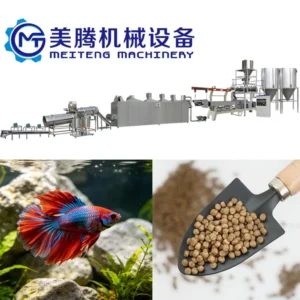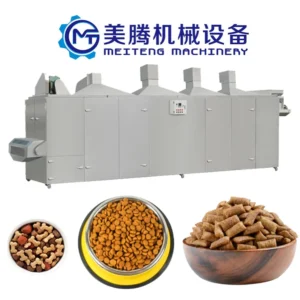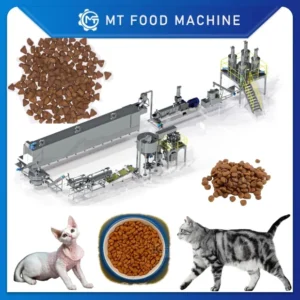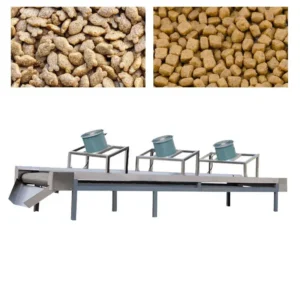
Matched Throughput Engineering — every station from batching to packing is calculated against your aquatic feed formulation, so the twin screw fish feed extruder extrusion technology never bottlenecks at the dryer or coater.
Technical Specifications
| Parameter | Value |
|---|---|
| Product Type | Twin Screw Aquatic Feed Extrusion Line |
| Screw Type | Twin-screw |
| Control System | PLC automatic control system |
| Contact Parts Material | Food-grade 304 stainless steel |
| Machine Body Material | 304 stainless steel |
| Line Stations | Raw material mixer, extruder, dryer, seasoning/coating machine, vibrating sieve, conveyor equipment |
| Pellet Adjustability | Size, hardness, buoyancy (floating and sinking) |
| Output Capacity | Medium to large scale continuous production (basis to be confirmed with raw material formulation, pellet size and moisture content) |
| Assembly State | Complete matched production line |
Application Suitability
| Application | Material or Output |
|---|---|
| Floating fish feed pellets for koi and goldfish | Fish meal, corn powder, compound additives at controlled moisture |
| Sinking pellets for bottom-feeding species | Soybean meal and starch-rich blends requiring high compression |
| Tropical fish ornamental feed | Fine particle formulations with colour additives |
| Freshwater aquaculture grow-out feed | High-protein blends with fish meal and soybean meal |
| Shrimp and crustacean sinking feed | Dense formulations requiring minimal expansion at the die |
Why Floating Pellets Sink When the Screw Profile Is Wrong
Buoyancy is decided inside the barrel, not at the die plate.
I once watched an aquaculture producer in Southeast Asia lose an entire week of production because every batch of floating feed came out sinking. The extruder was rated for the right throughput, the dryer was matched, but the screw configuration had been copied from a generic floating feed template without accounting for the buyer’s actual starch-to-protein ratio. By the time we pulled the screws and re-profiled the compression sections, the damage to that season’s delivery schedule was already done [NEED_CITE: starch gelatinisation thresholds in high-protein aquatic feed blends].
That is the kind of failure this page exists to prevent. The twin screw fish feed extruder extrusion technology described here treats buoyancy as a process variable, not a gamble.
Shear, Residence Time and the Gelatinisation Window
Full starch gelatinisation requires the raw material to reach a specific temperature and moisture threshold simultaneously while under mechanical shear. The twin-screw configuration provides intermeshing flight sections that control residence time precisely, ensuring that corn powder and starch-rich additives cook through before reaching the die. Under-gelatinised pellets expand unpredictably; over-cooked material degrades protein quality.
Die Geometry and Pellet Density Control
Floating pellets demand rapid expansion at the die face, which means the die orifice and land length must be matched to the melt pressure built up in the final barrel zone. Sinking pellets require the opposite — restricted expansion and higher compression through the die. The same extrusion platform produces both formats by swapping die plates and adjusting the screw profile in the metering section. This flexibility matters for producers who supply multiple species across a single season.
Barrel Temperature Profiling Across Zones
Each barrel section is independently heated and cooled. The feed zone keeps raw material cool enough to prevent premature gelatinisation and bridging, while the compression and metering zones ramp to the temperatures required for full starch cooking. Moisture injection points allow real-time adjustment when raw material humidity shifts between batches [NEED_CITE: barrel zone temperature profiling standards for food-grade extrusion].
How Core Parameters Translate to Pellet Quality
The L:D ratio of the twin-screw assembly determines how long raw material stays inside the barrel. A longer barrel gives more residence time for tough, high-fibre blends but can over-process delicate protein formulations. Screw speed controls shear intensity — higher RPM increases mechanical energy input, raising melt temperature and expansion rate at the die. The PLC control system logs these parameters continuously, so when a shift operator adjusts moisture or screw speed, the change is recorded and repeatable across production runs. Food-grade 304 stainless steel contact parts prevent corrosion from the acidic and saline compounds common in fish meal formulations, which would otherwise contaminate product and degrade pellet surface finish over time.
The Cost of Skipping the Trial Run
When an extruder ships without a documented trial on the buyer’s actual raw material, the first weeks of production become an expensive experiment. Screw combinations that work on one fish meal source may fail on another due to differences in fat content, particle size, or residual moisture. I have seen producers discard tonnes of off-spec feed before the screw configuration was corrected on-site [NEED_CITE: raw material variability in aquaculture feed manufacturing]. The in-house testing workshop exists specifically to absorb that risk before the line leaves the factory.
What Separates This Supply Approach
Every line is configured from the mixer through to the packing station by a single engineering team, which means throughput is balanced across all stations rather than assembled from mismatched vendors. Screw and die configurations are specified against the buyer’s raw material sample, not pulled from a generic catalogue. The trial run report documents pellet density, expansion ratio, and buoyancy on your actual formulation before the machine is crated. Voltage, frequency, and PLC language are confirmed to the destination market before production begins, avoiding the commissioning delays that occur when a 50 Hz control panel lands in a 60 Hz facility.
Documentation & Verification
- Line layout drawing with throughput matched across mixer, extruder, dryer and coater
- Screw and die configuration record tied to your raw material formulation and target buoyancy
- Trial run report on customer-supplied raw material including pellet density and expansion data
- Electrical schematic with confirmed voltage, frequency and PLC interface language
- CE declaration of conformity and ISO certificate
- Wear parts list covering screws, dies, barrel liners and seals
Installation, Commissioning & Support
- Foundation plan based on the full line footprint including mixer and dryer conveyor runs
- Dedicated power circuit specification matching the PLC-controlled extruder motor and heating zones
- On-site assembly of barrel sections, screw insertion and die plate alignment by factory engineers
- First-run commissioning with parameter logging across all barrel temperature zones
- Operator training on screw configuration changes for switching between floating and sinking pellets
- Scheduled wear part replacement intervals for screws, dies and barrel liners
What to Include in Your Inquiry
Specify your target pellet species, diameter range, and whether you need floating, sinking, or both formats on the same line. Share your raw material formulation — especially the fish meal source, starch percentage, and fat content — along with your local voltage and frequency. If you have existing upstream mixers or downstream dryers, note their capacity so the line can be matched accordingly.
Frequently Asked Questions
Q: How is the screw configuration decided for my raw material?
A: We run your actual raw material in the testing workshop and document the screw profile, die geometry, barrel temperatures and moisture settings that produce your target pellet density and buoyancy. That configuration record ships with the line.
Q: What temperature and moisture ranges produce floating versus sinking pellets?
A: Floating pellets typically require higher barrel temperatures and controlled moisture to maximise expansion at the die. Sinking pellets need lower expansion with higher compression. Exact ranges depend on your starch-to-protein ratio and are confirmed during the trial run.
Q: Can I switch between floating and sinking formats after the line is installed?
A: Yes. The twin-screw platform allows screw element rearrangement and die plate changes to shift between buoyancy targets. The PLC stores parameter sets so operators can recall the correct barrel temperatures, screw speed and moisture settings for each format.
Q: What does the trial run report cover?
A: It documents pellet density, expansion ratio, surface finish, starch gelatinisation assessment, and the full screw and die configuration used. The report is based on your supplied raw material, not a generic test blend.
Q: How do L:D ratio and screw speed affect pellet expansion?
A: A higher L:D ratio increases residence time for thorough cooking of dense blends. Screw speed controls shear energy input — higher speed raises melt temperature and expansion at the die. The PLC logs both parameters for consistent replication across shifts.