Precision Density Control — screw configuration and barrel temperature profile specified to your raw material, not a generic default, ensuring every floating or sinking pellet meets your market’s buoyancy specification.
Technical Specifications
| Parameter | Value |
|---|---|
| Product Type | Twin Screw Fish Feed Extruder Production Line |
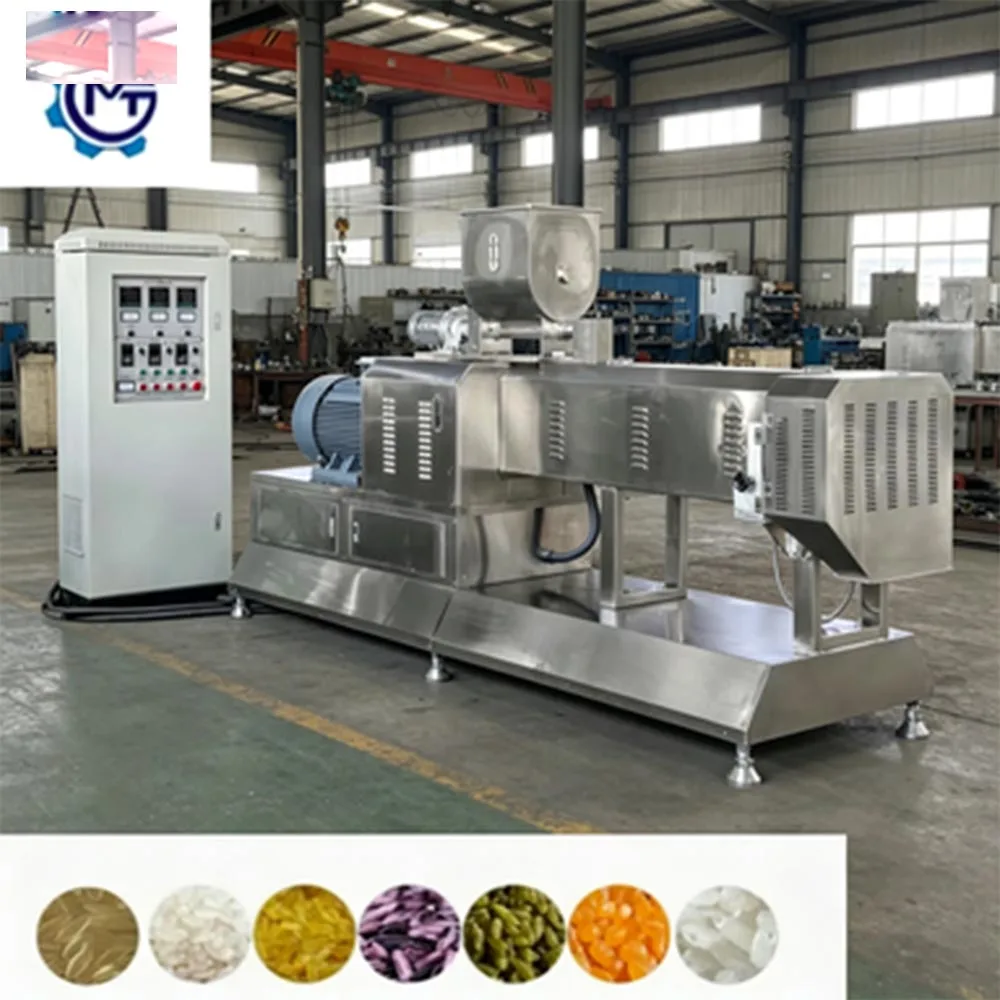
| Screw Type | Twin screw |
| Control System | PLC automatic control |
| Material Contact Parts | Food grade 304 stainless steel |
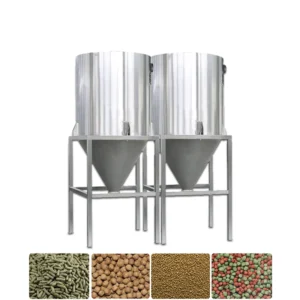
| Pellet Adjustability | Size, hardness, buoyancy (floating and sinking) |
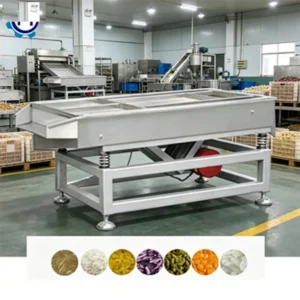
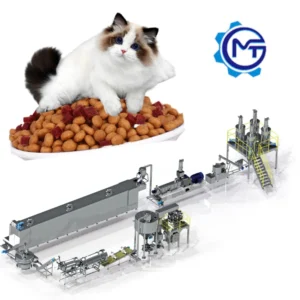
| Line Stations | Raw material mixer, extruder, dryer, seasoning coating machine, vibrating sieve, conveyor equipment |
| Output Capacity | Medium to large scale continuous production (basis to be confirmed) |
| Operation | Full continuous automatic production from mixing to finished product discharging |
| Assembly State | Complete matched production line configuration |
Application Suitability
| Application | Material or Output |
|---|---|
| Floating aquaculture feed for koi and goldfish | Fish meal, corn powder, soybean meal with compound additives |
| Sinking pellets for bottom-feeding freshwater fish | High-starch formulations requiring controlled gelatinisation |
| Tropical fish feed with precise buoyancy targets | Blended protein and carbohydrate raw materials |
| Commercial fish feed mass production | Continuous processing of compound aquatic feed formulations |
Why Buoyancy Fails Before the Extruder Even Starts
Matching screw geometry and die pressure to your exact raw material is the only way to hold pellet density within specification.
I once watched a line run perfectly on a standard fish meal formulation during factory testing, only for the buyer to substitute soybean residue as a bulk filler on arrival. The screw shear force and barrel temperature profile that produced perfect floating pellets on the original recipe generated dense, sinking pellets on the new one — and it took weeks of reconfiguration to recover. That is the gap between a generic build and a line engineered around your actual formulation [NEED_CITE: raw material variability in aquatic feed extrusion]. Twin Screw Fish Feed Extruder extrusion technology addresses this by treating screw configuration, die design, and moisture control as variables that must be locked to your material before production begins, not adjusted blindly on the factory floor.
Starch Gelatinisation Under Controlled Shear and Heat
Twin Screw Fish Feed Extruder extrusion technology subjects raw material to high-temperature, high-pressure conditions inside the barrel where starch granules rupture and gelatinise fully. The degree of gelatinisation directly determines how much the pellet expands at the die face, which in turn sets whether the pellet floats or sinks. Barrel sections are individually heated and monitored through the PLC, allowing the operator to build a temperature gradient that matches the starch content and moisture level of the specific formulation being run.
Die Geometry and Expansion Ratio
The die plate is the final gate before the pellet takes its shape, and its orifice diameter, land length, and pattern layout govern the expansion ratio as superheated moisture flashes off. A die specified for floating feed will have different land lengths and open-area ratios than one specified for sinking pellets. Screw configuration and die design are therefore paired as a set — changing one without the other shifts the density outcome unpredictably [NEED_CITE: die land length and pellet expansion in twin screw extrusion]. This pairing is documented before shipment so replacements can be ordered with confidence.
Reading the Specs That Actually Matter
The twin-screw configuration provides a self-wiping action that handles high-fat and high-protein formulations without material buildup, something single-screw designs struggle with when fish meal ratios climb. Food-grade 304 stainless steel contact parts prevent corrosion from salt-laden aquatic feed formulations and meet international food hygiene standards for export markets. PLC automatic control manages barrel temperature profile, screw speed, and feed rate simultaneously — parameters that, if adjusted independently by an operator on a manual panel, introduce batch-to-batch density variation. The complete matched line configuration means dryer capacity and seasoning drum throughput are sized to the extruder output, eliminating the bottleneck that occurs when stations are assembled from separate vendors.
The Cost of Skipping Raw Material Verification
When screw configuration is copied from a generic build rather than matched to the buyer’s formulation, the first symptom is usually density drift — floating pellets that sink after a few minutes, or sinking pellets that are too light for the target species. The second symptom is die blockage from ungelatinised starch buildup, forcing unplanned downtime for cleaning. The third is a coating drum that cannot keep pace because the extruder output varies with each batch [NEED_CITE: downstream throughput mismatch in extrusion lines]. These problems compound: the buyer loses market trust on pellet quality while simultaneously absorbing higher maintenance costs on a line that was never validated on their material.
What This Line Delivers Beyond the Machine
Every station from raw material mixer through vibrating sieve is sourced and matched under one supplier, so throughput calculations confirm capacity at each point rather than assuming compatibility. Screw configuration and die design are specified against the buyer’s raw material and target pellet buoyancy, recorded in a configuration document for future reference. An in-house testing workshop runs the buyer’s actual raw material before shipment, generating a trial run report that locks parameters before the line leaves the factory. Pre-sales consultation covers line layout, utility planning, and electrical schematic confirmation so that voltage, frequency, and control language match the installation site from day one.
Documentation & Verification
- Line layout and capacity calculation confirming matched throughput across every station
- Screw and die configuration record tied to your specific raw material formulation
- Trial run report on your raw material processed in the testing workshop before dispatch
- Electrical schematic and voltage confirmation aligned to your facility power supply
- CE declaration of conformity and ISO certificate included with shipment
- Operation and maintenance manual with wear parts list and replacement intervals
Installation, Commissioning & Support
- Foundation and floor space planning based on the complete matched line footprint and conveyor routing
- Dedicated power circuit sizing confirmed against PLC automatic control and extruder motor load requirements
- Assembly from sectional shipping state with alignment checks on twin-screw barrel and die plate
- First-run parameter setting using trial run report data to reproduce workshop results on site
- Operator training covering PLC interface navigation, barrel temperature zone adjustment, and die changeover procedure
- Wear parts list covering screws, dies, and cutter bearings with recommended stock levels for first replacement cycle
Before You Request a Quote
To configure a line that holds density on your formulation, we need your raw material recipe including protein, starch, and fat percentages, the target pellet diameter and whether it must float or sink, and your daily output requirement. Share your facility voltage and frequency, available floor space with ceiling height, and whether you need the control interface in a specific language. If you can send a sample of your actual raw material, we will run it in the testing workshop and return a trial run report with locked parameters before any commercial commitment.
Frequently Asked Questions
Q: How is screw configuration and die design matched to my raw material for correct pellet buoyancy?
A: We review your formulation’s starch, protein, and fat content, then select screw element arrangement, compression ratio, and die orifice geometry as a matched set. A trial run on your actual raw material in our testing workshop confirms the configuration produces the target buoyancy before the line ships.
Q: What barrel temperature profile and moisture control are used for floating versus sinking feed?
A: Floating pellets require higher barrel temperatures and controlled moisture to maximise starch expansion at the die face. Sinking pellets run at lower temperatures with higher moisture to limit expansion. The PLC manages each barrel zone independently so the profile can be saved and recalled per formulation.
Q: How is extruder throughput matched to dryer and coating capacity to avoid line bottlenecks?
A: We calculate mass flow at every station — mixer output, extruder throughput, dryer residence time, and coating drum capacity — during line layout design. Each station is sized so that no single point restricts the continuous production rate of the Twin Screw Fish Feed Extruder extrusion technology line.
Q: Can I run a trial on my raw material before shipment to verify pellet density and expansion?
A: Yes. Send a representative sample of your raw material to our testing workshop. We extrude it on a twin-screw unit configured to your target pellet specification, measure density and expansion, and provide a trial run report documenting all parameters before the production line leaves the factory.