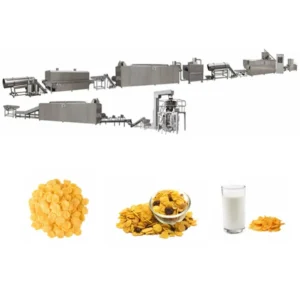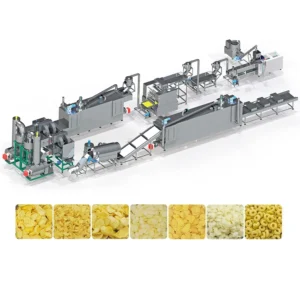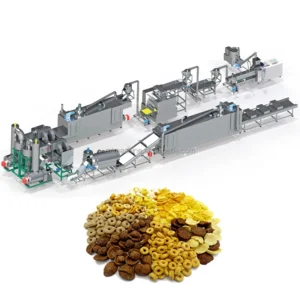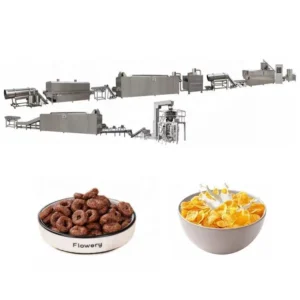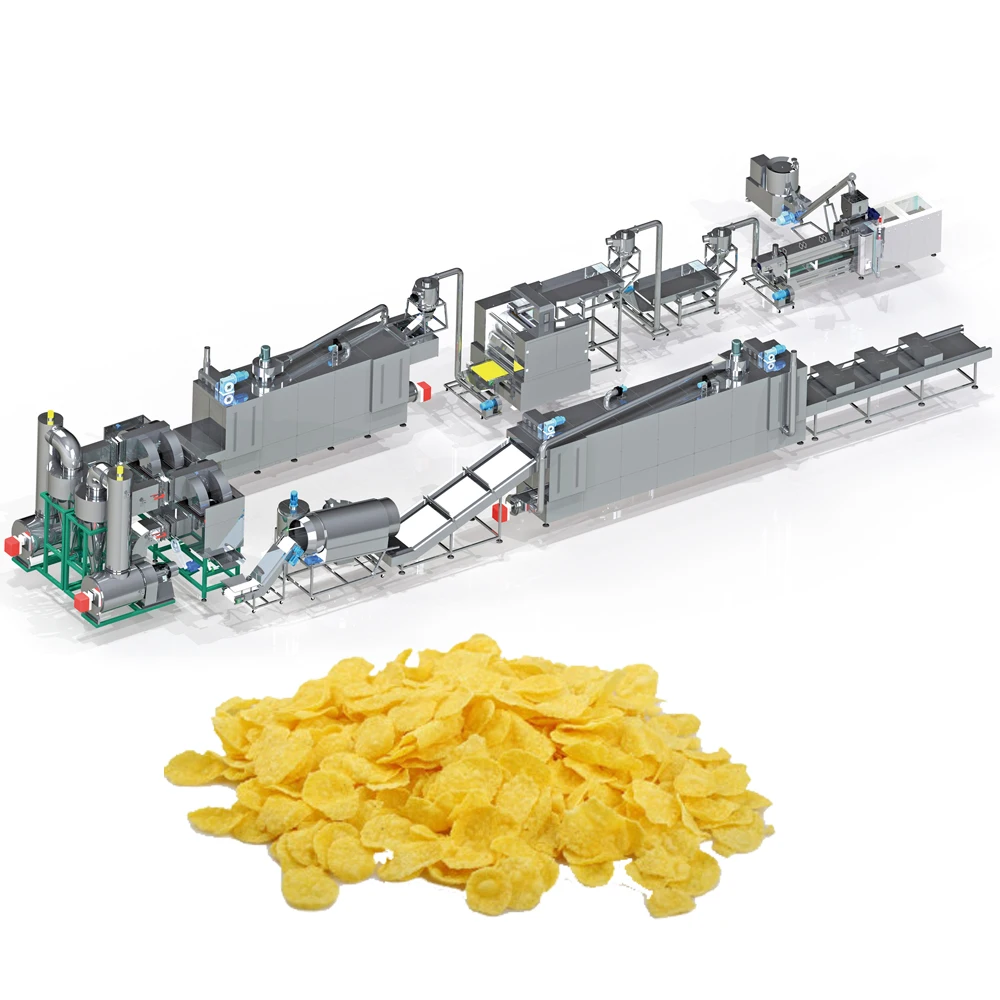
Screw Geometry Dialed to Your Formula — we configure the screw profile and die plate to your corn blend moisture and target flake density, not a catalog default.
Technical Specifications
| Parameter | Value |
|---|---|
| Model | MT75 |
| Product Type | Twin Screw Extruder for Corn Flakes Production Line |
| Screw Configuration | Twin-screw, wear-resistant alloy |
| Installed Power | 210 kW |
| Power Consumption | 150 kW |
| Output Capacity | 300–500 kg/h (basis not stated in source — confirm raw material, moisture and flake thickness) |
| Overall Dimensions | 45 × 1.5 × 3.5 m |
| Flaking Station | Hydraulic double-roller, PLC controlled, dual motor drive, infrared temperature sensor |
| Dryer Heating Source | Gas or electric |
| Roasting Oven | Hot air circulation, conciliation burner, dual fans, cyclone dust removal |
| Coating System | Double tumble sugar melting, elevator, coating drum, spray nozzle |
| Lubrication | Automatic with cooling function |
| Control System | PLC flaking control, MCC line management |
| Basic Raw Materials | Corn, rice, wheat, oat, barley powder |
| Shape Range | Ball, tube, stick, ring, fruit loop, star, wheel, flower, heart |
| Assembly State | Complete line from mixing to packing |
| Certification | CE, ISO |
Application Suitability
| Application | Material or Output |
|---|---|
| Natural corn flakes | Corn grits and corn flour blends |
| Sugar-coated corn flakes | Corn base with sugar syrup coating |
| Fortified breakfast cereals | Wheat, oat, barley, rice blends |
| Multi-shape cereal formats | Same extruder platform with die changes |
| Puffed snack variants | Cereal-based formulations on shared line |
Why Nominal Capacity Figures Mislead Cereal Buyers
An extruder rated at 300–500 kg/h on paper often delivers less on your specific corn blend because throughput depends on moisture content, starch composition and flake thickness — not just motor size.
I have watched lines stall at half their quoted output because the screw pitch was set for a generic corn meal while the buyer was running a higher-fat, coarser grit. The barrel fills unevenly, residence time drops and gelatinisation falls short. The corn flakes extrusion technology twin screw platform only reaches its nameplate capacity when the screw elements, barrel zones and die land length are matched to what is actually going into the hopper [NEED_CITE: twin-screw extrusion throughput dependency on raw material characteristics].
Barrel Zone Profiling and Starch Gelatinisation
Corn starch gelatinises between specific temperature thresholds, and each barrel zone must hold that window within tight limits. On the MT75, the barrel temperature profile is segmented so that the feed zone stays cool enough to prevent premature swelling while the compression and metering zones build the shear and heat needed for full gelatinisation. Getting this gradient wrong leaves hard, unexpanded cores inside the pellet that crack unpredictably when the flaking rollers press them flat.
Die Land Length and Pellet Density
The die plate is where the cooked dough meets its final restriction before exiting. A longer die land increases back-pressure, producing a denser pellet that flakes into a thicker, crunchier corn flake with longer bowl life. Shorter die lands give a lighter, more open structure. The corn flakes extrusion technology twin screw setup allows die swaps to dial in the exact density your market expects, whether that is a thick traditional flake or a thin, crisp variant.
Flaking Station Integration
The hydraulic double-roller flaking station runs under PLC control with infrared temperature monitoring on the roller surfaces. If the rollers run too cold, the extruded pellet shatters instead of pressing into a clean flake. If they run too hot, surface starch smears and the flake sticks. Dual independent motors on each roller allow gap and speed adjustment matched to the extruder output rate, keeping flake thickness consistent across the full production run [NEED_CITE: hydraulic flaking roller temperature control in cereal processing].
Reading the Specs That Actually Matter
Installed power at 210 kW tells you the motor can handle high-shear configurations needed for coarse corn grits, but actual consumption at 150 kW reflects typical running load. The overall line footprint at 45 metres long covers every station from mixing through packing, which matters for factory layout planning. The hydraulic flaking station with PLC control means roller gap adjustments hold their setpoint across shifts rather than drifting with manual overrides. Automatic lubrication with cooling keeps screw shaft bearings within temperature limits during long runs, reducing unplanned stops. Shape changes — from flakes to rings, balls or fruit loops — require only a die plate swap and screw element rearrangement, not a different machine.
What Happens When Extrusion Is Not Matched to Your Formula
I have seen producers install a line configured for standard corn meal, then feed it a blend with added oat fibre for a health-positioned cereal. The fibre absorbs water differently, the dough viscosity shifts and the pellets exit the die at inconsistent density. Downstream, the flaking rollers crush some pellets flat while others crumble, producing a mix of whole flakes and dust that fails packaging weight checks. The roasting oven then toasts unevenly because thin fragments burn while thick pieces stay pale [NEED_CITE: raw material variability impact on extruded cereal consistency].
Why Source From This Line Builder
Every station on this corn flakes line — extruder, dryer, flaking rolls, roasting oven, coating drum — is specified together so throughput matches across the chain rather than bottlenecking at one point. The screw configuration and die design are set to the buyer’s actual raw material, not carried over from a previous project. An in-house testing workshop runs trial batches on customer-supplied corn blends before shipment, so expansion behaviour and flake density are confirmed while adjustments are still cheap. The MT75 platform covers natural flakes, sugar-coated variants and multi-shape cereals on one extruder base, reducing capital outlay for producers running multiple SKUs.
Documentation & Verification
- Line layout drawing with station-by-station capacity calculation for your corn blend
- Screw element arrangement and die configuration record matched to your formula
- Trial run report on your raw material from the in-house testing workshop
- Electrical schematic with confirmed voltage, frequency and control language
- Factory acceptance test record before crating and dispatch
Installation, Commissioning & Support
- Foundation plan based on the 45-metre line footprint and station weights
- Dedicated power circuit sized for 210 kW installed load plus dryer and roaster draw
- MCC and PLC panels pre-wired and labelled to confirmed voltage and frequency
- Roller gap and barrel zone calibration during on-site commissioning
- Operator training covering screw configuration changes and die swaps
- Wear parts list with screw elements, die plates and flaking roller sleeves
What We Need to Configure Your Line
Send your actual corn blend composition, moisture content at the mixer and the flake thickness your packaging line expects. Confirm your local voltage and frequency, control panel language preference and available factory floor length and ceiling height. If you are running an existing dryer or roaster upstream or downstream, share its capacity so the extruder output can be matched.
Frequently Asked Questions
Q: How is screw configuration and die design determined for my specific cereal formulation and target flake density?
A: We start with your raw material sample and run it through the testing workshop on the MT75. The screw element sequence — feed pitch, kneading block angle, metering length — is adjusted until pellet density and expansion match your target. The die land length is then selected to set final back-pressure and flake thickness.
Q: Can a trial run be done on my raw material before shipment to confirm expansion and texture?
A: Yes. The in-house testing workshop runs your actual corn blend through the extruder and flaking station. You receive a trial run report showing pellet expansion ratio, flake thickness measurements and roasting colour before the line ships, so formulation tweaks happen at our facility, not yours.
Q: How are extruder throughput, dryer capacity and roasting oven matched to avoid bottlenecks in the line?
A: Each station is calculated against the extruder output at your specific moisture level and flake thickness. The dryer residence time, roasting oven airflow and coating drum volume are all sized to handle peak extruder output without queuing product between stations or starving downstream equipment.
Q: What barrel temperature profile and moisture range are needed for proper starch gelatinisation in corn flakes?
A: Corn starch requires specific moisture and temperature thresholds to fully gelatinise. The barrel zones are set in a gradient from cool feed to hot metering, and preconditioner moisture is adjusted based on your corn blend absorption rate. The trial run confirms the exact profile before production settings are locked.