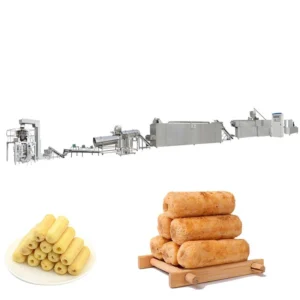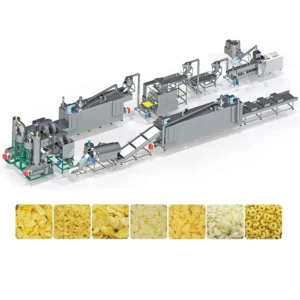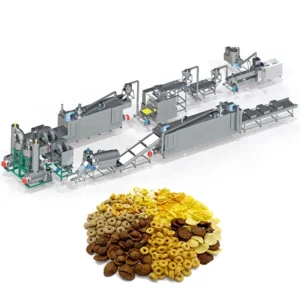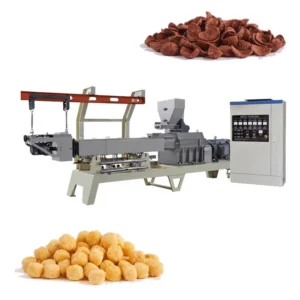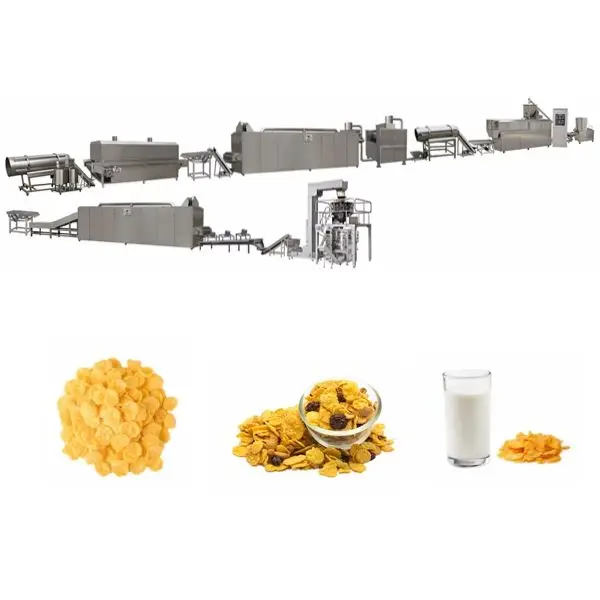
Screw Configuration Matched to Your Raw Material — Every extrusion build starts with testing your exact corn, rice, or multi-grain blend in the workshop to lock in the screw profile and die geometry before steel is cut.
Technical Specifications
| Parameter | Value |
|---|---|
| Product Type | Corn Flake Production Line (Twin-Screw Extrusion) |
| Model | MT75 |
| Screw Type | Twin Screw |
| Installed Power | 210 kW |
| Power Consumption | 150 kW |
| Output Capacity (MT75) | 300–500 kg/hr (basis not stated in source — confirm raw material, moisture content, and target flake density) |
| Output Capacity (MT70) | 150–200 kg/hr (basis not stated in source — confirm raw material and product format) |
| Output Capacity (MT85) | 300–400 kg/hr (basis not stated in source — confirm raw material and product format) |
| Overall Dimensions (MT75) | 45 × 1.5 × 3.5 m |
| Control System | PLC and MCC |
| Flaking Station | PLC-controlled hydraulic double-roller system with dual motor drive and infrared sensor temperature control |
| Heating Source (Dryer) | Gas or Electric |
| Roasting Oven | Hot air roasting with conciliation burner, dual circulating fans, cyclone dust removal |
| Coating System | Double tumble sugar melter, elevator, coating drum, spraying nozzle |
| Natural Line Process Flow | Mixing → Extruding → Flaking → Drying → Hot Air Roasting → Cooling → Packing |
| Sugar-Coated Line Process Flow | Mixing → Extruding → Flaking → Drying → Hot Air Roasting → Sugar Spraying → Sugar Coating → Drying → Cooling → Packing |
| Raw Materials | Corn, rice, wheat, oat, barley powder |
| Final Products | Natural corn flakes, sugar-coated corn flakes, shaped breakfast cereals (ball, tube, stick, ring, fruit loop, star, wheel, flower, heart) |
| Assembly State | Complete turnkey line from mixing through packing |
| Voltage & Frequency | Configurable to target market standard (basis to be confirmed) |
| Certification | CE, ISO |
Application Suitability
| Application | Material or Output |
|---|---|
| Natural corn flake manufacturing | Corn grits and corn flour blends for retail breakfast cereal |
| Sugar-coated corn flake production | Corn base with sugar spray and tumble coating for sweetened cereal lines |
| Multi-grain breakfast cereal | Rice, wheat, oat, and barley powder formulations |
| Shaped cereal formats | Ball, ring, fruit loop, star, wheel, and other die-cut geometries from the same extrusion platform |
| Fortified breakfast cereal | Vitamin and mineral premix incorporated during batching for nutrition programme supply |
What the Capacity Number Hides on Corn Flake Lines
Extruder throughput means nothing when the flaker and roaster cannot keep pace.
I worked on a corn flake project where the buyer ordered a line based on a catalogue output figure. Their corn grits were coarser than the standard test material. The twin-screw extruder ran fine, but starch gelatinisation was incomplete, the flaking rolls could not compress the pellet properly, and the roasting oven produced pale, soft flakes with no bowl-life crispness [NEED_CITE: starch gelatinisation requirements for corn flake extrusion]. The rated capacity on paper never materialised on the factory floor because the screw configuration and barrel temperature profile were set for a different raw material. That is why corn flake production line extrusion technology decisions must begin with the actual grain you will run, not a generic specification sheet.
Barrel Temperature Zones and Starch Gelatinisation
Corn flake quality starts inside the barrel. The twin-screw extruder uses multiple independent heating zones along the barrel length, each set to a specific temperature that matches the starch gelatinisation curve of the grain blend being processed. Corn requires a different thermal profile than oat or barley, and even small deviations in moisture content shift the gelatinisation window. The PLC control system logs barrel temperature at every zone continuously, giving the process engineer real-time data to adjust when raw material batches vary.
Screw Configuration as the Real Product Variable
The screw elements — conveying sections, kneading blocks, and reverse-flight segments — determine residence time, shear intensity, and the degree of mechanical energy input the material receives. A high-shear configuration works for fine corn flour but will over-fragment coarse grits, producing pellets that shatter instead of flaking cleanly. Every corn flake production line extrusion technology build we ship carries a screw and die configuration record matched to the buyer’s raw material formulation and target flake density, not a generic arrangement copied from a previous project.
Reading the Specs Beyond the Nameplate
The MT75 draws 210 kW installed power and runs at approximately 150 kW under load, which tells a process engineer two things: the main drive motor has headroom for viscous doughs, and the actual energy cost per kilogram of output depends on how efficiently the line is balanced. The overall line length of 45 metres includes every station from batching to packing, which matters for factory floor planning and utility routing. The PLC-controlled flaking station uses a hydraulic double-roller system with infrared temperature monitoring — this is the point where extruded pellets are compressed into thin sheets, and roller pressure and gap tolerance directly control final flake thickness. Too thick, and the roaster cannot penetrate the centre; too thin, and flakes break during conveying [NEED_CITE: flake thickness and bowl-life crispness correlation in breakfast cereal manufacturing]. The hot air roasting oven uses dual circulating fans and a cyclone dust removal system, which maintains even heat distribution across the bed depth and removes fines before they scorch.
The Hidden Cost of Skipping the Trial Run
When a line ships without a prior trial on the buyer’s actual raw material, the real product development begins after installation — on the buyer’s factory floor, with the buyer’s time and material budget. Screws that work on standard corn grits may produce dense, under-expanded pellets on a high-fibre multi-grain blend. The flaker rolls then compress unevenly, and the roaster produces inconsistent blistering. Every station downstream inherits the problem. The result is weeks of parameter adjustment, wasted raw material, and delayed market launch [NEED_CITE: production line commissioning delays caused by unverified extrusion parameters].
Why Source This Line From a Single Supplier
The extruder, flaker, dryer, roaster, and coater are engineered together so throughput is matched at every station — no bottleneck where one machine idles waiting for the next. Screw configuration and die design are specified against your raw material blend and the flake density your market expects, not copied from a generic template. The in-house testing workshop runs your actual corn, rice, or multi-grain formulation before shipment, producing a trial run report that documents achievable output, flake geometry, and required parameter settings. The same PLC architecture that controls the extruder barrel zones also manages the hydraulic flaking rollers and the roasting oven temperature, giving one unified control language across the entire 45-metre line. Pre-sales consultation covers line layout, utility requirements, and phased installation scheduling, so foundation work and electrical provision are ready when the equipment arrives.
Documentation & Verification
- Screw and die configuration record matched to your grain blend and target flake density
- Trial run report on your raw material documenting output, pellet expansion, and flake thickness
- Line layout drawing with throughput calculations for every station from mixer to packer
- Electrical schematic with voltage and frequency confirmed for your installation site
- Factory test record with PLC parameter logs captured during pre-shipment run
- Operation and maintenance manual covering screw changeover and flaker roller adjustment
Installation, Commissioning & Support
- Foundation plan based on the 45 × 1.5 × 3.5 m footprint with anchoring points for extruder and flaker
- Dedicated electrical circuit sized for 210 kW installed load with voltage and frequency matched to local supply
- Equipment ships in modular sections for container transport and on-site assembly along the line length
- First-run commissioning includes barrel zone temperature calibration and flaker roller gap setting
- Operator training covers screw element changeover and PLC recipe storage for different grain formulations
- Wear parts list with reorder specifications for screws, die inserts, and flaker roller surfaces
What We Need to Build Your Line Accurately
Send us the specific grain or multi-grain blend you intend to run, including particle size distribution and typical moisture content. Let us know the target flake format — natural, sugar-coated, or shaped — and the daily output you need to justify the investment. Confirm the voltage, frequency, and control language at your installation site so electrical panels and PLC interfaces are configured before dispatch. If you have existing upstream batching or downstream packing equipment, share the interface details so the line connects without gaps.
Frequently Asked Questions
Q: How is screw configuration determined for a specific corn or multi-grain formulation?
A: We start by reviewing your raw material specification — grain type, particle size, moisture content, and any premix additions. Based on that, we select the combination of conveying elements, kneading blocks, and die geometry that delivers the residence time and shear profile needed for complete starch gelatinisation without over-fragmenting the grain. The configuration is tested on your material in our workshop before the line ships.
Q: What barrel temperature and moisture levels are needed for proper flake expansion?
A: The barrel is divided into multiple independently controlled heating zones. The target temperature profile depends on your grain blend — corn typically requires higher barrel temperatures than oat or barley. Moisture is introduced at the mixing stage and sometimes injected into the barrel. Our trial run on your raw material establishes the exact temperature setpoints and moisture percentage that produce the pellet expansion your flaker and roaster need.
Q: Can a trial run be conducted on our raw material before shipment?
A: Yes. We run your actual grain formulation through the extruder in our testing workshop. The trial run report documents the screw configuration used, barrel temperature settings, pellet expansion ratio, and resulting flake thickness and texture after flaking and roasting. This report ships with the machine so your team can replicate the results during commissioning.
Q: How is throughput balanced between extruder, flaker, dryer, and roaster?
A: Each station is sized so its maximum processing rate matches or slightly exceeds the extruder output at your target recipe. The flaker roller width, dryer belt length, and roasting oven bed area are all calculated from the same throughput figure. This prevents situations where one station runs at partial load while another creates a bottleneck upstream or downstream.
Q: What adjustments are needed when switching between natural and sugar-coated corn flakes?
A: The extrusion and flaking stages typically run the same screw configuration and roller settings for both variants. The difference comes after roasting: sugar-coated flakes pass through the sugar spraying and coating drum stations, then enter a secondary drying stage to set the coating. The PLC stores separate recipes for each variant, so changeover involves selecting the correct program and activating or bypassing the coating stations.