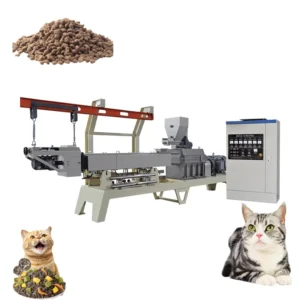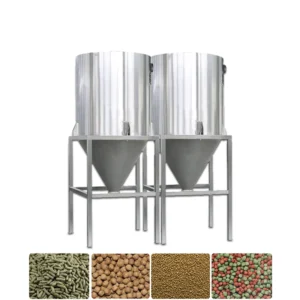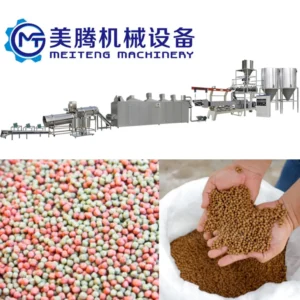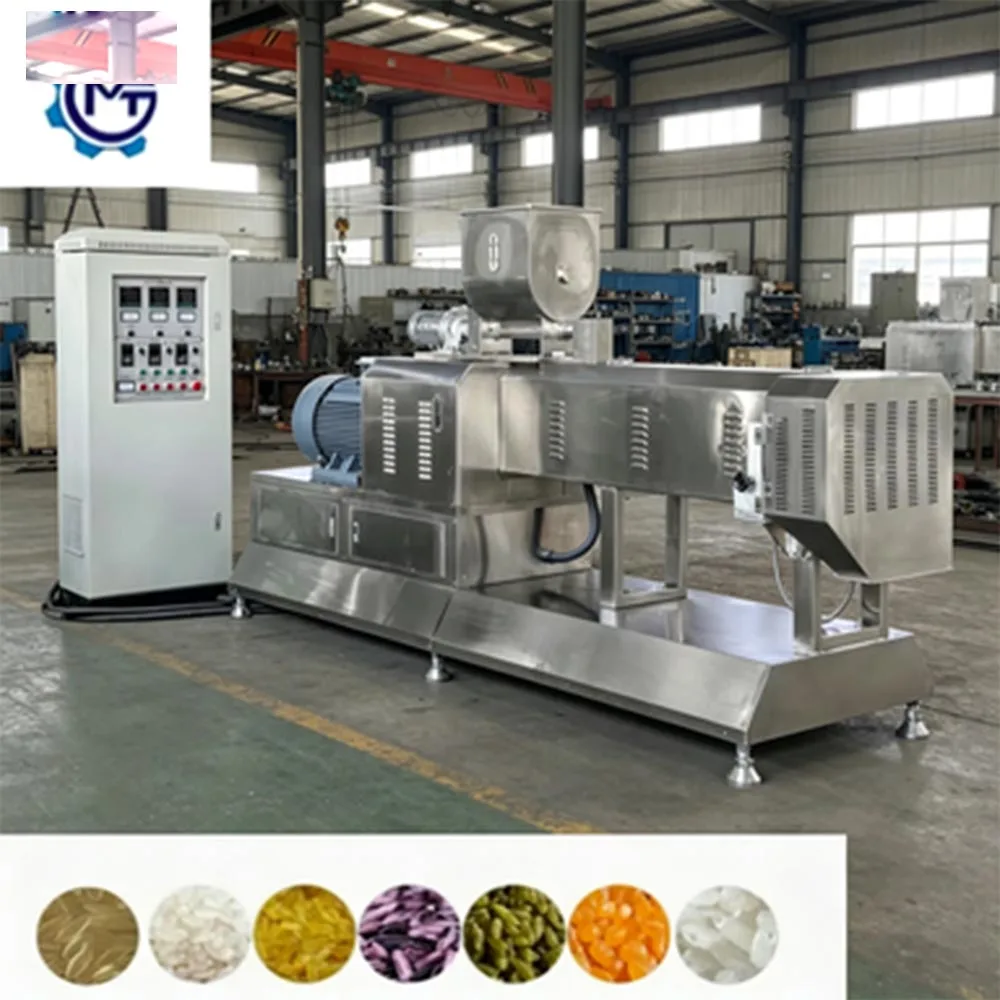
Process-Matched Extrusion Design — Twin-screw configuration and die geometry are specified to the buyer’s aquatic feed formulation rather than copied from a standard build, ensuring pellet density and buoyancy match market requirements from the first production run.
Technical Specifications
| Parameter | Value |
|---|---|
| Product Type | Twin Screw Aquatic Feed Extrusion Line |
| Screw Type | Twin-screw |
| Control System | Intelligent PLC automatic control system |
| Line Stations | Raw material mixer, extruder, dryer, seasoning coating machine, vibrating sieve, conveyor equipment |
| Material Contact Parts | Food-grade 304 stainless steel |
| Pellet Adjustability | Pellet size, hardness, buoyancy (floating and sinking) |
| Production Mode | Full continuous automatic production |
| Assembly State | Complete matched production configuration |
| Output Capacity | Large stable processing capacity (basis to be confirmed — dependent on raw material formulation, moisture content, and pellet size) |
| Certification | CE (manufacturer certified since 2014); ISO certified |
Application Suitability
| Application | Material or Output |
|---|---|
| Floating catfish and tilapia feed | Fish meal, soybean meal, corn powder, compound additives — extruded for low-density buoyant pellets |
| Sinking shrimp and bottom-feeder pellets | High-protein formulations requiring minimal expansion and controlled density |
| Ornamental fish feed (koi, goldfish, tropical species) | Precision-sized pellets with tight buoyancy specifications and consistent surface finish |
| Transition from single-screw lines | Broader raw material flexibility with improved starch gelatinisation and density control |
Why Pellet Buoyancy Fails When the Raw Material Changes
Floating feed that sinks, or sinking pellets that drift to the surface — the root cause almost always traces back to extrusion screw configuration and barrel temperature profile, not the downstream dryer. Specifying the screw and die set to your actual formulation is the only reliable way to hold buoyancy within tolerance.
I learned this the hard way on a Southeast Asian project years back. We ran trial shots on a standard catfish formula and everything checked out. The customer’s actual fish meal ran several points higher in protein than our test batch. On-site, every pellet floated. The screw elements and die plate had to be reconfigured from scratch before the line could produce the sinking pellets the local market demanded. That experience shaped how I approach every aquatic feed project since: no formulation in hand, no configuration finalized. [NEED_CITE: starch gelatinisation behaviour at varying protein and moisture levels in twin-screw extrusion]
Starch Gelatinisation Under Controlled Shear and Heat
Aquatic feed pellets depend on thorough starch gelatinisation to bind the formulation and set the final pellet structure. The twin-screw extrusion process generates shear and heat across multiple barrel zones, each independently managed. This level of control lets the operator match the thermal profile to the specific starch source — whether corn, wheat, or cassava — rather than forcing a single temperature setting across every formulation. Proper gelatinisation directly influences water stability, which determines how long the pellet holds together after entering the pond or tank.
Die Geometry and the Floating Versus Sinking Decision
The die plate is where pellet diameter, length, and expansion ratio converge. For floating pellets, the die orifice and land length are designed to allow maximum expansion as the extrudate exits under pressure. For sinking variants, the same twin-screw extruder can run a different die configuration that restricts expansion, producing a denser pellet. This changeover is a matter of swapping die plates and adjusting screw speed and moisture input — not replacing the extruder. The PLC control system stores recipes so operators can switch between floating and sinking runs without manual guesswork.
Reading the Specs That Actually Matter for Aquatic Feed
The distinction between single-screw and twin-screw extrusion becomes critical when formulations include high-protein or high-fat ingredients. Single-screw designs struggle with sticky or variable raw materials because they rely on friction between the material and barrel wall for conveyance. A twin-screw setup provides positive displacement, handling formulations with fish meal, soybean meal, and compound additives without surging or blockage. The food-grade 304 stainless steel contact parts resist corrosion from salt-laden aquatic formulations and withstand the cleaning cycles required between production runs. The intelligent PLC system monitors barrel zone temperatures, screw speed, and feeder rates simultaneously, holding conditions steady across a multi-hour run so that pellet density in the last bag matches the first. Moisture content at the preconditioner and barrel steam or water injection points must be tracked closely — even small deviations shift the expansion ratio and alter buoyancy. [NEED_CITE: twin-screw positive displacement advantages in high-protein extrusion applications]
When a Generic Screw Build Costs You a Production Week
A line assembled with off-the-shelf screw elements and a standard die plate will run your test formulation adequately. It will not necessarily run your actual production formula. The consequence is not a minor inconvenience — it is days of trial and error on the factory floor, burning raw material, producing unsaleable product, and missing delivery commitments to feed distributors. In some cases, the extruder barrel and screws must be shipped back to the manufacturer for reconfiguration while the entire downstream line sits idle. I have watched aquaculture producers lose contracts because their pellet density was outside the range their buyers specified, and the extruder supplier had no record of which screw combination was installed. [NEED_CITE: cost of unplanned line downtime in feed manufacturing operations]
Why This Line Is Configured Around Your Formulation
The screw configuration and die design are specified against your raw material data sheet and target pellet specification before production begins — not selected from a catalogue. The in-house testing workshop runs your actual formulation through the extruder before shipment, generating a written trial report that documents buoyancy, density, and surface quality. Throughput across every station — mixer, extruder, dryer, seasoning drum, vibrating sieve — is calculated as a matched set so that no single unit bottlenecks the line. Electrical schematics and voltage specifications are confirmed against your facility’s power supply before the control cabinet is wired. The complete production configuration ships as one coordinated package rather than a collection of separately sourced machines that must be reconciled during installation.
Documentation & Verification
- Line layout and capacity calculation showing matched throughput from mixer through packing station
- Screw and die configuration record tied to your raw material formulation and target pellet density
- Trial run report documenting buoyancy, expansion ratio, and surface quality on your actual formulation
- Electrical schematic and voltage confirmation aligned to your facility supply before cabinet wiring
- CE declaration of conformity and ISO certificate included with shipment documentation
- Operation and maintenance manual with wear parts list and replacement intervals
Installation, Commissioning & Support
- Foundation and floor space planning based on the matched line layout from mixer through packing
- Power supply verification for the PLC cabinet and each motor station before energising
- Assembled extruder barrel and screw set aligned and verified on-site during commissioning
- First-run parameter logging — barrel temperatures, screw speed, moisture — to establish baseline recipes
- Operator training on floating and sinking pellet changeover procedures using the PLC recipe system
- Wear parts inventory — screw elements, die plates, seals — sized to the first replacement cycle
What We Need to Configure Your Line
Provide your raw material formulation including protein, fat, and starch percentages along with moisture content at the mixer output. Specify the target pellet diameter, buoyancy requirement, and whether you need both floating and sinking production from the same line. Share your facility voltage, frequency, and available floor space so the line layout and electrical design can be finalised before production.
Frequently Asked Questions
Q: How does screw configuration affect floating versus sinking pellet density, and how is it specified to my raw material?
A: Screw element arrangement controls shear intensity and residence time inside the barrel, which determines how fully starch gelatinises and how much the extrudate expands at the die. For floating pellets, the configuration allows higher expansion; for sinking pellets, it restricts it. The combination is selected after reviewing your formulation’s protein, starch, and fat content, then validated in a trial run.
Q: What barrel temperature profile and moisture range are needed for full starch gelatinisation in aquatic feed extrusion?
A: The profile varies with the starch source and protein level in your formulation. Corn-based formulations typically require different zone settings than wheat or cassava blends. Moisture at the preconditioner and barrel injection points must be held within a narrow band — too low prevents gelatinisation, too high causes collapse after the die. The PLC system logs these values continuously for repeatability.
Q: Can one twin-screw extruder produce both floating and sinking pellets, or do I need separate lines?
A: A single twin-screw extruder can produce both by changing the die plate, adjusting screw speed, and modifying moisture input. The PLC recipe system stores parameters for each pellet type so changeover is repeatable. The dryer and seasoning station must also be sized to handle the different throughput and moisture profiles of each variant.
Q: What trial run process is available before shipment to confirm pellet buoyancy, density, and surface quality on my formulation?
A: Your raw material is run through the extruder in the in-house testing workshop before the line ships. The trial documents pellet diameter, buoyancy behaviour in water, expansion ratio, and surface texture. A written report accompanies the shipment so you can compare on-site commissioning results against the factory baseline and identify any adjustments needed.