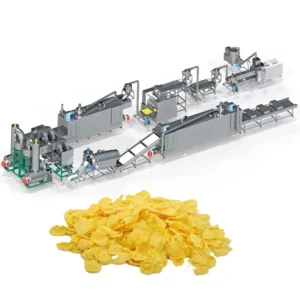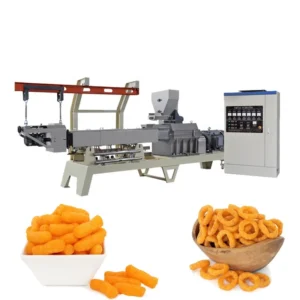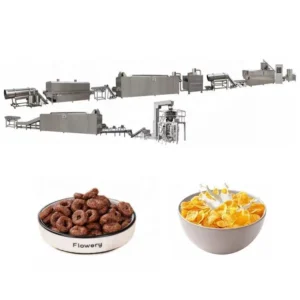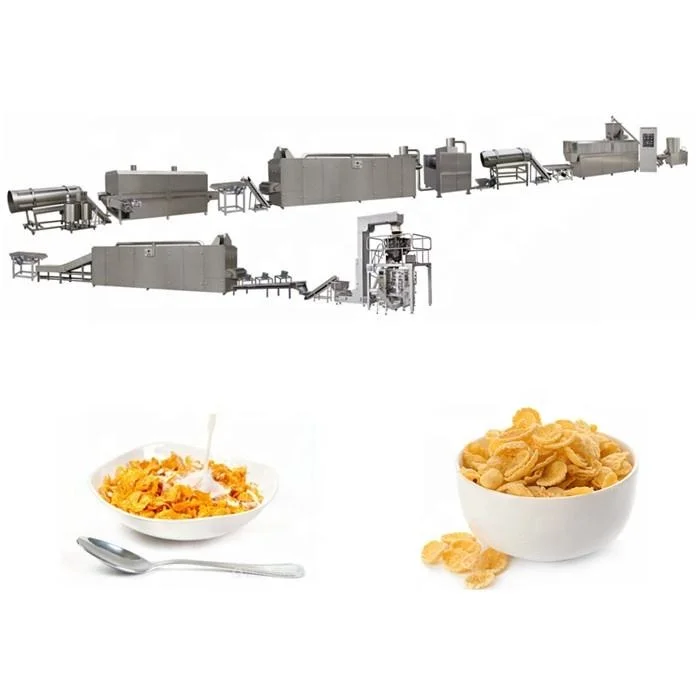
Precision-matched screw and die profiles — Every MT70, MT85, and MT75 corn flakes extrusion line ships only after trial runs on the buyer’s actual grain formulation confirm expansion behavior and flake density.
Technical Specifications
| Parameter | Value |
|---|---|
| Product Type | Breakfast Cereal Corn Flakes Production Line |
| Model Options | MT70 / MT85 / MT75 |
| Extruder Type | Twin Screw |
| Installed Power (MT70) | 160 kW |
| Installed Power (MT85) | 190 kW |
| Installed Power (MT75) | 210 kW |
| Power Consumption (MT70) | 120 kW |
| Power Consumption (MT85) | 140 kW |
| Power Consumption (MT75) | 150 kW |
| Output Capacity (MT70) | 150–200 kg/hr (basis not stated in source — confirm raw material and moisture content) |
| Output Capacity (MT85) | 300–400 kg/hr (basis not stated in source — confirm raw material and moisture content) |
| Output Capacity (MT75) | 300–500 kg/hr (basis not stated in source — confirm raw material and moisture content) |
| Overall Dimensions (MT70) | 41 × 1.5 × 2.2 m |
| Overall Dimensions (MT85) | 43 × 1.5 × 3.2 m |
| Overall Dimensions (MT75) | 45 × 1.5 × 3.5 m |
| Control System | PLC |
| Flaking Machine Drive | Double motors with separate roller driving; hydraulic system |
| Flaking Temperature Control | Infrared sensor |
| Dryer Heating Source | Gas or Electric (configurable) |
| Roasting Oven | Hot air circulating, dual fans, cyclone dust removal, conciliation burner |
| Coating System | Double tumble drum for sugar melting, elevator, coating drum, spraying nozzle |
| Raw Materials | Corn, rice, wheat, oat, barley powder |
| Screw Feature | Automatic lubricating and cooling function |
| Assembly State | Complete turnkey line |
| Standards | CE; ISO certified |
Application Suitability
| Application | Material or Output |
|---|---|
| Natural corn flakes production | Corn grits and corn flour at controlled moisture |
| Sugar-coated breakfast cereals | Corn, rice, or wheat base with sugar spray coating |
| Shaped cereal formats | Rings, balls, fruit loops, stars, wheels from corn or multi-grain blends |
| Fortified breakfast cereals | Wheat, oat, or barley powder with added nutritional premix |
| Multi-grain flake production | Blends of rice, oat, and barley with adjusted screw profile |
Why Nominal Capacity Figures Mislead Breakfast Cereal Buyers
A corn flakes extrusion production line turnkey rated at a fixed hourly output on paper often fails to sustain that throughput once the buyer’s real grain blend enters the barrel.
I spent years on assembly floors before moving into technical sales, and the pattern is predictable. A line runs beautifully during the factory demo on standard corn grits, then the buyer switches to a higher-fiber oat blend and the expansion ratio collapses. The flakes come out dense, the roaster cannot keep up, and the whole corn flakes extrusion production line turnkey sits idle while someone flies in to reconfigure the screw elements. [NEED_CITE: grain formulation variability and extrusion throughput stability]
That is why capacity numbers in the table above carry a note asking buyers to confirm their raw material and moisture content before treating them as firm commitments. Real throughput depends on what you actually feed into the hopper.
Barrel Temperature Profiling and Starch Gelatinisation
The twin-screw extruder in this line uses a segmented barrel with independent heating zones. Corn starch requires a specific temperature ramp to achieve full gelatinisation before the dough exits the die. If the barrel profile is set too low, the starch remains partially raw and the flakes will not blister properly in the roasting oven. The PLC control system allows operators to store and recall temperature profiles for each grain formulation, maintaining batch-to-batch consistency across production runs.
Die Geometry and Flake Thickness Control
The die plate determines the initial shape and thickness of the extruded sheet before it reaches the flaking rollers. For natural corn flakes, a wider die opening paired with slower roller speed produces the thicker, more rigid flakes that hold up in milk. Shaped cereals like rings or fruit loops require a completely different die insert and a downstream cutting or forming station. Every corn flakes extrusion production line turnkey we configure includes a screw and die configuration record matched to the buyer’s target product, so switching between formats is a documented changeover rather than guesswork. [NEED_CITE: die design influence on breakfast cereal texture]
How Power Ratings Translate to Actual Energy Draw
The MT70 carries an installed power of 160 kW but draws around 120 kW during normal operation. The gap between installed and consumed power matters for electrical infrastructure planning. A buyer sizing transformers and dedicated circuits based on peak installed load across every station — extruder, dryer, roaster, coating drum — will overbuild the supply. Conversely, underestimating the simultaneous draw of the hot air roasting oven with its dual circulating fans and the hydraulic flaking machine can trip breakers mid-run and damage the PLC controller.
The Cost of Mismatched Dryer and Coating Stations
When the extruder output exceeds what the downstream dryer can handle, wet flakes accumulate on the belt and stick together before reaching the roaster. The result is uneven moisture, inconsistent blistering, and product that fails the bowl-life test. [NEED_CITE: downstream bottleneck effects in cereal production lines] I have walked into facilities where the previous supplier sized the dryer for a nominal capacity that never materialized on the buyer’s actual oat-heavy recipe, leaving the coating drum underfed and the packing station waiting.
Why Procurement Starts with a Trial Run
A single-supplier line means the extruder, flaker, dryer, roaster, and coating drum are specified as one system rather than assembled from mismatched vendors. Our in-house testing workshop runs each buyer’s real grain formulation — whether that is pure corn grits or a high-fiber oat and barley blend — before the line ships. The trial run report documents actual throughput, expansion ratio, and flake density so the buyer knows what to expect at commissioning. Screw elements and die inserts are selected and recorded based on that trial, not copied from a generic build. Every line carries CE and ISO certification, and electrical schematics confirm voltage and frequency for the destination market before production begins. The PLC control system and MCC panel are built with the buyer’s local language and utility standards in mind, eliminating the commissioning delays that arise when voltage and control language are left unconfirmed. [NEED_CITE: CE machinery directive compliance for food extrusion equipment]
Documentation & Verification
- Line layout and capacity calculation showing matched throughput across extruder, flaker, dryer, and roaster
- Trial run report on buyer’s actual grain formulation conducted before shipment
- Screw and die configuration record specific to target flake thickness and density
- Electrical schematic with confirmed voltage, frequency, and PLC language for destination market
- CE declaration of conformity and ISO certificate included with shipping documents
- Wear parts list covering screws, dies, and flaking rollers with replacement intervals
Installation, Commissioning & Support
- Foundation and floor space planned around line dimensions ranging from 41 to 45 meters in length
- Dedicated electrical circuits sized for 160–210 kW installed power depending on selected model
- Complete turnkey line delivered in modular sections for sequential assembly and alignment
- First-run commissioning includes PLC parameter tuning and barrel temperature profiling on-site
- Operator training covers screw element changeover and die insert swaps for different cereal shapes
- Spare wear parts package includes matched screw elements and hydraulic flaking roller sets
What We Need to Configure Your Line
To prepare an accurate line layout and capacity proposal, share your target product format — natural flakes, sugar-coated, or shaped cereals — along with the specific grain blend and moisture content you plan to run. Let us know your facility’s voltage and frequency standards, preferred PLC control language, and available floor space so the electrical schematic and line dimensions align with your building before production starts.
Frequently Asked Questions
Q: How is line capacity verified on my specific raw material formulation before shipment?
A: We run your exact grain blend in our in-house testing workshop and document the actual throughput, expansion ratio, and flake density in a trial run report. This confirms what the line produces on your material, not on a generic demo recipe. The screw and die configuration is then locked to those results before dispatch.
Q: How do you ensure the dryer and coating drum capacity match the extruder output?
A: Every station in the corn flakes extrusion production line turnkey is specified as one system from a single supplier. We calculate residence time in the dryer and tumbling time in the coating drum against the extruder’s verified output on your material, so no station becomes a bottleneck during continuous production.
Q: What screw configuration is selected for natural flakes versus sugar-coated or shaped cereals?
A: Natural flakes require a screw profile that produces a dense, low-expansion sheet suitable for flaking and roasting. Sugar-coated and shaped cereals need different die inserts and often a modified screw element arrangement to control dough viscosity. Each configuration is recorded and provided to the buyer for future changeovers.
Q: Is voltage, frequency, and PLC control language confirmed before production begins?
A: Yes. We confirm your facility’s electrical standards and preferred control language during the specification stage. The electrical schematic, MCC panel, and PLC interface are built to those requirements, preventing commissioning delays that arise when these details are left until the machine arrives on-site.