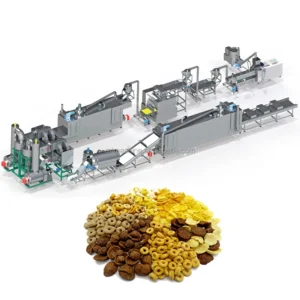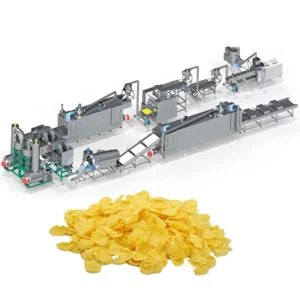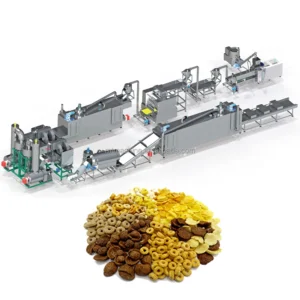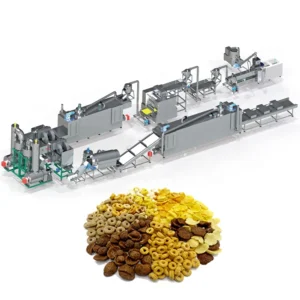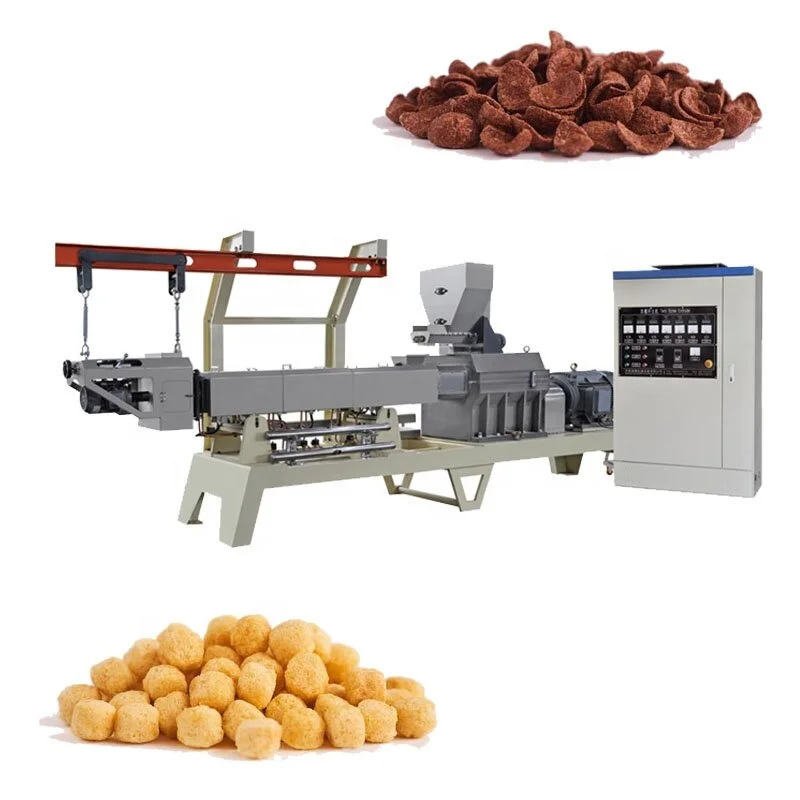
Custom Screw and Die Engineering — every MT70 corn flakes extrusion line ships with screw elements and die geometry matched to the buyer’s actual grain formulation, verified by trial runs before dispatch.
Technical Specifications
| Parameter | Value |
|---|---|
| Model | MT70 |
| Product Type | Corn Flakes Production Line |
| Extruder Configuration | Twin-screw |
| Installed Power | 160 kW |
| Power Consumption | 120 kW |
| Output Capacity | 150–200 kg/h (basis not stated in source — confirm raw material, moisture content, and flake thickness) |
| Overall Dimensions (L×W×H) | 41 × 1.5 × 2.2 m |
| Control System | PLC and MCC |
| Flaking Machine | Hydraulic double-roller, infrared sensor temperature control, double motors for separate roller driving |
| Dryer Heating Source | Gas or Electric |
| Roasting Oven | Vibrating pan, conciliation burner, dual circulating fans, cyclone dust removal |
| Coating System | Double tumble sugar melting, elevator, coating drum, spraying nozzle |
| Screw Feature | Automatic lubricating, cooling function, wear-resistant |
| Certification | CE, ISO |
Application Suitability
| Application | Material or Output |
|---|---|
| Natural corn flakes breakfast cereal | Corn grits, degerminated maize, whole corn flour |
| Sugar-coated corn flakes | Corn, rice, wheat blends with sugar or honey glaze |
| Multi-grain breakfast flakes | Oat, barley, wheat, and rice powder mixtures |
| Shaped puffed cereal formats | Ball, tube, ring, fruit loop, star, wheel, flower, heart via die change |
Why "150 kg/h on Paper" Fails When Your Grits Hit the Barrel
A quoted throughput figure means nothing unless it was achieved on your specific raw material at your target moisture level.
I once spent seven days on-site reworking screw elements and barrel temperature zones because the customer’s degerminated corn grits behaved completely differently from the standard corn flour used during factory acceptance. The expansion never developed, the flakes came out dense, and the roasting oven could not dry them evenly. That corn flakes extrusion production line turnkey project should have been tested with the buyer’s actual material before it left the workshop [NEED_CITE: impact of raw material particle size on twin-screw extrusion performance]. When throughput is stated without naming the grain type, moisture content, and flake thickness, the number is a laboratory fantasy rather than a production guarantee.
Barrel Zones and Temperature Profiling for Starch Gelatinisation
The twin-screw extruder in this corn flakes extrusion production line turnkey system feeds material through multiple independently heated barrel zones. Starch gelatinisation in corn grits requires a precise temperature ramp — too low and the dough remains raw at the die, too high and the material scorches before it reaches the flaking rollers. The PLC control system lets operators store and recall temperature profiles for different grain blends, which matters when you switch from pure corn to an oat-barley mixture that gelatinises at a different point.
Die Geometry and Flake Density Control
Die aperture shape and land length directly determine the extrudate cross-section and its expansion behaviour as it exits into ambient pressure. For corn flakes, a slit die produces the thin ribbon that the flaking rollers then compress into sheets. The die design must account for the specific melt viscosity of your formulation — a high-fibre oat blend flows differently than degerminated corn [NEED_CITE: die land length and melt pressure relationship in food extrusion]. Every die is documented so you can reorder the same geometry or request a modified profile for a new product format.
Reading the Power and Throughput Figures
The MT70 installs 160 kW of connected load and draws approximately 120 kW under typical operating conditions. That gap reflects startup surges in the extruder main drive, the flaking roller motors, and the roasting oven burner fans. Output is listed at 150–200 kg/h, but the basis — corn variety, incoming moisture, flake thickness target, and sugar coating percentage — must be confirmed during the line configuration stage. The overall line footprint of 41 × 1.5 × 2.2 m includes the mixer, extruder, flaker, dryer, roasting oven, coating system, and cooler arranged in sequence.
The Hidden Cost of Mismatched Station Capacity
An extruder that produces 200 kg/h of extrudate is useless if the downstream dryer can only handle 120 kg/h. The wet extrudate piles up, sticks together, and blocks the flaking rollers. I have seen lines where the coating drum was sized for a lower throughput, forcing the operator to run the entire corn flakes extrusion production line turnkey at reduced speed just to keep the sugar coating even. Every station — mixing, extrusion, flaking, drying, roasting, coating, cooling — must be calculated against the same throughput figure, and that calculation should be in your line layout document before the first weld [NEED_CITE: throughput balancing in multi-stage food processing lines].
Why Source the Full Line from One Supplier
The extruder, flaking machine, roasting oven, and coating system are engineered as one matched set, so throughput and utility loads balance across every station rather than being assembled from separate vendors who each quote their own optimum. Screw configuration and die design are specified to your raw material formulation and target flake density, not copied from a generic build. The in-house testing workshop runs your actual grain blend before shipment, so product development happens at the factory rather than on your floor during commissioning. PLC and MCC panels are wired and labelled together, and the electrical schematic confirms voltage, frequency, and control language for your market before the crates leave Shandong.
Documentation & Verification
- Line layout and capacity calculation confirming throughput balance across mixing, extrusion, flaking, drying, roasting, and coating
- Screw element arrangement and die configuration record matched to your grain formulation
- Factory trial run report on your raw material before dispatch
- Electrical schematic with voltage, frequency, and control language confirmed for your facility
- CE declaration of conformity and ISO certificate for customs and regulatory clearance
- Wear parts list covering screw segments, die inserts, and flaking roller surfaces
Installation, Commissioning & Support
- Foundation plan based on the 41 × 1.5 × 2.2 m line footprint and utility connection points
- Dedicated power circuit sized for the 160 kW installed load with voltage and frequency matching your local grid
- Machines shipped in sectional modules for container loading and reassembled on-site in sequence
- First-run parameter setting covering barrel temperature zones, screw speed, and flaking roller gap
- Operator training on PLC recipe storage for switching between natural and sugar-coated production
- Initial spare set of screw elements, die inserts, and roller surfaces provided for the first replacement cycle
What We Need to Configure Your Line
Send us the exact grain or grain blend you plan to run — corn variety, particle size, and incoming moisture content — along with your target flake thickness and whether you need natural, sugar-coated, or both formats. Confirm your local voltage and frequency, the available floor length and ceiling height in your production hall, and whether you prefer gas or electric heating for the dryer and roasting oven. If you can ship a sample of your raw material to our testing workshop, we will run it on the twin-screw extruder and include the trial results with your quotation.
Frequently Asked Questions
Q: How is line output verified on the buyer’s actual raw material before shipment?
A: We run your grain sample through the twin-screw extruder in our in-house testing workshop, adjusting screw configuration and barrel temperatures until the extrudate matches your target density and flake thickness. A trial run report documenting all parameters is included with the shipment, so commissioning on your floor starts from a known baseline rather than trial and error.
Q: How are screw configuration and die design selected for different grain blends?
A: Each grain blend — whether pure degerminated corn, a corn-rice mix, or a high-fibre oat-barley formulation — has a different starch gelatinisation point and melt viscosity. We select screw element pitch, kneading block arrangement, and die land length to match those properties, then record the configuration so you can replicate or modify it for future product runs.
Q: How is throughput balanced between the extruder, flaker, dryer, and coating station?
A: Every station is calculated against the same output figure during the line layout stage. The dryer capacity, flaking roller width, roasting oven pan area, and coating drum volume are all sized to handle the extruder’s output at your specified moisture and flake thickness, preventing bottlenecks that force the entire line to run below its rated speed.
Q: What voltage, frequency, and control language are confirmed before commissioning?
A: Your local electrical standards are confirmed during the quotation stage. The PLC and MCC panels are wired to your voltage and frequency, and the HMI language is set to your operators’ preference. The electrical schematic is included in the documentation package so your maintenance team can trace every circuit.
Q: What spare wear parts are available at first replacement?
A: The initial spare package includes twin-screw elements, die inserts, and flaking roller surfaces — the components that experience the most wear during normal corn flake production. A full wear parts list with part numbers is provided so you can reorder directly when the first replacement cycle arrives.