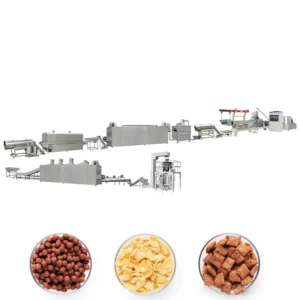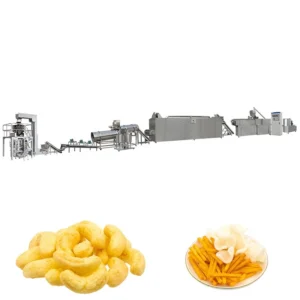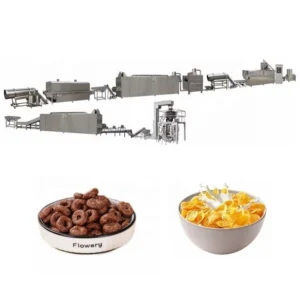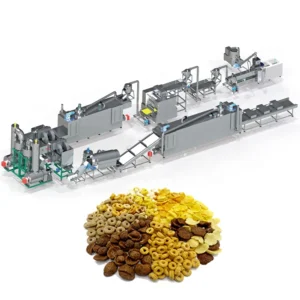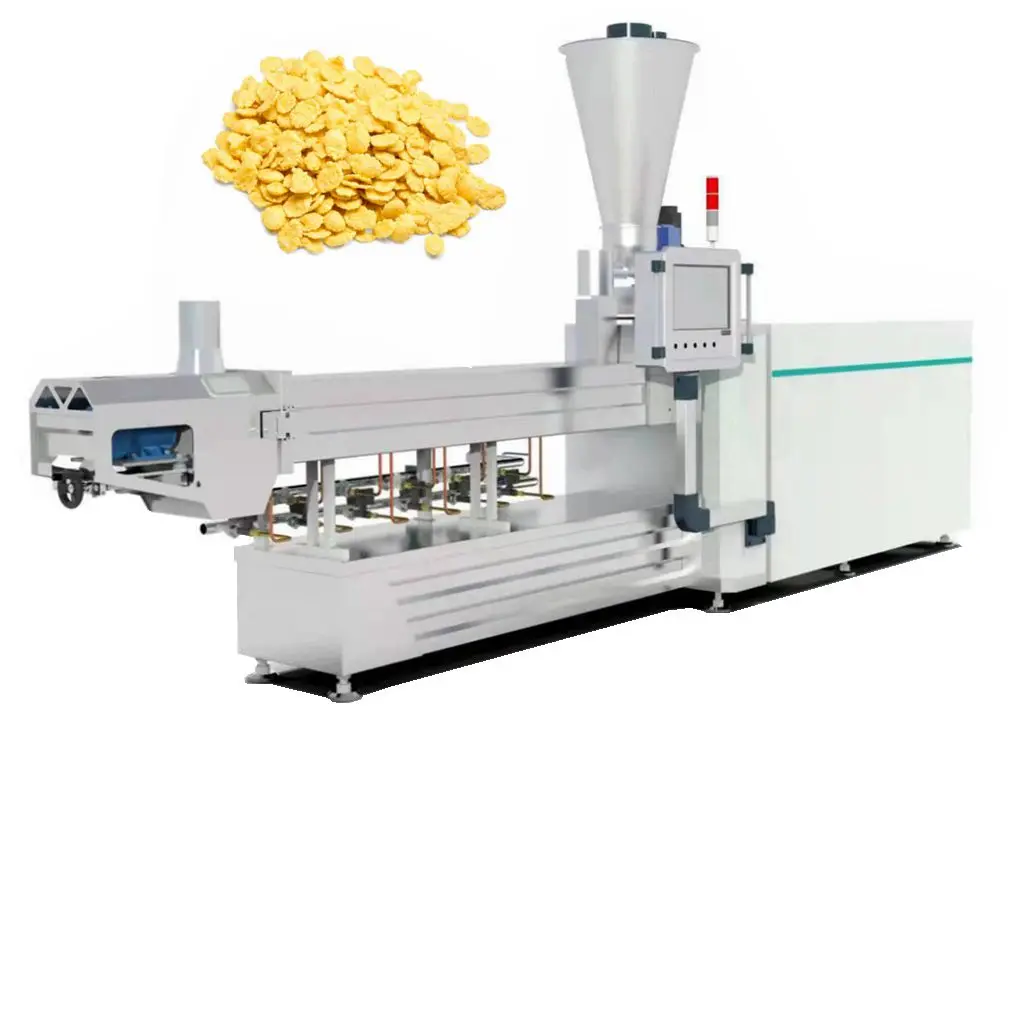
Screw & Die Configuration Matched to Material — Every MT75 twin-screw line we set up starts with a screw profile chosen for your exact corn, rice, or oat blend, verified on our test bench before the machine leaves Jinan.
Technical Specifications
| Parameter | Value |
|---|---|
| Model | MT75 (also MT70, MT85 variants available) |
| Product Type | Corn Flakes Breakfast Cereals Production Line |
| Screw Type | Twin Screw |
| Installed Power (MT75) | 210 kW |
| Power Consumption (MT75) | 150 kW |
| Output Capacity (MT75) | 300–500 kg/h (basis not stated in source — confirm raw material formulation and moisture content) |
| Overall Dimensions (MT75) | 45 × 1.5 × 3.5 m |
| Control System | PLC and MCC |
| Flaker Control | PLC with hydraulic system, double rollers, double motors, infrared sensor |
| Heating Source (Dryer) | Gas or Electric |
| Roasting Oven | Hot air circulation with vibrating pan, high temperature spraying tubes, dual circulating fans, cyclone dust removal |
| Coating System | Double tumble for sugar melting, elevator, coating drum, spraying nozzle |
| Lubrication | Automatic lubricating system |
| Assembly State | Complete line |
Application Suitability
| Application | Material or Output |
|---|---|
| Breakfast cereal manufacturing | Natural or sugar-coated corn flakes from standard corn grits |
| Multi-grain flake production | Blends of rice, wheat, oat, and barley powder requiring tailored gelatinisation |
| Puffed shaped cereal formats | Balls, tubes, rings, fruit loops, stars, and wheels via die changes |
| Fortified breakfast cereal lines | Vitamin and mineral premixed with corn or oat base formulations |
Why "300–500 kg/h" Doesn’t Tell the Whole Story
Capacity on a datasheet means nothing until it holds steady on your actual grit.
A buyer once showed me a proposal from another supplier promising a fixed throughput figure for corn flakes. When we ran his specific corn grits — slightly coarser than standard — on our test bench, the extruder barrel pressure spiked, gelatinisation was incomplete, and the flakes came out dense rather than crisp. Without that trial, he would have paid for a line that couldn’t hit the quoted output on his real material. Every corn flakes extrusion production line turnkey project we build is trialled with your raw formulation before shipment so that throughput, flake density, and texture are confirmed on what you actually pour into the hopper. [NEED_CITE: variability of corn grit particle size across supply regions]
How Screw Configuration Controls Gelatinisation
In twin-screw extrusion for breakfast cereals, the screw elements determine how long your starch stays in the barrel and how much shear it receives. We select the mixing block count, pitch lengths, and die opening based on your formulation’s starch content and moisture target. A high-amylose corn blend needs a longer residence time and a gentler shear profile compared to a standard yellow corn grit. Getting this wrong means under-gelatinised dough that won’t flatten cleanly under the flaker rollers, or over-worked dough that turns gummy and loses its characteristic snap after roasting.
Temperature Profile and Barrel Zoning
The MT75 barrel is divided into independently heated and cooled zones. Each zone is tuned so that the dough transitions from blending through cooking to pressure building in a controlled sequence. If zone three runs hot while zone four drops, you get uneven moisture migration inside the pellet, and the flaker produces cracks instead of smooth, uniform sheets. We map the barrel temperature curve to your formulation during the in-house trial run, then lock those setpoints into the PLC so the operator doesn’t have to guess on production day. [NEED_CITE: starch gelatinisation temperature thresholds by cereal grain type]
Reading the Spec Sheet Like a Buyer
The installed power of 210 kW tells you the motor capacity available, but actual consumption runs around 150 kW during steady-state extrusion — the difference is headroom for start-up torque and harder formulations. The PLC-controlled flaking station uses hydraulic double rollers with separate motors, which means each roller speed can be adjusted independently to compensate for dough viscosity changes. The overall dimensions of 45 × 1.5 × 3.5 metres define your floor space requirement, but you also need clearance above for the coating drum elevator and duct routing for the roaster’s cyclone dust removal system. Voltage and frequency are confirmed per your facility before production begins, not assumed from a catalogue default.
The Cost of Skipping the Flaker-Dryer Match
I’ve walked into plants where the extruder was producing at spec but the downstream flaker couldn’t keep up, so operators had to throttle the screw speed and lose throughput they’d already paid for. Worse is a mismatched dryer — corn flakes leaving the flaker at high moisture that enter an undersized dryer and come out partially raw in the centre, then scorch on the surface during roasting. The result is a cereal that looks fine in the bag but goes soggy within seconds of hitting milk. These bottlenecks and quality failures happen when stations are sourced from separate vendors who don’t communicate on throughput. [NEED_CITE: moisture content targets for corn flakes before roasting]
Why Procurement Teams Source This Line Here
- Screw configuration and die design are specified to your corn or multi-grain formulation, not copied from a generic build sheet.
- Extruder, flaker, dryer, roaster, and coating drum are all sized to the same throughput, so no station starves or chokes the next.
- An in-house testing workshop runs your actual raw material before shipment, producing a trial report you review before the machine ships.
- PLC and MCC controls manage the full sequence from batching to packing, with infrared temperature monitoring on the flaker and dual circulating fans in the roaster.
- CE and ISO certifications are held across the product range, and all contact materials meet food-grade requirements throughout the line.
Documentation & Verification
- Screw and die configuration record matched to your corn or grain blend
- Trial run report on your raw material before shipment
- Line layout with capacity calculation for every station
- Electrical schematic with confirmed voltage and frequency
- Operation and maintenance manual with wear parts list
- CE declaration of conformity and ISO certificate
Installation, Commissioning & Support
- Floor plan accounts for 45 m line length plus clearance for coating elevator and roaster ductwork
- Electrical supply sized for 210 kW installed load with dedicated breaker per station
- Line arrives in modular sections; our team aligns flaker rollers to extruder die on site
- PLC parameters loaded from your trial run data during first commissioning session
- Operator training covers screw speed, barrel zone temperatures, and hydraulic flaker pressure adjustment
- Wear parts list identifies screw elements, dies, and flaker roller shells with reorder codes
What to Include in Your Enquiry
When you reach out, send your corn grit or grain blend specification, including moisture content and particle size range. Confirm your local voltage and frequency so the MCC can be built to match. If you have existing upstream batching or downstream packing equipment, share the throughput and interface details so we can size the corn flakes extrusion production line turnkey project to fit. Let us know whether you need natural flakes only or sugar-coated variants, as the coating drum and tumble system change the line layout.
Frequently Asked Questions
Q: How is output capacity verified on my specific corn or multi-grain formulation before shipment?
A: We run your actual raw material in our testing workshop using the screw configuration and die selected for your blend. The trial produces a report showing throughput, flake density, and texture results. You review this report before the line ships, so capacity is confirmed on your material, not a generic benchmark.
Q: How do screw configuration and barrel temperature affect starch gelatinisation and flake density?
A: Screw element pitch and mixing block count determine residence time and shear energy, while barrel zone temperatures control the cooking sequence. Together they set the degree of starch gelatinisation, which directly governs how the dough flattens under the flaker and how crisp the final corn flakes extrusion production line turnkey product becomes after roasting.
Q: What die options exist for shaped cereal formats beyond standard flakes?
A: The same twin-screw extruder platform can produce balls, tubes, sticks, rings, fruit loops, stars, wheels, flowers, and heart shapes by swapping the die plate and adjusting the cutter at the die face. We specify the die to your target shape during the proposal stage.
Q: How is voltage, frequency, and control language confirmed before production?
A: During the specification confirmation step, you provide your facility’s voltage and frequency along with the preferred PLC display language. The MCC is then built to those exact parameters, and the electrical schematic is included in your documentation package for review.
Q: What wear parts are included, and how are replacements supplied?
A: The line ships with a documented wear parts list covering screw elements, die plates, and flaker roller shells. Reorder codes are included in the operation manual, and replacement sets are available directly from us to avoid extended downtime when the first changeover falls due.