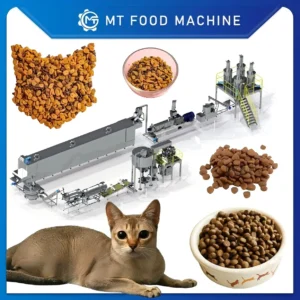
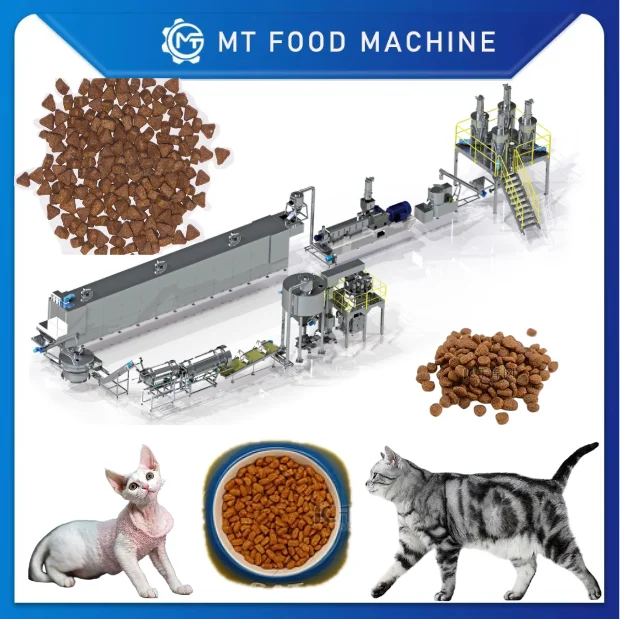
Thermodynamic Precision — Barrel zones on the MT100 are mapped to the gelatinisation window of the buyer’s actual starch-protein matrix, not a default curve.
Technical Specifications
| Parameter | Value |
|---|---|
| Model | MT100 |
| Product Type | Twin Screw Pet Food Extrusion Line |
| Output Capacity | 1.5–2.0 t/h (basis not stated in source — confirm raw material / moisture / pellet size) |
| Control System | PLC controlled |
| Application Range | Cat, dog, fish, bird, and cattle feed |
| Operation Profile | Easy-to-use design, reduced labor needs |
| Technical Support | Video technical support and online after-sales service |
| Certification | CE, ISO |
Application Suitability
| Application | Material or Output |
|---|---|
| Dry kibble for dogs and cats | Meat meal, corn, wheat, soy, and fat blends targeting specific crunch density |
| Floating and sinking aquatic feed | Fish meal, soy protein, and starch blends for catfish, tilapia, and shrimp |
| Bird and cattle feed | Grain-based and roughage formulations requiring controlled expansion |
| Multi-species production runs | Variable protein, fat, and carbohydrate ratios switched between batches |
Why Generic Screw Profiles Sink Floating Feed and Break Kibble Bites
The screw configuration must be rebuilt around your actual formulation, not copied from a standard library.
When a buyer’s recipe shifts from a generic corn-starch test blend to a high-protein, high-moisture meat slurry, the shear and residence time inside the barrel change completely. The material no longer gelatinises at the same temperature, and expansion collapses at the die. This twin screw pet food extrusion line technology addresses that mismatch by specifying the screw element sequence and die geometry to the exact raw material blend the buyer will run.
I have seen producers lose entire production days trying to force a generic screw build through a formulation it was never designed for. The pellets come out dense, sink when they should float, or shatter during coating. The fix is never a minor temperature tweak; it requires rethinking the compression ratio and shear profile from the feed zone to the metering section [NEED_CITE: twin screw extrusion screw element configuration for varying protein content].
Shear, Temperature, and the Gelatinisation Window
Starch gelatinisation does not happen at a single point. It is a range, and that range shifts depending on the ratio of protein and fat in the mix. The MT100 barrel is divided into independently heated zones, and the PLC records the temperature at each stage. This allows the operator to hold the material inside the gelatinisation window long enough for the starch granules to swell and bind, but not so long that the protein matrix degrades and the kibble loses structural integrity. Getting this balance right is the core of twin screw pet food extrusion line technology for any multi-species producer.
Die Geometry and the Density Target
The die plate is the last point of control before the product expands. Its open area, land length, and hole diameter together determine the pressure drop at exit, which in turn governs how much the kibble or pellet expands. A floating fish feed pellet needs a sharp pressure drop and high expansion; a dense dog kibble bite needs a restricted die with a longer land. The die is specified to the buyer’s target bulk density and is documented before the machine leaves the factory [NEED_CITE: die land length and expansion ratio relationship in food extrusion].
Reading the Specs That Actually Matter
The PLC control system on this line does more than automate start-up sequences. It logs barrel temperature profiles, screw speed, and feeder rates for every production run, so a formulation that worked in March can be recalled exactly in September. The output capacity of 1.5–2.0 t/h is a reference figure that will shift depending on pellet size, moisture content, and raw material density — a small kibble at low moisture will hit the upper end, while a large, high-moisture aquatic pellet will sit lower. The application range covering cat, dog, fish, bird, and cattle feed reflects the screw and die combinations available, not a single universal build. Twin screw pet food extrusion line technology only delivers consistency when the buyer understands that the machine is a platform configured around their recipe, not a fixed product.
The Cost of Ignoring Raw Material Behaviour
When a line is ordered on catalogue capacity alone and the screw build is never matched to the buyer’s actual protein-to-starch ratio, the consequences appear on the first production day. The extruder draws excess current trying to push under-gelatinised material through the die, wear on the screw flights accelerates, and the dryer cannot remove moisture evenly because the pellet density varies across the batch. These are not defects; they are the direct result of treating the extruder as a commodity. Producers who skip the formulation-specific configuration often find themselves replacing screw elements far earlier than expected [NEED_CITE: premature screw wear causes in food extrusion lines].
What Separates This Build
The MT100 is supplied as a complete line, not a standalone extruder. Throughput at the mixer, extruder, dryer, and coating drum is calculated together so no single station bottlenecks the next. The screw and die configuration is specified against the buyer’s raw material sample and target product density, and that specification is recorded. Before shipment, the line runs a trial on the buyer’s actual formulation in the testing workshop, producing a report that documents barrel temperatures, screw speed, moisture addition, and the resulting pellet density and texture. This removes the guesswork from on-site commissioning. The twin screw pet food extrusion line technology platform is backed by CE and ISO certification, which governs build standards for electrical safety and quality management. Documentation includes the electrical schematic with voltage and frequency confirmed to the buyer’s facility, so the control panel language and motor ratings match local supply before the machine is wired.
Documentation & Verification
- Line layout showing throughput matching from batching through extrusion to packing
- Screw and die configuration record tied to your raw material and target pellet density
- Trial run report on your formulation produced in the testing workshop before dispatch
- Electrical schematic with voltage, frequency, and control language confirmed to your site
- CE declaration of conformity and ISO certificate for the complete line
Installation, Commissioning & Support
- Foundation drawing provided for the MT100 extruder footprint and dryer length
- Power supply confirmed to local voltage and frequency before the PLC panel is built
- Barrel and screw assembly verified on-site against the configuration record
- First production run supervised with PLC parameter logging from day one
- Operator training covers screw element handling, die changes, and PLC recipe recall
- Wear parts list with screw flight and die plate reorder codes included at delivery
Before You Request a Quote
To size the MT100 correctly, share your target product format — kibble, floating pellet, or sinking pellet — along with the primary raw materials and their approximate protein, fat, and moisture content. Specify the daily output target in tonnes and the pellet diameter range. Confirm your facility’s voltage, frequency, and preferred control panel language. If you have existing upstream mixers or downstream dryers, provide their capacities so the line can be balanced around them.
Frequently Asked Questions
Q: How is the screw and die configuration matched to my specific raw material and target kibble density?
A: We review your formulation sheet — protein, fat, starch ratios, and moisture — then select the screw element sequence and die geometry to hit your target expansion and bulk density. The configuration is documented and can be replicated on future production runs through the PLC recipe memory.
Q: What does the barrel temperature profile look like for my formulation?
A: Each barrel zone is set independently. The profile is developed during the trial run on your raw material, ramping through the gelatinisation window specific to your starch-protein blend. The PLC logs every zone so the exact curve can be recalled for repeat batches.
Q: Can a trial run be done on my raw material before shipment?
A: Yes. Your raw material is run through the MT100 in our testing workshop. The resulting report covers barrel temperatures, screw speed, moisture addition, pellet density, and texture, giving you a verified baseline before the line arrives at your facility.
Q: How is throughput balanced between the extruder, dryer, and coating drum?
A: Each station is calculated against the MT100 extruder output for your specific pellet size and moisture content. The dryer length and coating drum volume are matched so material flows continuously without queuing or starving any section of the line.
Q: What moisture and shear parameters are controlled during extrusion?
A: Moisture is injected at defined barrel zones and monitored against the PLC setpoint. Shear is governed by screw speed and the compression ratio of the element sequence. Both are recorded per batch so adjustments are data-driven rather than manual guesswork.