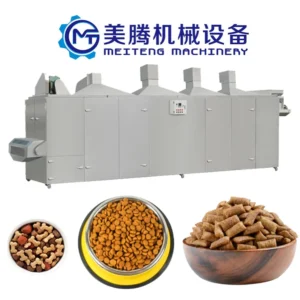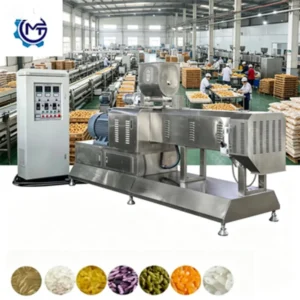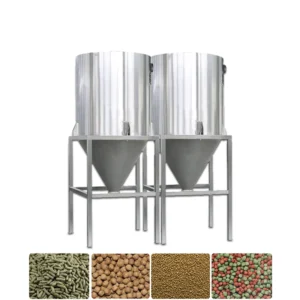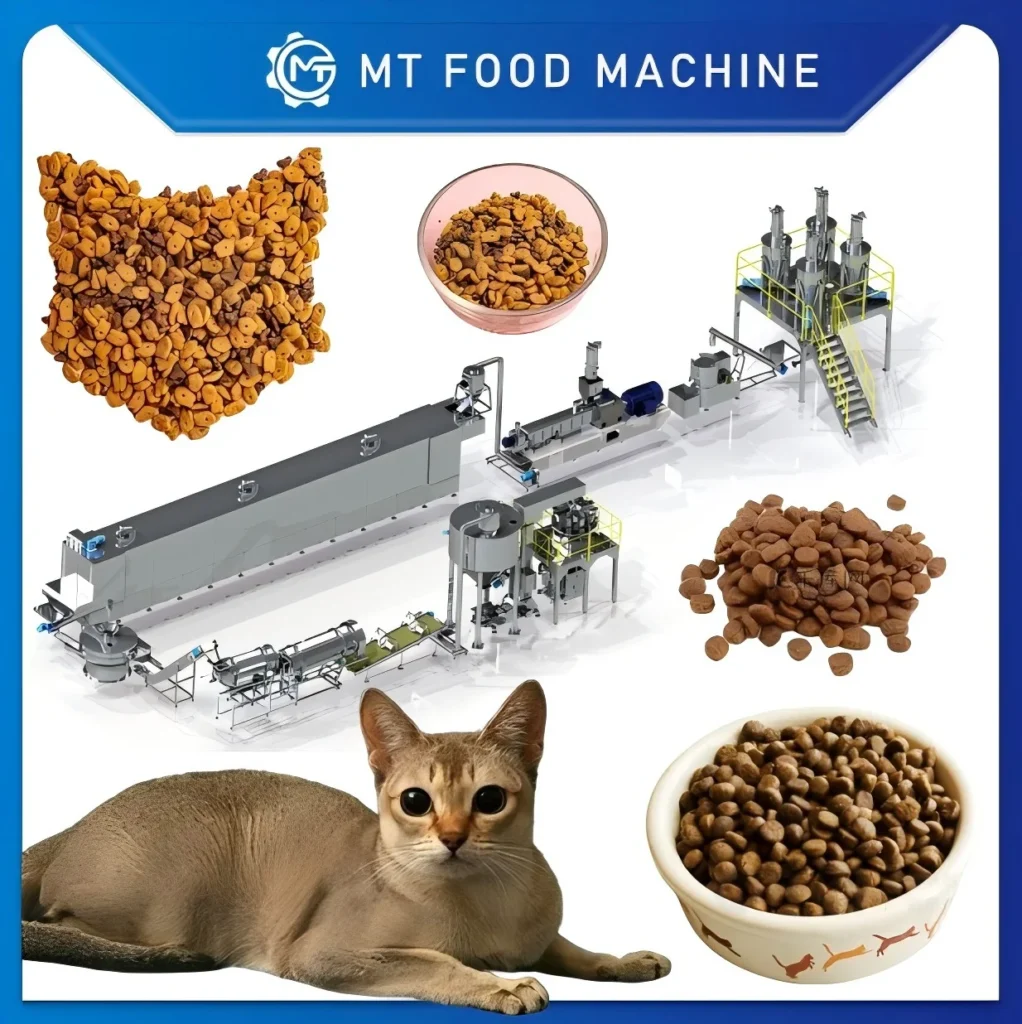
Screw Configuration Matched to Formula — Every MT-70 build starts with the buyer’s actual ingredient list, not a generic screw profile copied from a standard catalog.
Technical Specifications
| Parameter | Value |
|---|---|
| Model | MT-70 |
| Product Type | Pet Food Processing Line |
| Control System | PLC |
| Output Capacity | 200–250 kg/h (basis not stated in source — confirm raw material, moisture and kibble size) |
| Applications | Dog, cat and fish feed production |
| Certifications | CE, ISO |
| Line Stations | Includes mixing, extrusion, drying and coating stations (full station list to be confirmed) |
| Warranty | 1 year |
Application Suitability
| Application | Material or Output |
|---|---|
| Dry dog kibble | Corn, poultry meal, bone meal and vitamin premix blends |
| Cat food pellets | High-protein formulations with fresh meat inclusion and animal fat coatings |
| Floating fish feed | Soybean meal, fish meal and starch-based aquatic formulations |
| Sinking aquatic pellets | Dense formulations for bottom-feeding species such as catfish and shrimp |
What the Stated Capacity Figure Actually Means on Your Recipe
A rated throughput number is only valid on the raw material it was measured against.
Many extrusion lines ship with a nameplate capacity derived from a standard corn or starch test run. When the buyer introduces a recipe with higher fresh meat content, altered fat ratios or different starch sources, the actual output often falls well short of that number. The MT-70 addresses this by running trial batches on customer-supplied ingredients before the line leaves the factory, so the pet food extrusion line specifications you receive reflect your formula, not a laboratory benchmark [NEED_CITE: variability of extrusion output across different raw material profiles].
Screw Geometry and Barrel Temperature Profiling
The MT-70 uses a twin-screw extrusion platform where screw element sequencing determines shear intensity, residence time and starch gelatinisation behaviour. For a high-meat kibble recipe, the screw profile must manage elevated fat content without losing expansion at the die face. Barrel zones are independently heated and monitored through the PLC, allowing the operator to set temperature gradients that match the thermal requirements of each ingredient fraction. Getting the pet food extrusion line specifications right at this stage prevents dense, under-expanded pellets that fail market density expectations.
Die Selection and Pellet Density Control
Die orifice diameter, land length and face geometry govern the expansion ratio and final bulk density of every pellet leaving the extruder. Floating aquatic feed demands a die profile that maximises expansion and traps air cells within the starch matrix, while sinking pellets for shrimp or catfish require restricted expansion and higher compression at the die face [NEED_CITE: die geometry influence on extruded pellet buoyancy]. The MT-70 die plate is specified after the trial run, ensuring the pellet behaviour matches what the buyer’s market expects rather than a generic default.
How Extrusion Parameters Translate to Real Production Behaviour
Screw speed, barrel moisture injection and feed rate interact continuously during extrusion. On the MT-70, the PLC manages these variables as an integrated set rather than isolated dials, so a change in feed rate automatically triggers compensating adjustments in barrel temperature and screw RPM. This matters directly when switching between a light, porous cat kibble and a dense, slow-sinking shrimp pellet on the same line — the control system holds the pet food extrusion line specifications within the target window across recipe changeovers. The L/D ratio of the barrel assembly provides sufficient residence time for complete starch gelatinisation across both high-protein and high-starch formulations, which directly affects pellet durability during drying and transport.
The Cost of a Mismatched Dryer and Coating Station
An extruder that runs at full capacity is worthless if the downstream dryer cannot remove moisture fast enough, or if the flavouring drum cannot apply fat and palatant evenly at that throughput. Buyers who assemble lines from separate vendors often discover the bottleneck only during commissioning, when wet pellets pile up ahead of an undersized dryer or coating coverage falls below specification. The resulting product fails shelf-life tests and palatability trials, forcing weeks of rework [NEED_CITE: downstream bottleneck impact on extruded pet food quality].
Why Sourcing the Full Line from One Supplier Matters Here
The MT-70 is supplied as an integrated line from batching through extrusion, drying, coating and packing, so throughput is calculated and matched at every station before fabrication. Screw configuration and die design are specified against the buyer’s raw material and target kibble density, not pulled from a generic library. An in-house testing workshop runs trial batches on customer-supplied ingredients before shipment, producing a documented trial run report that becomes the baseline for commissioning. Twin-screw expertise spans pet food, aquatic feed, snack and cereal applications, so configuration decisions are informed by cross-category process knowledge. Pre-sales engineering covers line layout, utility planning and electrical specification, followed by on-site installation, operator training and ongoing wear parts support.
Documentation & Verification
- Line layout drawing with throughput matched across every station on the MT-70
- Screw and die configuration record specific to your raw material and target pellet
- Trial run report produced on your ingredients before the line ships
- Electrical schematic with voltage, frequency and PLC language confirmed for your market
- CE declaration of conformity and ISO certificate for customs and regulatory clearance
- Wear parts list with screw elements and die plates identified by part number
Installation, Commissioning & Support
- Foundation plan and floor loading data based on the MT-70 line footprint and weight distribution
- Dedicated electrical circuit sized to the confirmed motor power and PLC control panel load
- Modular delivery with reassembly, alignment and utility connection supervised on site
- First production run with screw speed, barrel temperature and die clearance set to trial run baseline
- Operator training covering recipe changeover procedures on the PLC interface
- Wear parts inventory recommendation covering screw elements, die plates and barrel liners
- Scheduled maintenance intervals for gearbox oil, bearing lubrication and screw inspection
What We Need from You to Configure the Line
To build an accurate line proposal, share your target recipe with ingredient percentages and moisture content, the kibble shapes and sizes you plan to produce, and your daily output requirement. Confirm the voltage, frequency and phase available at your facility, along with the preferred PLC operating language. If you have existing upstream or downstream equipment that the MT-70 must integrate with, provide the interface specifications so the line layout accounts for those connection points.
Frequently Asked Questions
Q: How is the 200–250 kg/h capacity verified, and on which raw material basis?
A: That figure is measured under specific conditions. Before we quote a firm capacity, we run your actual raw material through our testing workshop and document the achievable throughput at your target moisture, kibble size and recipe formulation. The pet food extrusion line specifications in your proposal will state the verified output on your ingredients, not a generic benchmark.
Q: How are screw configuration and die design selected for different kibble densities and species?
A: Screw element sequencing and die geometry are chosen after reviewing your recipe and target pellet behaviour. High-meat dog kibble requires a different screw profile and die land length than floating fish feed. The trial run validates these selections before the MT-70 ships, so configuration is locked to your products, not assumed from a standard build.
Q: What voltage, frequency and PLC language options are confirmed before shipment?
A: We confirm your site electrical supply — voltage, phase and frequency — during the proposal stage and reflect it in the electrical schematic. The PLC interface language is agreed at the same time. This prevents commissioning delays caused by mismatched power supplies or control panels that operators cannot read [NEED_CITE: electrical standard variation across export markets].
Q: How is dryer and coating capacity matched to extruder output to avoid line bottlenecks?
A: Every station on the MT-70 line is calculated against the extruder’s verified throughput on your recipe. Dryer belt length, airflow and residence time are sized to handle the moisture load leaving the die, and the coating drum is specified for the fat application rate your formula requires. Throughput matching is documented in the line layout.
Q: Can a trial run be conducted on our raw material before the line ships?
A: Yes. We require a sample of your actual ingredients and run them through the MT-70 in our testing workshop. You receive a trial run report documenting throughput, pellet density, expansion ratio and screw configuration. This report becomes the commissioning baseline when the line is installed at your facility.