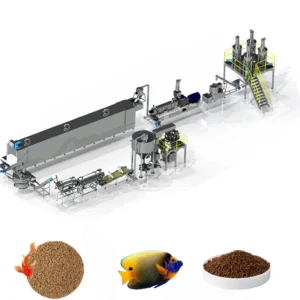
Screw Geometry Tuned to Formula — Every barrel zone, die orifice and flight depth is specified against your declared starch-protein ratio and target kibble density before production begins.
Technical Specifications
| Parameter | Value |
|---|---|
| Product Type | Pet Food Extrusion Production Line |
| Line Configuration | Fully automated twin-screw extrusion from mixing to packaging |
| Output Capacity | 150 kg/h to 3 T/h (basis not stated in source — confirm raw material formulation, moisture content and kibble size) |
| Extruder Type | Twin-screw, food-grade contact materials |
| Control System | Advanced sensors and precision controls (PLC/MCC option to be confirmed) |
| Recipe Range | Dry kibble, semi-moist pet food, pet treats |
| Energy Design | Energy-saving technologies (specific consumption values to be confirmed) |
| Maintenance | Modular components for quick cleaning and maintenance |
| Layout | Customizable capacity and factory layout |
| Assembly State | Complete production line including mixing, extrusion, drying, and packaging |
| Standards | FDA, CE |
Application Suitability
| Application | Material or Output |
|---|---|
| Dry kibble for dogs and cats | Corn, rice, meat meal, poultry by-product at controlled moisture |
| Floating and sinking aquatic feed | Soybean meal, fish meal, starch blends for catfish, tilapia, shrimp |
| Bird and small animal pellets | Millet, sorghum, seed mixes with vitamin premix |
| Semi-moist pet food | High-meat-content formulations requiring lower expansion ratios |
| Pet treats and dental chews | Dense, low-moisture starch-protein matrices |
| Cattle supplement pellets | Fibre-rich blends with molasses binding agents |
Why Nominal Capacity Fails on High-Protein Formulations
A line rated on corn grits will not deliver the same throughput on a 40% meat-meal blend.
Most buyers compare extruders on a single number — kilograms per hour — without asking what raw material that number assumes. I spent two weeks on-site in the Middle East after a line commissioned at its nameplate figure only reached roughly six-tenths of that output once the client’s actual high-protein, low-starch formula was fed in. The starch fraction was too low to gelatinise properly under the original screw profile, so the dough never built enough internal pressure for consistent expansion. Capacity only stabilised after the screw elements were re-sequenced and the die orifice diameter adjusted, a process that should have happened before the machine left the factory [NEED_CITE: starch gelatinisation thresholds in low-starch extrusion formulations].
Barrel Temperature Profiling Across Formulation Types
Starch gelatinisation in a twin-screw extruder is governed as much by shear history as by barrel wall temperature. For a standard dry kibble running above 25% starch, a gently rising temperature profile from the feed zone to the metering section is usually enough to achieve uniform expansion at the die face. Switch that same line to a semi-moist treat running on a high-meat recipe and the heat input must be re-balanced: less reliance on external barrel heating, more reliance on mechanical shear to develop the internal friction that drives protein texturisation. Pet food extrusion technology twin screw platforms allow these zone-by-zone adjustments in real time without halting production.
Die Geometry and Kibble Density Control
The die plate is where expansion ratio, cell structure and final kibble density are decided simultaneously. A larger orifice with a short land length promotes rapid flash-off of superheated moisture, producing the light, highly expanded kibble expected by dog food markets. For sinking aquatic feed, the same twin-screw platform uses a die with smaller orifices and longer land lengths, holding back expansion so the pellet stays dense enough to drop through the water column. Getting this geometry wrong means floating feed that sinks, or kibble that is too porous to survive the coating drum without generating excessive fines.
Reading the Specifications That Actually Matter
L:D ratio, barrel zone count and screw element interchangeability are the three parameters that separate a flexible pet food line from a single-purpose machine. A longer barrel gives raw material more residence time, which is essential when running fibre-rich or novel-protein blends that need extended thermal and mechanical treatment to break down anti-nutritional factors. Barrel zone count determines how finely you can tune the temperature gradient; more zones mean tighter control over the transition from raw mix to fully gelatinised dough. Modular screw elements — kneading blocks, reverse-flight sections, conveying flights — let the operator rebuild the screw configuration on the shaft to match a new recipe rather than ordering an entirely new screw set. These are the specifications that decide whether a line can pivot from dog kibble on Monday to cat treats on Thursday.
The Hidden Cost of Skipping Pre-Shipment Validation
Lines assembled from generic screw and die sets often arrive on site unable to hit the product specification the buyer’s market expects. I have watched a South American plant run three weeks of commissioning trials, burning through raw material and labour, before the extruder could produce kibble that met their density target. The root cause was a screw configuration copied from a reference build designed for a completely different formula. By the time the correct elements were shipped internationally, the delayed launch had already cost the buyer more than the trial run would have [NEED_CITE: cost of post-installation re-engineering versus factory pre-validation].
Why This Line Is Engineered Before It Is Priced
The extrusion screw and die geometry are matched to your declared raw material blend and target kibble specification, not pulled from a reference library. An in-house testing workshop runs your actual formulation through the twin-screw platform before shipment, generating a trial report that documents throughput, expansion ratio and product density on your recipe. Throughput matching between mixing, extrusion, drying and packing stations is calculated as one system, so no single station bottlenecks the others. Electrical schematics and voltage are confirmed against your factory supply before metal is cut, avoiding commissioning delays caused by mismatched motors or control panels. CE-certified construction with food-grade contact materials throughout meets regulatory requirements in markets across Europe, the Americas and Southeast Asia.
Documentation & Verification
- Screw and die configuration record matched to your raw material blend
- Trial run report on customer formula before dispatch
- Machine specification sheet with barrel zone count and L:D ratio
- Electrical schematic and voltage confirmation aligned to your site
- CE declaration of conformity with supporting test records
- Operation and maintenance manual with wear parts list
Installation, Commissioning & Support
- Foundation plan sized to twin-screw extruder dynamic load and vibration profile
- Dedicated power circuit matching confirmed motor rating and voltage
- Modular line sections arrive pre-assembled for faster on-site joining
- First-run parameter setting by extrusion technician using your raw material
- Operator training on screw swap procedures and die changeover
- Wear parts inventory covering screws, dies and barrel liners
What to Include in Your First Inquiry
Help us configure the right twin-screw setup by sharing your target kibble type, the primary protein and starch sources in your formula, and the daily output you need to sustain. If your facility operates on a non-standard voltage or frequency, include those details so the motor and control panel can be specified accordingly. Let us know whether you want to send a batch of your raw material for a pre-shipment trial run.
Frequently Asked Questions
Q: How is extruder capacity verified against my specific raw material formulation?
A: Capacity is confirmed through a trial run on your actual formula in the testing workshop before shipment. The run documents throughput at steady state, expansion ratio, kibble density and moisture at the die exit. If results fall short, screw elements and die geometry are adjusted until the output matches your production target on your recipe.
Q: What screw configuration suits my target kibble density and shape?
A: The screw profile is built from modular elements — conveying flights, kneading blocks and reverse sections — arranged to match your starch-protein ratio and desired expansion level. High-expansion dry kibble needs a different shear and compression sequence than dense sinking aquatic feed, and the configuration is recorded so it can be rebuilt identically for future orders.
Q: How do barrel temperature zones and moisture injection affect texture?
A: Each barrel zone has independent heating and cooling, allowing a gradient that moves raw mix through gelatinisation without scorching. Moisture injection at selected zones controls the steam available for expansion at the die face. Together they determine cell structure, surface porosity and the bite hardness your market expects [NEED_CITE: moisture-starch interaction in twin-screw extrusion].
Q: Can the same platform switch between dry kibble, semi-moist and treat production?
A: Yes, provided the screw elements, die plate and downstream drying capacity are reconfigured for each format. Dry kibble runs at higher expansion with longer drying, semi-moist food needs lower expansion and higher final moisture, and treats require dense compression with minimal puffing. Changeover procedures are documented in the operation manual.
Q: What does the pre-shipment trial run report cover?
A: The report records raw material batch details, screw and die configuration used, barrel temperature settings at each zone, throughput at steady state, product density and expansion measurements, and kibble photographs. It serves as the baseline reference for on-site commissioning so the line can be tuned to the same parameters from day one.