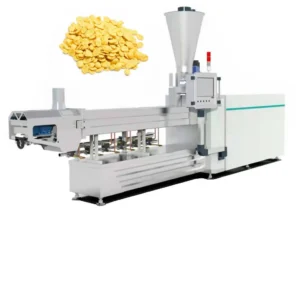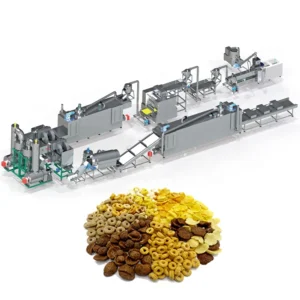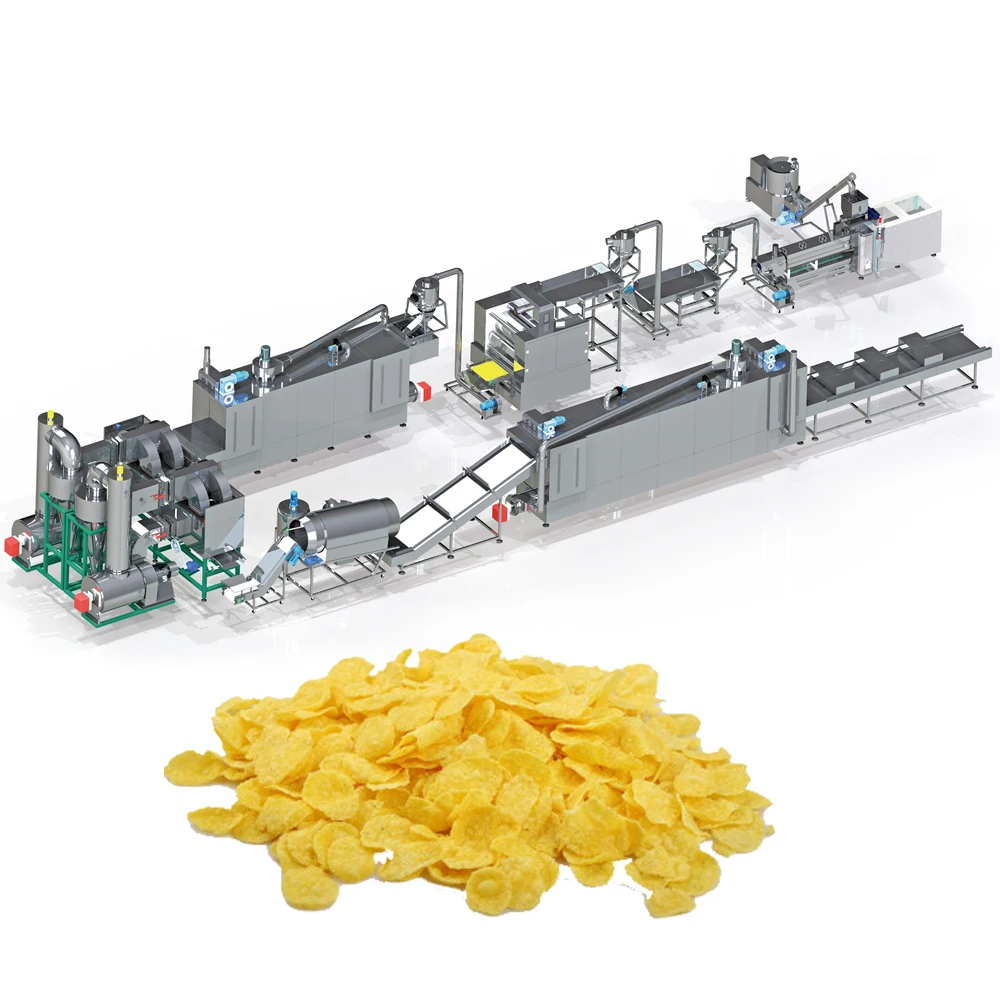
Screw configuration matched to raw material — every MT-series extruder ships with a screw profile and die layout calculated from the buyer’s actual flour blend and target flake density, not copied from a generic template.
Technical Specifications
| Parameter | Value |
|---|---|
| Product Type | Corn Flakes Extrusion Production Line |
| Models Available | MT-65 / MT-70 / MT-75 / MT-85 |
| Screw Type | Twin screw, co-rotating, sectional modules |
| Installed Power (MT-65) | 84 kW |
| Real Power (MT-65) | 59 kW |
| Output Capacity (MT-65) | 120–150 kg/h (basis not stated in source — confirm raw material, moisture content, flake thickness) |
| Dimension (MT-65) | 12,000 × 1,200 × 2,200 mm |
| Installed Power (MT-70) | 132 kW |
| Real Power (MT-70) | 92 kW |
| Output Capacity (MT-70) | 200–250 kg/h (basis not stated in source — confirm raw material, moisture content, flake thickness) |
| Dimension (MT-70) | 23,000 × 1,500 × 2,200 mm |
| Installed Power (MT-75) | 186 kW |
| Real Power (MT-75) | 140 kW |
| Output Capacity (MT-75) | 300–400 kg/h (basis not stated in source — confirm raw material, moisture content, flake thickness) |
| Dimension (MT-75) | 24,000 × 1,500 × 2,800 mm |
| Installed Power (MT-85) | 239 kW |
| Real Power (MT-85) | 167 kW |
| Output Capacity (MT-85) | 400–500 kg/h (basis not stated in source — confirm raw material, moisture content, flake thickness) |
| Dimension (MT-85) | 28,000 × 1,500 × 2,800 mm |
| Mixer Tank | φ600 × 500 mm; 4 kW |
| Screw Conveyor | 0.75 kW; includes vibrating sifter |
| Flake Press Roller | 510 × 310 × 1,050 mm; 16.12 kW; adjustable roller gap with integrated cooling |
| High-Temperature Oven | Gas-fired, both-side baking; 3.75 kW |
| Sugar Spraying System | 28.75 kW; includes melting tank and temperature-keeping roller |
| Control System | Separate controller box for flake press; PLC and MCC available |
| Contact Material | Food-grade stainless steel |
| Extruder Features | Self-cleaning function; forced automatic gearbox lubrication; non-stop cutting |
| Warranty | 1 year complete warranty, life-time maintenance service |
| Lead Time | 5–30 days after advance payment |
| Standards | CE (certificate available) |
Application Suitability
| Application | Material or Output |
|---|---|
| Traditional corn flakes | Corn grits, corn flour, sugar syrup coating |
| Multi-grain breakfast flakes | Blended oat, wheat, and rice flour formulations |
| Fortified breakfast cereals | Vitamin and mineral-enriched cereal blends |
| Oat-based snack chips | Rolled oat and whole-grain oat mixtures |
| Core-filled cereal snacks | Corn or rice flour shell with chocolate or cream filling |
| Puffed corn snacks | Corn grits or corn flour without flake pressing stage |
Why Your Flake Density Specification Gets Ignored on the Line
The extruder screw profile and die geometry must be calculated against your exact raw material formulation, or the flakes will never reach the density and bowl-life your market requires.
I have watched cereal producers accept a corn flakes extrusion production line specifications sheet that listed a capacity number but said nothing about the screw arrangement behind it. Six months later, the same producer is adjusting moisture content by trial and error because the barrel temperature zones do not match the gelatinisation window of their particular corn blend. The die orifices are too large, so the extrudate expands unevenly, and the flake press crushes it into fragments instead of flat, intact flakes [NEED_CITE: starch gelatinisation temperature ranges for cereal grains]. When you introduce oat flour or wheat bran into the recipe, the viscosity curve shifts entirely, and a screw configuration built for pure corn grits produces either under-cooked dough or scorched discharge.
How Screw Configuration Controls Flake Texture
The co-rotating twin-screw design in the MT-series allows each barrel section to be fitted with different screw elements — conveying, kneading, or reverse-pitch — so the shear profile can be shaped around how your specific cereal blend absorbs water and releases starch. Corn flakes extrusion production line specifications mean very little if the kneading block length does not correspond to the residence time your formulation needs for full gelatinisation. A short kneading zone on a high-fibre oat blend leaves uncooked centres, while an overly aggressive arrangement on pure corn flour burns the dough before it reaches the die.
Barrel Temperature Zones and Moisture Management
Each barrel segment on these extruders is heated and cooled independently, which matters because starch gelatinisation in corn-based dough typically occurs within a narrow temperature band [NEED_CITE: thermal profiling in twin-screw food extrusion]. If the feed zone runs too hot, the material gelatinises prematurely and clings to the screw root, starving the metering section. Too cold in the die zone, and the extrudate exits without the elasticity needed to survive the flake press rollers intact. The moisture content at the mixer stage — usually adjusted between specific hydration levels depending on grit particle size — sets the baseline that the barrel profile must then sustain through every zone.
Reading the Specification Sheet Against Your Recipe
The installed power figures across the MT-65, MT-70, MT-75, and MT-85 models reflect different gearbox and motor pairings, but the real determinant of whether a given model fits your line is the relationship between screw diameter, free volume inside the barrel, and the throughput your recipe demands at its target moisture level. A higher-fibre formulation requires more torque at lower screw speeds, which pushes the selection toward a larger barrel diameter. The flake press roller gap, adjustable on this line, then sets the final thickness — but only if the extrudate arrives at the press with consistent density and temperature, which is entirely a function of the screw and barrel work upstream.
The Cost of Skipping the Trial Run
Producers who skip the pre-shipment trial run discover problems at their own facility, where replacing a screw element means days of downtime instead of minutes in a testing workshop. A line that ran perfectly on standard corn grits during the factory test may behave differently once the buyer’s actual supplier delivers flour with a slightly different particle size distribution or starch-to-protein ratio. The flake press then produces uneven sheets, the oven cannot dry them uniformly, and the sugar coating system receives a product that is already outside tolerance [NEED_CITE: raw material variability in cereal processing]. Every station downstream amplifies the error introduced at the extruder.
What Separates a Matched Line from a Bundled One
Every station on this corn flakes extrusion production line is specified as a set rather than assembled from separate vendor quotations, so the extruder output rate is verified against the flake press throughput, the oven drying capacity, and the sugar spraying drum residence time. The screw configuration and die design are documented against your raw material before the machine leaves the workshop. An in-house testing workshop conducts trial runs on the buyer’s actual formulation, producing a written report that records the screw arrangement, barrel temperatures, moisture levels, and the resulting flake density and thickness. Electrical schematics and voltage confirmation are locked down before production begins, avoiding the commissioning delays that happen when a 50 Hz motor arrives in a 60 Hz market. CE documentation accompanies every shipment, and wear parts lists specify the screw elements and die plates you will need for the first replacement cycle.
Documentation & Verification
- Screw and die configuration record calculated from your specific corn or multi-grain formulation
- Trial run report documenting flake density and thickness on your raw material before shipment
- Electrical schematic with voltage and frequency confirmed against your facility supply
- Line layout drawing showing station-by-station throughput balance from mixer to packing
- CE declaration of conformity covering the complete extrusion and downstream line
- Wear parts list identifying screw elements, die plates, and press roller surfaces for first reorder
Installation, Commissioning & Support
- Foundation plan accounts for the MT-85 line length approaching 28 metres and press roller vibration loads
- Dedicated power circuit sized to the real running power of the selected model, not just the installed figure
- Line arrives in modular station assemblies for staged positioning within your ceiling height constraint
- First-run commissioning includes barrel temperature profiling and flake press gap calibration on your recipe
- Operator training covers screw element rearrangement when switching between corn grits and oat blends
- Spare screw elements and die plates stocked against the wear parts list provided before shipment
What to Prepare Before Requesting a Quotation
Share your raw material specification — corn grits particle size, flour blend ratios, any oat or wheat inclusion percentage — along with the target flake thickness and the bowl-life your market expects. Confirm the voltage and frequency at your facility, the control language your operators need, and the available floor space including ceiling height, since the oven and sugar spraying sections require vertical clearance. If you have an existing mixer upstream or a packing system downstream, provide their throughput figures so the line can be balanced around them.
Frequently Asked Questions
Q: How is screw configuration selected for different raw materials like corn grits versus oat blends?
A: The screw element sequence — conveying, kneading, and reverse-pitch sections — is arranged based on the gelatinisation behaviour of your specific formulation. Corn grits require a different residence time and shear profile than high-fibre oat blends, so the kneading block length and barrel temperature zones are adjusted accordingly. This configuration is documented before the machine ships.
Q: How do I verify actual output capacity against the quoted figure?
A: Capacity depends on raw material type, moisture content at the mixer, and target flake thickness. Request a trial run on your own formulation in the testing workshop, which produces a measured output rate under real conditions. The trial report records the exact parameters, so you can compare the result against your production target before committing to shipment.
Q: What barrel temperature and moisture range are needed for proper starch gelatinisation?
A: The range varies with your grain blend and particle size, but gelatinisation in corn-based formulations typically requires specific barrel zone temperatures paired with a controlled moisture addition at the mixer. The trial run establishes these values for your recipe, and the PLC system stores the profile for repeatable batch production across every run.
Q: How is flake thickness controlled, and what affects final flake density?
A: The flake press roller gap is adjustable, directly setting the thickness of each flake. However, density is equally influenced by the extrudate condition arriving at the press — its temperature, moisture, and expansion ratio, all determined upstream by the screw configuration and die geometry. The integrated cooling system on the press roller prevents sticking and stabilises forming rate.
Q: What is the process for a pre-shipment trial run on my raw material?
A: You send a representative sample of your actual formulation to the testing workshop. Engineers configure the screw elements and die to your specification, run the line, and record all parameters — temperatures, moisture, screw speed, press gap, and the resulting flake density and thickness. A written report is issued, and any configuration adjustments are made before the machine is cleared for shipment.