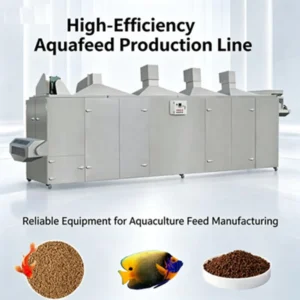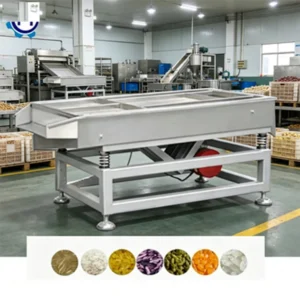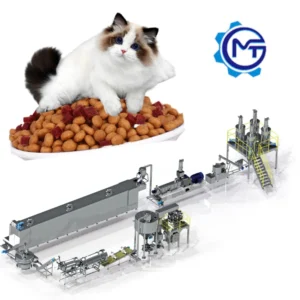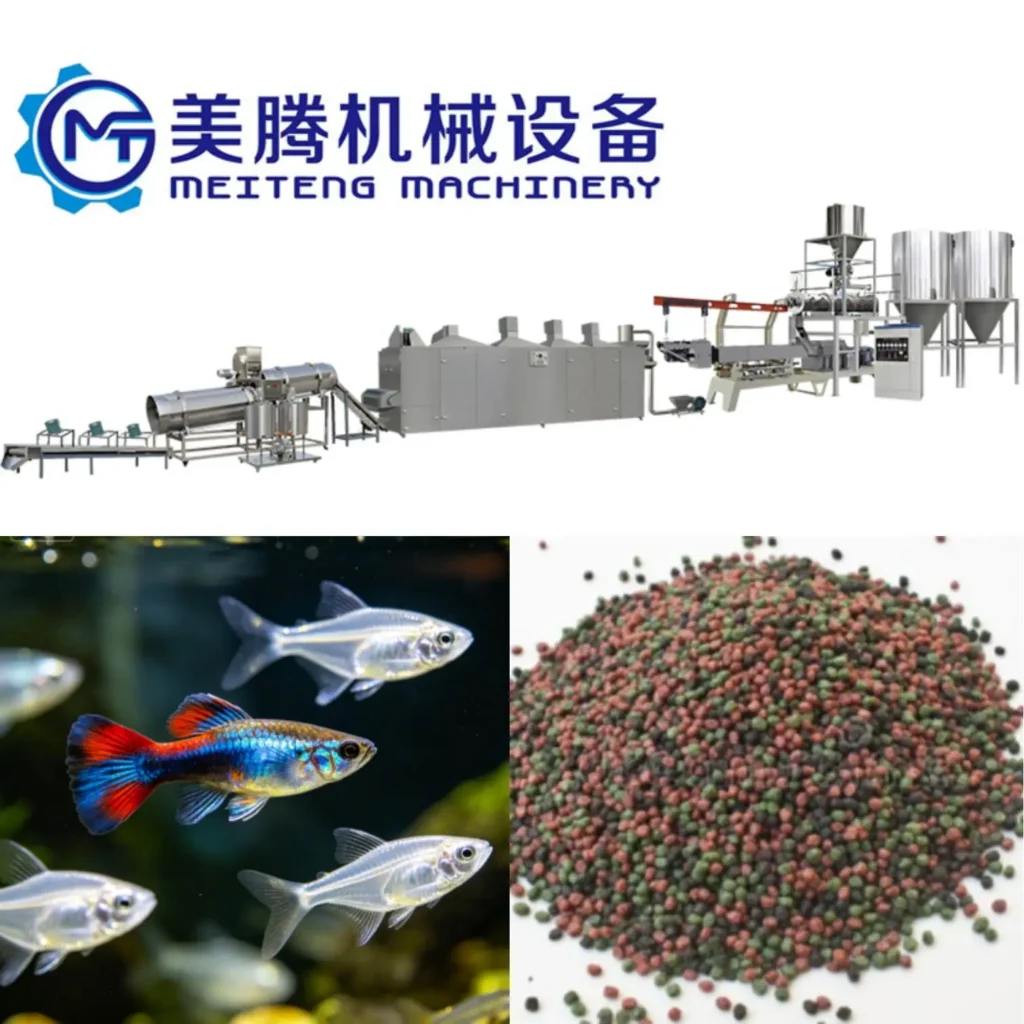
Matched Screw Geometry — screw elements and die apertures configured against the buyer’s actual feed formulation to control starch gelatinisation and pellet buoyancy across floating and sinking formats.
Technical Specifications
| Parameter | Value |
|---|---|
| Product Type | Twin-Screw Fish Feed Extrusion Line |
| Output Capacity | 200–300 kg/h (basis not stated in source — confirm raw material formulation, moisture content and pellet size) |
| Screw Type | Twin-screw |
| Construction Material | 304 stainless steel on food-contact surfaces |
| Control System | PLC / MCC or manual control (to be confirmed per order) |
| Voltage & Frequency | Configurable to target market electrical standard |
| Screw Configuration | Matched to raw material and target pellet buoyancy |
| Die Design | Specified to pellet diameter and expansion ratio |
| Barrel Temperature | Multi-zone profile with independent heating and cooling |
| Steam or Water Injection | Available depending on formulation requirements |
| Line Stations | Batching, mixing, extrusion, drying, coating, cooling, packing (scope to be confirmed) |
| Certification | CE and ISO (documentation provided per unit) |
Application Suitability
| Application | Material or Output |
|---|---|
| Floating pellets for surface-feeding species | Trout and salmon feed using fish meal, starch binder and lipid coating |
| Sinking pellets for bottom-feeding species | Catfish and shrimp feed with higher-protein, lower-starch formulations |
| Multi-species production on a single line | Switchable screw and die setups between floating and sinking runs |
| Nursery and juvenile feed | Small-diameter pellets requiring tight die tolerances and controlled expansion |
Why Generic Screw Builds Sink Your Floating Pellet
The difference between a pellet that holds buoyancy and one that drops to the pond floor is decided before the extruder ever starts.
Every feed manufacturer I have worked with in Shandong has seen the same pattern: a line arrives, the operator loads the local formulation, and the pellets either refuse to float or expand far beyond spec. The problem almost always traces back to a twin-screw fish feed extrusion line screw configuration die design that was copied from a different application — typically a snack or pet food setup — without accounting for the starch content, protein level and moisture behaviour of aquaculture raw materials. Floating pellets for trout and salmon demand a specific gelatinisation window that only opens when screw shear, barrel temperature and die pressure align with the actual recipe. Sinking pellets for catfish need the opposite: lower expansion, higher density, and a die geometry that restricts rather than encourages puffing [NEED_CITE: starch gelatinisation thresholds in aquafeed extrusion].
Shear, Moisture and the Gelatinisation Window
Starch gelatinisation in aquafeed is not a fixed temperature — it shifts depending on moisture level, shear input and residence time inside the barrel. The twin-screw fish feed extrusion line screw configuration die design must therefore be specified together with the barrel temperature profile, not treated as a separate decision. When a formulation runs lean on starch, the screws must generate more mechanical shear to compensate; when starch content is high, excessive shear burns the material before it reaches the die.
Die Geometry and Pellet Density Control
The die is where expansion and density are finalised. A larger die aperture with a short land length produces high expansion and low density — the profile needed for floating pellets. Sinking pellets require a smaller aperture and longer land length to restrict expansion and push density above the waterline threshold. Switching between the two on the same line means changing die plates and, in most cases, adjusting the screw element sequence in the final barrel zones. This is why we document the die configuration against each target product before production begins [NEED_CITE: die land length and expansion ratio relationship in twin-screw extrusion].
Reading the Specs That Actually Matter
The L:D ratio of the barrel determines how long raw material stays under heat and shear — a longer ratio gives more gelatinisation time, which matters for formulations with slow-hydrating starches. The number of barrel zones and whether each can be independently heated or cooled determines whether the temperature profile can follow the formulation’s needs rather than forcing a compromise. Steam or water injection capability becomes critical when raw material moisture varies seasonally, as it does with most locally sourced fish meal and grain. The control system — whether PLC, MCC or manual — governs how precisely these variables can be held constant across a multi-hour production run, and that consistency is what separates a repeatable process from one that drifts off-spec by mid-shift.
The Cost of Running a Mismatched Configuration
I once worked on a line ordered for multi-species aquatic feed in the Middle East where the starch content in the local raw material was well below what a generic screw build assumed. The pellets could not hold buoyancy, and output fell to roughly sixty percent of the quoted figure. The fix required a full screw reconfiguration and a rewritten temperature curve — weeks of delay that a matched setup from the start would have avoided [NEED_CITE: raw material variability impact on extrusion throughput]. When the configuration is wrong, the dryer and coater downstream also operate outside their designed range, compounding the bottleneck.
Why Sourcing Here Changes the Outcome
The testing workshop inside the Shandong factory runs trial extrusion on the buyer’s actual raw material before the line ships — the screw configuration and die design are adjusted until the target pellet density and expansion are verified, not assumed. Throughput is matched across every station from batching through packing so no single machine bottlenecks the rest. Pre-sales consultation covers the formulation behaviour that a catalogue spec sheet cannot capture. Installation engineers stay through commissioning and operator training, ensuring the crew knows how to change screw elements and die plates between floating and sinking runs. Wear parts — screws, dies, barrel liners — are catalogued and available when the first replacement cycle arrives.
Documentation & Verification
- Screw and die configuration record matched to your raw material and target pellet buoyancy
- Trial run report from the testing workshop covering your formulation before dispatch
- Electrical schematic with voltage and frequency confirmed for your local grid standard
- Line layout and capacity calculation showing throughput balance across every station
- CE declaration of conformity and ISO certificate provided with shipment documentation
Installation, Commissioning & Support
- Foundation plan accounts for the extruder footprint, dryer length and coater positioning
- Dedicated power circuit specified to the confirmed voltage and frequency of the target market
- Line arrives in modular sections with assembly sequence documented for the site crew
- First-run commissioning includes screw and die adjustment on the buyer’s actual raw material
- Operator training covers changeover procedure between floating and sinking pellet configurations
- Wear parts list with reorder intervals for screws, dies and barrel liners included in the manual
What We Need to Configure Your Line
Send us the target species, the raw material formulation including starch and protein percentages, and the pellet diameter range you need for each product. Confirm the local voltage, frequency and preferred control language so the electrical and PLC setup matches your workshop before the line arrives. If you have existing upstream batching or downstream packing equipment, share the interface specifications so throughput can be balanced across the full system.
Frequently Asked Questions
Q: How is the screw configuration and die design matched to my raw material and target pellet density?
A: We run your actual raw material in the testing workshop, measuring expansion, density and gelatinisation at different screw element sequences and die geometries. The configuration that hits your target buoyancy is documented and locked in before the line ships, so production starts from a verified baseline rather than trial and error on your factory floor.
Q: What determines whether the pellet floats or sinks, and how is that controlled during extrusion?
A: Pellet buoyancy is governed by expansion ratio at the die exit, which depends on screw shear, barrel temperature and die aperture size. Floating pellets need high expansion and low density; sinking pellets need restricted expansion and higher density. Both are controlled by adjusting screw elements and die plates, with changes documented for repeatable changeover.
Q: How is the 200–300 kg/h output capacity verified, and on what raw material formulation?
A: That output range must be confirmed against your specific formulation, moisture content and pellet size. During the trial run in our testing workshop, we measure actual throughput on your raw material and document the result. If the figure falls outside the range, we adjust the configuration and re-test before finalising the quotation.
Q: Can the line switch between floating and sinking pellet production, and what changeover is involved?
A: Yes. Switching typically involves changing the die plate and rearranging screw elements in the final barrel zones to alter shear and expansion behaviour. The changeover procedure is documented during commissioning, and operators are trained on the sequence so that product transitions remain within a planned timeframe.
Q: Is a trial run on my raw material conducted before shipment, and what does the report cover?
A: Every line goes through a trial run in the testing workshop using the buyer’s raw material. The report covers pellet density, expansion ratio, throughput at stable running conditions, and the specific screw and die configuration used. This record ships with the line as the reference baseline for production.