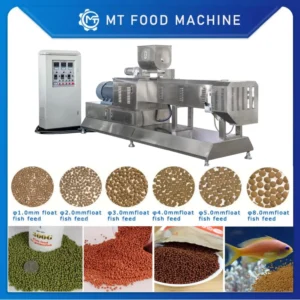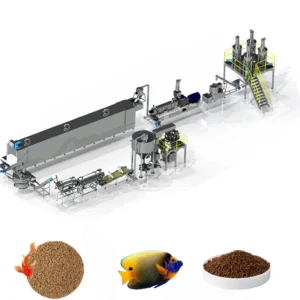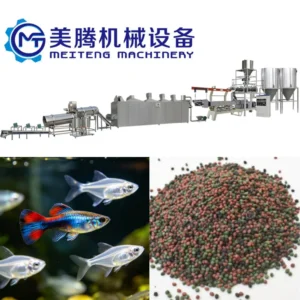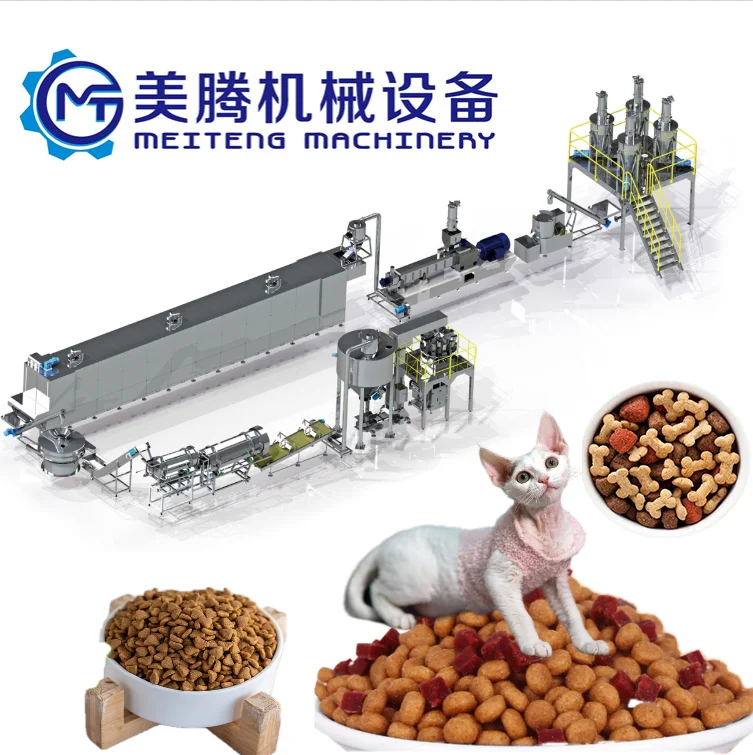
Custom Extrusion Engineering — Screw configuration and die geometry on the MT70 are specified against the buyer’s actual raw material and target kibble density, not copied from a generic build.
Technical Specifications
| Parameter | Value |
|---|---|
| Model | MT70 |
| Product Type | Twin Screw Pet Food Extrusion Line |
| Extruder Type | Twin Screw |
| Output Capacity | 100-200 kg/h (basis not stated in source — confirm raw material, moisture content, kibble size) |
| Voltage & Frequency | 380V 50Hz Three Phase |
| Control System | Automated PLC |
| Material Contact | Food-grade materials |
| Line Stations | Mixing, Extrusion, Drying, Packaging |
| Recipe Adaptability | Dry kibble, semi-moist pet food, pet treats |
| Standards | CE, FDA |
Application Suitability
| Application | Material or Output |
|---|---|
| Dry Kibble Production | Poultry meal, corn flour, and soy protein blends for dog and cat food |
| Semi-Moist Pet Food | High-moisture meat slurry mixes requiring controlled gelatinisation |
| Pet Treat Manufacturing | Specialized doughs with varied fat and protein ratios for extruded treats |
| Nutritional Formulas | Fortified vitamin and mineral premixes integrated into standard kibble bases |
Why "Nominal Capacity" Misses the Real Output
Actual throughput depends entirely on how the screw profile and barrel temperature match your specific raw material.
Process engineers often see a line quoted at a nominal capacity, only to find it cannot hold that output once the buyer’s actual ingredients enter the barrel. A twin screw pet food extrusion line extrusion technology setup copied from a generic build will produce the wrong texture or density when the formulation shifts [NEED_CITE: twin screw extrusion process parameters for varying raw materials]. The starch gelatinisation window narrows significantly with alternative protein sources, making matched screw configuration a prerequisite for maintaining rated output.
Barrel Temperature Profile and Starch Gelatinisation Control
Precise control over the thermal history of the dough is what separates a stable kibble from a batch with uneven expansion. On the MT70, independent heating zones along the barrel allow process engineers to map a specific temperature profile that corresponds to the gelatinisation point of the starch source being used. This twin screw pet food extrusion line extrusion technology approach ensures that moisture and shear work together to achieve consistent expansion before the dough reaches the die face.
Die Geometry and Kibble Density Management
The final density and sink-float characteristics of the kibble are largely determined by the shear rate at the die and the pressure drop immediately after exit. Die design is specified to match the target kibble specification, influencing how the extrudate expands as it leaves the high-pressure environment [NEED_CITE: die design principles in food extrusion processing]. Correct geometry prevents the post-extrusion collapse that leads to sinking aquatic feed or overly dense dog kibble that fails market expectations.
Reading the Specs: Screw Configuration and PLC Logic
The distinction between a standard build and a process-matched extruder lies in the screw element arrangement and the control architecture. The automated PLC system allows for the monitoring of barrel temperature and motor torque, providing the data necessary to maintain consistency across long production runs. Twin screw extrusion relies on specific screw element sequences—conveying, kneading, and reverse elements—to manage residence time and shear intensity. A configuration designed for high-protein aquatic feed will differ fundamentally from one optimized for starchy breakfast cereals or standard dry pet kibble. Furthermore, the inclusion of food-grade materials throughout the contact zones ensures compliance with safety standards when processing meat-based slurries. The MCC and PLC control integration ensures that the downstream dryer and cooler operate in sync with the extruder’s actual output, preventing bottlenecks.
The Consequences of Unmatched Throughput
When an extruder is supplied without matching dryer or coating capacity, the entire line bottlenecks regardless of the extruder’s potential. More critically, floating feed sinking or kibble density falling outside the specification the market expects leads to rejected shipments and lost contracts [NEED_CITE: pet food density standards and market specifications]. Skipping a trial run means product development begins only after installation, turning a scheduled startup into an expensive engineering experiment on the factory floor.
Engineering Verification and Process Matching
Our approach focuses on the technical variables that determine line performance rather than nominal catalog numbers. Screw configuration and die design are documented specifically against the buyer’s raw material and target product, ensuring the twin screw pet food extrusion line extrusion technology performs as required from day one. The in-house machine testing workshop allows for trial runs on customer raw material before shipment, validating expansion ratios and density targets. Pre-sales consultation involves engineer design of the line layout to ensure throughput is matched across every station, from the batching system through to packaging. Voltage, frequency, and control language are confirmed before production begins to align with the buyer’s facility infrastructure.
Documentation & Verification
- Line layout and capacity calculation matched to target throughput across all stations
- Machine specification sheet detailing screw configuration and barrel zone mapping
- Screw and die configuration record documented against specific raw material formulation
- Electrical schematic and voltage confirmation aligned with facility power infrastructure
- Trial run report on customer raw material validating expansion and density targets
Installation, Commissioning & Support
- Foundation planning based on MT70 footprint and vibration isolation requirements
- Dedicated 380V three-phase circuit verification for PLC and MCC control systems
- Assembly sequence managed to ensure food-grade material integrity during installation
- Commissioning includes screw profile verification against actual production ingredients
- Operator training focused on barrel temperature adjustment and die maintenance protocols
- Wear parts list specifying screw elements and die plates for inventory planning
Inquiry and Technical Alignment
To move forward with a technical evaluation, process engineers should provide the specific raw material formulation, target kibble density, and required moisture content. Information regarding the facility’s voltage and frequency is necessary to confirm the control system configuration. Finally, submitting a sample of the raw material allows for a trial run to verify the twin screw pet food extrusion line extrusion technology output before final line specification.
Frequently Asked Questions
Q: How are screw elements and die plates selected for specific raw materials?
A: The selection process involves analyzing the starch-to-protein ratio and moisture content of your formulation. We configure the kneading blocks and conveying elements to achieve the required shear and residence time, then match the die orifice geometry to control the pressure drop and final expansion ratio of the kibble.
Q: What variables control starch gelatinisation inside the barrel?
A: Gelatinisation is managed through the interaction of barrel temperature zones, screw speed, and moisture injection levels. The automated PLC allows engineers to monitor and adjust these parameters in real-time, ensuring the dough reaches the necessary thermal and mechanical energy input for complete starch conversion.
Q: Is it possible to run a trial with our own ingredients before delivery?
A: Yes, the in-house testing workshop is equipped to run trial batches using your specific raw materials. This process generates a trial run report that documents the actual capacity, expansion characteristics, and density achieved, providing verified data before the line is shipped.
Q: How is the control system adapted for different operator languages?
A: The PLC interface and MCC logic are configured during the engineering phase to match the language and technical standards of the destination country. This includes translating HMI screens and ensuring electrical schematics align with local voltage and frequency requirements.
Q: How does raw material variation affect the stated output capacity?
A: The stated capacity range depends heavily on the bulk density and expansion ratio of the specific ingredients used. High-protein or high-fat formulations may require different screw speeds and die configurations, which can alter the volumetric output compared to standard corn-based kibble recipes.