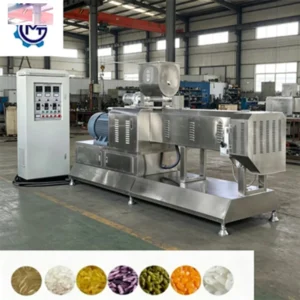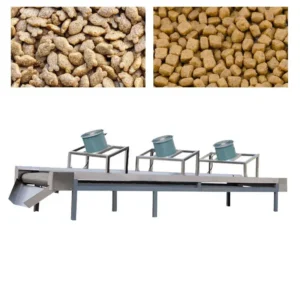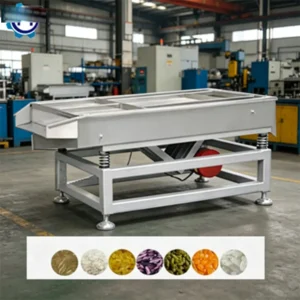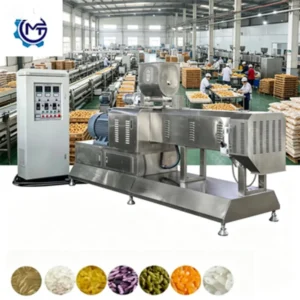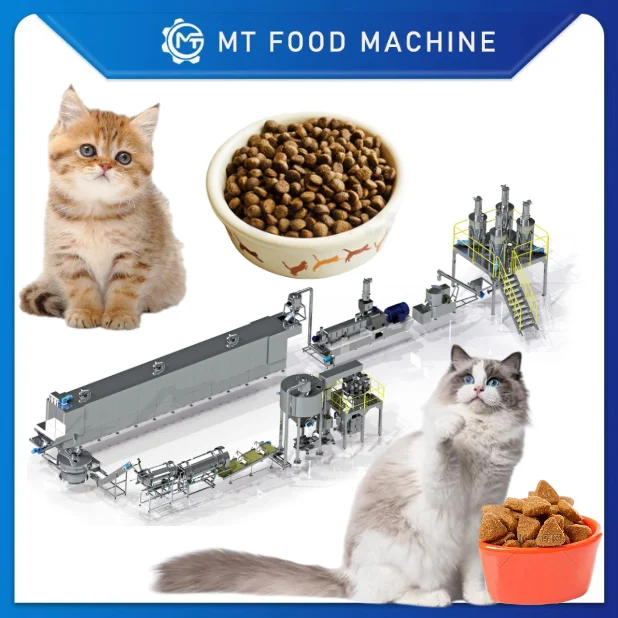
Precision Extrusion Engineering — Screw geometry and barrel thermal profiling are specified to the buyer’s actual formulation before a PLC controlled pet food extrusion line leaves the factory, preventing the throughput shortfalls that plague generic builds.
Technical Specifications
| Parameter | Value |
|---|---|
| Product Type | Twin Screw Pet Food Extrusion Line |
| Output Capacity | 450–550 kg/h (basis not stated in source — confirm raw material formulation, moisture content and kibble size) |
| Control System | PLC Controlled |
| Line Configuration | Multi-Species Pet Food Processing Line |
| Screw Type | Twin-Screw (verify against manufacturer catalog) |
| L:D Ratio | Verify against manufacturer catalog |
| Barrel Zones | Verify against manufacturer catalog |
| Die Configuration | Matched to target kibble density and shape (verify against manufacturer catalog) |
| Line Stations | Mixing, extrusion, drying, flavouring, cooling, packing (verify against manufacturer catalog) |
| Voltage & Frequency | Configurable to facility requirements (verify against manufacturer catalog) |
| Assembly State | Complete processing line |
| After-Sales Support | Video technical support and online service |
| Standards | CE and ISO certified manufacturing |
Application Suitability
| Application | Material or Output |
|---|---|
| Dry kibble production for dogs and cats | Meat meal, corn, wheat, rice, soy, and vitamin premix blends |
| Floating aquatic feed for catfish and tilapia | Fish meal, starch binders, and lipid coatings requiring low-density expansion |
| Sinking pellets for shrimp and bottom-feeding species | High-protein formulations compressed to target specific gravity |
| Avian and small bird feed | Seed-based and grain-based mixes shaped for beak size |
| Cattle and livestock supplement pellets | Fibrous roughage and protein concentrate blends |
Why Nominal Capacity Figures Mislead Buyers on a PLC Controlled Pet Food Extrusion Line
A quoted output number means nothing unless it was measured on your exact raw material blend.
I once watched a cat food producer install a line rated for a certain hourly throughput, only to find their high-protein, low-moisture formula expanded poorly and ran at barely half that rate. The extruder was not defective — it was simply configured for a generic recipe. When screw pitch, barrel heating zones, and die aperture are selected without trial runs on the buyer’s actual formulation, commissioning stalls and the entire line rhythm breaks down [NEED_CITE: twin-screw extrusion throughput dependency on raw material formulation]. This PLC controlled pet food extrusion line ships only after an in-house trial validates throughput on the specific ingredients you plan to run.
Barrel Temperature Profiling and Starch Gelatinisation
The extrusion zone on this PLC controlled pet food extrusion line uses multiple independently heated barrel sections. Each zone maintains a set-point that guides the starch gelatinisation curve as material moves from the feed inlet toward the die face. Precise thermal staging ensures that protein denaturation and starch expansion occur at the correct screw flight position, which directly controls kibble density and surface texture — the two parameters pet owners and aquaculture operators judge first.
Screw Element Arrangement and Shear Energy Input
Twin-screw element sequencing determines how much mechanical shear the dough receives before it reaches the die. Forward-conveying flights move material steadily, while kneading blocks introduce the high-shear mixing needed to break cell walls in fibrous or high-fat formulations. The configuration record for each PLC controlled pet food extrusion line documents which elements sit at which barrel position, so buyers know the shear profile was chosen for their recipe rather than copied from a standard template [NEED_CITE: screw element configuration effects on extrudate texture].
Interpreting the Capacity and Control Specifications
The listed 450–550 kg/h output range must be confirmed against the buyer’s specific moisture content, protein ratio, and target kibble diameter, because each variable shifts the actual throughput noticeably. The PLC control architecture replaces manual relay logic with programmable set-points for barrel temperature, screw speed, and feeder rate, keeping batch-to-batch density within a narrow band. Voltage and frequency must be locked in before production begins; a motor wound for one grid standard will overheat or underperform on another. The die configuration — aperture count and land length — governs expansion ratio and final kibble shape, so it is specified after the trial run rather than assumed from a catalog default.
The Hidden Cost of Skipping a Pre-Shipment Trial
Lines that ship without a formulation-specific trial often require weeks of on-site adjustment, during which the dryer, flavouring drum, and packing station sit idle waiting for the extruder to stabilise. Operators burn through raw material chasing the right expansion, and wear parts such as screw tips and die inserts degrade faster under trial-and-error tuning [NEED_CITE: commissioning delays caused by untested extrusion configurations]. That lost production window is the real expense — far beyond the line’s invoice price.
Why Procurement Through This Channel Reduces Risk
Screw configuration and die geometry are matched to the buyer’s raw material and target kibble density, not pulled from a generic build sheet. An in-house testing workshop runs the buyer’s actual ingredients through the extruder before shipment, producing a documented trial report. The line arrives as a throughput-matched set — extruder, dryer, flavouring drum, and packing station balanced to one another — rather than a collection of standalone machines. PLC and MCC panels are wired and labelled to the facility’s confirmed voltage, frequency, and control language. Pre-sales engineering consultation extends through installation, commissioning, and operator training, so the first production run is supervised rather than left to guesswork [NEED_CITE: turnkey extrusion line project delivery stages].
Documentation & Verification
- Screw and die configuration record matched to your raw material trial results
- Trial run report on your actual formulation conducted before dispatch
- Electrical schematic confirming voltage, frequency, and PLC language for your market
- CE declaration of conformity and ISO manufacturing certificate
- Wear parts list with interchange diagrams for screw elements and die inserts
- Line layout drawing showing station spacing and utility connection points
Installation, Commissioning & Support
- Foundation plan scaled to the complete line footprint and vibration isolation needs
- Dedicated circuit sizing based on confirmed PLC and drive motor power draw
- Modular station delivery allowing phased rigging in low-headroom workshops
- First-run parameter logging by an engineer to set PLC recipe baselines
- Operator training covering screw changeover, die cleaning, and barrel flush procedures
- Spare screw element and die insert kit matched to your first replacement cycle
What to Include in Your Inquiry
Provide your target species, raw material formulation with approximate moisture and protein percentages, and desired kibble dimensions so the screw and die package can be specified accurately. Confirm your facility voltage, frequency, and preferred PLC interface language to avoid rewiring after arrival. If you have existing upstream mixers or downstream packing equipment, share their throughput ratings so the line can be balanced end-to-end.
Frequently Asked Questions
Q: How is the output capacity verified against my specific raw material formulation and kibble size?
A: Before shipment, your actual ingredients are run through the extruder in the in-house testing workshop. The trial measures real throughput at your target moisture content and kibble diameter. Results are documented in a trial report, and screw or die adjustments are made if the output falls outside the agreed range.
Q: What screw configuration and die design is recommended for my target product density?
A: The screw element sequence and die aperture are selected based on your formulation’s protein level, fat content, and desired expansion ratio. A configuration record is provided showing element positions and die land length, so you can reproduce the same kibble density across future production runs.
Q: How do I confirm voltage, frequency, and PLC control language for my facility?
A: During the specification confirmation stage, you provide your local grid standard and preferred interface language. The electrical schematic and PLC program are then prepared to match, and a pre-dispatch verification ensures motors, heaters, and drives are rated correctly for your site.
Q: What does the pre-shipment trial run involve?
A: Your raw material is shipped to the testing workshop, where the line runs a production batch under controlled conditions. Engineers record barrel temperatures, screw speed, moisture addition, and output rate. The trial report accompanies your shipment as a baseline for commissioning.
Q: Which spare wear parts should I stock for the first year?
A: The wear parts list identifies screw tip elements, die inserts, barrel liners, and cutter blades that experience the highest abrasion. A recommended first-year spare kit is assembled based on your formulation’s abrasiveness and your planned annual running hours.