Precision Screw Matching — Every twin-screw configuration is validated against your actual raw material formulation before the extruder leaves our Jinan workshop, not borrowed from a generic catalogue build.
Technical Specifications
| Parameter | Value |
|---|---|
| Product Type | Fish Feed Production Line |
| Output Capacity | Up to 5 t/h (basis not stated in source — confirm raw material formulation, moisture content, pellet diameter and target species) |
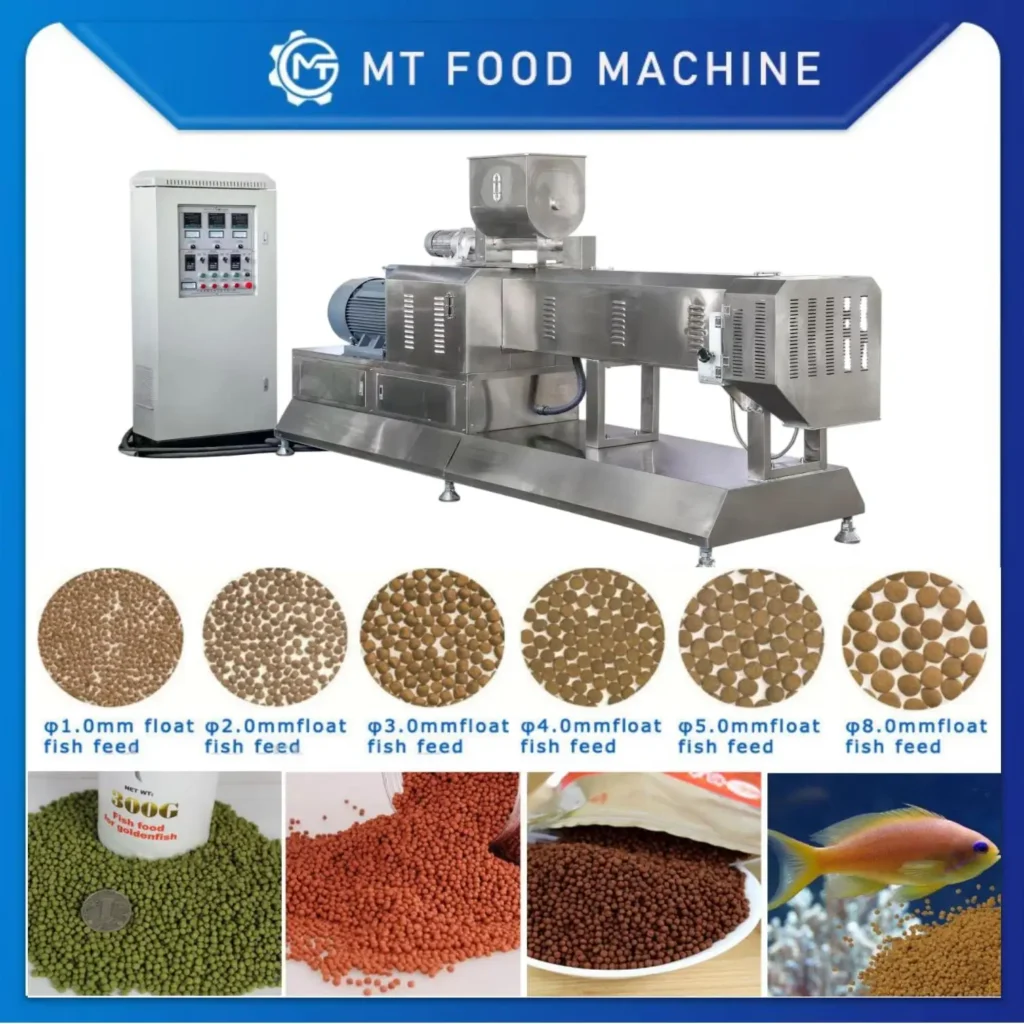
| Extruder Type | Twin-screw extruder |
| Construction Material | 304 stainless steel (food-grade contact parts) |
| Control System | PLC and MCC control |
| Screw Configuration | Matched to raw material and target pellet specification |
| Die Configuration | Specified to target pellet size and density |
| Line Stations | Batching / mixing → extrusion → drying → coating / flavouring → cooling → packing |
| Voltage & Frequency | To be confirmed to buyer’s site |
| Certification | CE (since 2014), ISO |
| Assembly State | Complete turnkey line, factory-tested before shipment |
Application Suitability
| Application | Material or Output |
|---|---|
| Floating pellet production for trout and salmon | High-starch formulations with fish meal, wheat flour and vitamin premix |
| Sinking pellet production for catfish | Dense formulations with higher protein content and lower expansion targets |
| Shrimp feed extrusion | Fine-grind raw material blends requiring tight water stability |
| Multi-species feed lines | Switchable screw and die sets on a single extruder platform |
Why Generic Screw Builds Sink Your Floating Pellets
Floatability is not a setting you dial in after installation — it is baked into the screw and die geometry before the machine ships.
I once stood beside a pond in South Asia watching a feed mill owner scoop sunken pellets off the bottom. The twin screw fish feed extrusion technology on his line had been configured with a standard screw profile that worked fine for corn-based snacks but could not generate enough expansion for his local fish meal formulation. Starch gelatinisation was incomplete, pellet density ran too high, and the market rejected the product within the first month. When a supplier copies a screw build from a different application, the consequences show up as sinking pellets, poor feed conversion ratios, and unhappy farmers [NEED_CITE: starch gelatinisation requirements in aquatic feed extrusion].
Barrel Temperature Profile and Moisture-Shear Balance
A twin-screw extruder processes fish feed through multiple barrel zones, each contributing a specific thermal and mechanical function. Early zones hydrate the starch granules while later zones apply the shear necessary for full gelatinisation. The barrel temperature profile must align with the moisture injection rate and screw speed to produce consistent expansion. When the moisture-shear balance drifts, pellets exit the die with uneven density — some floating, some sinking, some cracking during drying.
Die Geometry and Pellet Density Control
The die plate determines pellet diameter, length and initial expansion ratio. For floating trout pellets, a larger die orifice with controlled pressure drop allows the superheated moisture inside the dough to expand the pellet outward. For sinking catfish feed, a tighter die restricts expansion and produces a denser pellet that holds together underwater for extended periods. Getting the die geometry wrong means the fish feed extruder screw configuration cannot deliver the target floatability regardless of how well the rest of the line runs [NEED_CITE: die design parameters for floating versus sinking aquatic pellets].
Reading the Specification Sheet Beyond Nominal Capacity
Output capacity figures for extrusion lines depend entirely on the raw material formulation, moisture content and pellet diameter being run. A line rated for one product may behave very differently when switching to a higher-protein or higher-fat recipe. The twin screw fish feed extrusion technology in this line is configured around the buyer’s actual ingredient list rather than a benchmark formula. Screw element spacing, kneading block arrangement and barrel zone count are selected to match the specific rheology of the formulation, which directly determines whether the extruder can hold steady throughput across long production shifts.
When the Dryer Cannot Keep Up With the Extruder
An extruder running at full output means nothing if the downstream dryer is undersized. Wet pellets pile up, residence time in the dryer drops, and moisture leaves the cooling station above safe storage levels. Mould growth in bags follows within days. The same bottleneck logic applies to the coating drum and packing station. Every throughput mismatch between stations originates from treating the extruder as a standalone purchase rather than part of a balanced line [NEED_CITE: throughput matching across extrusion line stations].
Engineering Choices That Show Up in Every Batch
Meiteng designs the screw configuration and die set specifically for your raw material and target pellet, not from a template used across unrelated product categories. The in-house testing workshop in Jinan runs your actual ingredients through the extruder before shipment, generating a trial report that documents expansion ratio, bulk density and floatability under controlled conditions. PLC and MCC control architecture locks in barrel temperatures, screw speed and moisture injection rates so that the first bag and the ten-thousandth bag leave the line with identical pellet characteristics. Line layout and capacity calculations match throughput at every station — mixing, extrusion, drying, coating, cooling and packing — so no single unit bottlenecks the others. CE certification has been maintained since 2014 across the product range.
Documentation & Verification
- Screw and die configuration record tied to your raw material and target pellet spec
- Trial run report generated on your formulation in our testing workshop before dispatch
- Line layout showing throughput balance across every station from batching to packing
- Electrical schematic with voltage, frequency and HMI language confirmed to your site
- CE declaration of conformity and ISO certificate included in shipping documents
- Wear parts list covering screws, dies and seals with part numbers for reordering
Installation, Commissioning & Support
- Foundation plan provided matching the PLC-controlled extruder footprint and utility connections
- Voltage and frequency confirmed to local supply before electrical cabinet is wired
- Extruder barrel and screw assembled on-site with alignment checked against die plate
- First production run supervised with screw speed and barrel zone temperatures logged
- Operators trained on HMI navigation, recipe recall and emergency stop sequences
- Spare screw elements and die plates shipped with initial order to cover early wear
What We Need to Build Your Line
Before we can propose a screw build and line layout, we need your raw material formulation including protein, starch and fat percentages, the target pellet diameter and whether you need floating, sinking or both formats. Share your site voltage, frequency and preferred control language along with available workshop floor space so we can match dryer and cooler capacity to extruder output. If you can send a sample of your local ingredients to Jinan, we will run a trial before quoting lead time.
Frequently Asked Questions
Q: How is the output capacity verified for my specific fish feed formulation?
A: Capacity depends on raw material composition, moisture level and pellet diameter. We run your actual formulation through the twin-screw extruder in our testing workshop and document throughput, expansion ratio and pellet density in a trial report. The confirmed output is then used to size the dryer, coater and packing station so every component matches.
Q: How do you choose screw and die geometry for different fish species?
A: Floating pellets for trout require more expansion at the die, so we select screw elements that build higher internal pressure and pair them with larger die orifices. Sinking catfish pellets need restricted expansion, so we tighten the die and adjust kneading blocks to limit starch puffing. Each configuration is recorded and repeatable.
Q: What controls starch gelatinisation across the barrel zones?
A: Barrel temperature profile, moisture injection rate and screw speed work together. Early zones hydrate the starch while later zones apply shear to complete gelatinisation. The PLC maintains set points across all zones so the twin screw fish feed extrusion technology delivers consistent expansion even during long production runs.
Q: Can I send my raw material for a trial before the line ships?
A: Yes. Our Jinan workshop accepts customer raw material samples for trial extrusion runs. We measure floatability, bulk density, water stability and pellet appearance, then share a full report. Screw configuration and die selection are adjusted based on trial results before the extruder is cleared for shipment.