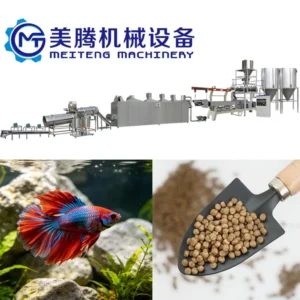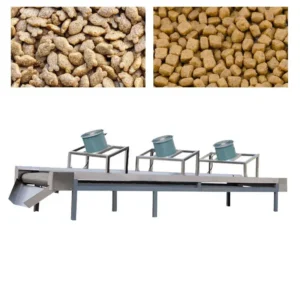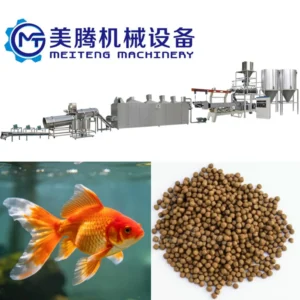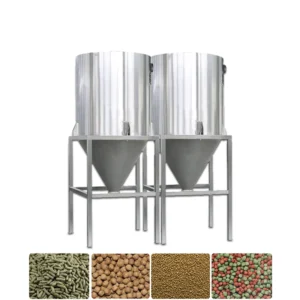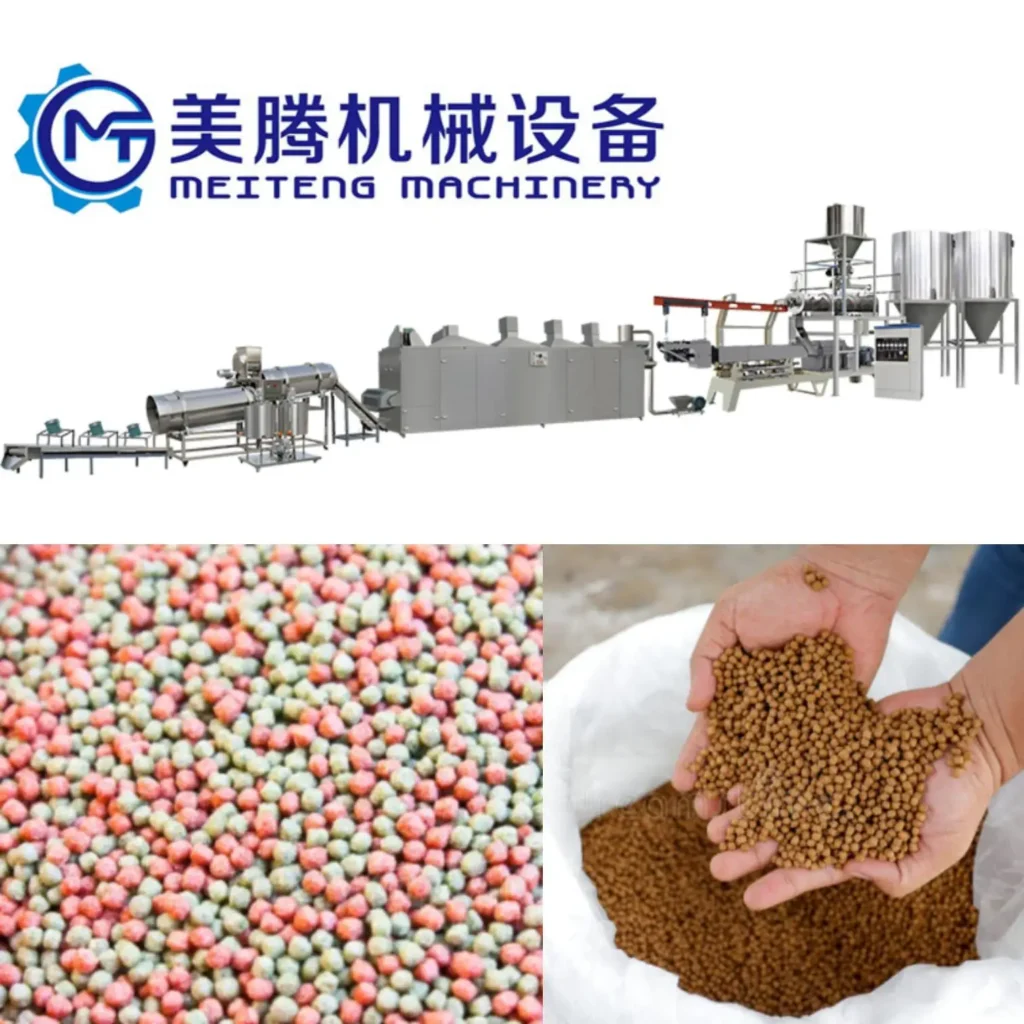
Formulation-Matched Screw Profiling — every barrel section and die aperture is matched to the buyer’s actual grain-to-protein ratio rather than copied from a generic aquatic feed build.
Technical Specifications
| Parameter | Value |
|---|---|
| Product Type | Twin Screw Fish Feed Extrusion Line |
| Extruder Configuration | Twin-screw with segmented barrel and modular screw elements |
| Contact Material | 304 stainless steel across all product contact zones |
| Output Capacity | Up to 3 t/h (basis not stated in source — confirm raw material formulation, moisture content, and pellet size) |
| Line Stations | Batching and mixing, extrusion, drying, coating and seasoning, cooling, packing |
| Control Architecture | PLC and MCC control |
| Die Design | Configured per target pellet geometry and density |
| Standards | CE declared, ISO certified manufacturing |
Application Suitability
| Application | Material or Output |
|---|---|
| Floating aquaculture feed | Grain-based formulations for tilapia, catfish and carp requiring low-density expanded pellets |
| Sinking aquaculture feed | Higher-protein blends for shrimp and bottom-feeding species requiring controlled density |
| Cold-water species feed | Formulations for trout and salmon with elevated fat and protein content |
| Multi-species production | Single line switching between floating and sinking recipes through screw and die reconfiguration |
Why Floating Pellets Sink When the Formula Changes
A pellet that floats on one recipe will sink on another if the extruder screw profile was not built around the buyer’s actual formulation.
I spent two weeks in Dubai reconfiguring an entire aquatic feed line because the factory trial used standard fish meal, while the customer’s daily production ran high levels of mixed plant meals. The pellets went straight to the bottom. The extruder was not undersized; the screw arrangement and die geometry had simply never seen that formulation [NEED_CITE: starch gelatinisation behaviour under varying plant-protein ratios]. When the raw material profile shifts, the shear, residence time and expansion characteristics all shift with it.
How Screw Arrangement Governs Pellet Buoyancy
The twin-screw extruder in this fish feed extrusion line uses modular screw elements — conveying, kneading and reverse-shear sections — assembled in a sequence specific to the target pellet density. Floating feed demands high expansion at the die face, which means the kneading blocks must generate enough mechanical shear to fully gelatinise the starch fraction before the material exits. Sinking feed requires the opposite: a denser, less expanded pellet achieved through reduced shear and shorter residence time. Switching between species on the same line means physically rearranging screw elements and swapping die plates, not merely adjusting a setpoint on the PLC.
Barrel Temperature Profiling Across Multiple Zones
Each barrel section carries independent heating and cooling circuits, giving the process engineer control over the thermal gradient from feed inlet to die face. Starch gelatinisation in aquaculture formulations typically initiates around the mid-barrel zones and must be sustained — not spiked — to achieve uniform expansion. If the rear zones run too hot, moisture flashes off prematurely and the pellet exits under-expanded. If the front zones run too cool, the material reaches the die without adequate plasticisation, producing a crumbly texture that breaks down in water before the fish can consume it [NEED_CITE: barrel zone temperature mapping for gelatinisation control].
Reading the Specifications Beyond Nominal Capacity
The twin-screw configuration provides self-wiping action between the screws, which keeps high-fat and high-moisture aquatic formulations from building up on the barrel walls — a problem that single-screw extruders encounter when processing shrimp or salmon feed with elevated lipid content. The 304 stainless steel contact surfaces resist the corrosive effect of salt-laden aquatic formulations over extended production runs. Die aperture and land length together determine the back-pressure at the die face, which directly controls expansion ratio and therefore floatability. PLC and MCC control across the full line allows the operator to store separate recipes for each species, locking in screw speed, barrel temperatures and feeder rates so that batch-to-batch consistency does not depend on manual memory.
What Happens When the Screw Profile Is Wrong
When the screw configuration is copied from a generic build rather than engineered for the buyer’s formulation, the symptoms do not always appear on day one. The line may produce acceptable floating pellets during a short trial, then drift into inconsistent density as moisture content in the incoming grain varies across seasons. Operators compensate by chasing temperature setpoints, which masks the root cause until a customer complaint arrives — typically a report that feed pellets are sinking in the pond or dissolving too fast in the water column [NEED_CITE: field reports of pellet density drift in aquaculture feed operations]. Reconfiguring the screw stack on-site costs far more in downtime than specifying it correctly before shipment.
Why Procurement Starts with the Formulation Sheet
This fish feed extrusion line is supplied as a complete sequence from batching through packing, which means throughput at every station — mixer capacity, dryer residence time, coating drum volume — is matched to the extruder output rather than assembled from independent vendors. Screw and die configurations are specified against the buyer’s raw material sheet and target pellet density, not pulled from a standard catalogue. Every line undergoes a trial run in the in-house testing workshop using the customer’s own formulation before dispatch, so expansion, floatability and water stability are verified before the equipment leaves the factory. The electrical schematic and control language are confirmed against the destination market before production begins, preventing commissioning delays caused by voltage or interface mismatches [NEED_CITE: electrical standard variations across aquaculture markets]. Documentation covers the full chain from layout calculation to wear parts list.
Documentation & Verification
- Line layout showing throughput balance across mixing, extrusion, drying, coating and packing stations
- Screw and die configuration record matched to your raw material formulation and target pellet density
- Trial run report produced on your specific formulation in the testing workshop before shipment
- Electrical schematic confirming voltage, frequency and control language for your facility
- CE declaration of conformity and ISO manufacturing certificate included with dispatch package
- Operation and maintenance manual with wear parts list for screws, dies and barrel liners
Installation, Commissioning & Support
- Foundation plan and utility routing provided for the full line including extruder, dryer and coating stations
- Electrical connection schedule specifying dedicated circuits and breaker ratings for PLC and MCC control panels
- Screw element assembly sequence documented so on-site teams can reconfigure for different species
- First-run commissioning includes barrel temperature profiling and die pressure adjustment on your formulation
- Operator training covers recipe storage on the PLC, screw changeover procedure and daily inspection points
- Wear parts inventory recommendation based on your production hours and raw material abrasiveness
What to Prepare Before Requesting a Quote
To size this fish feed extrusion line accurately, the engineering team needs the target species list and whether each requires floating or sinking pellets. Provide the raw material formulation — including the grain-to-protein ratio, fat content and any non-standard ingredients such as algae meal or insect protein. Specify the local voltage and frequency, the preferred control language on the PLC interface, and the available floor space and ceiling height. If you have existing upstream or downstream equipment that must integrate with the new line, share those specifications so the throughput calculation accounts for the full production chain.
Frequently Asked Questions
Q: How do screw configuration and die design determine whether fish feed pellets float or sink?
A: Floating pellets require high expansion at the die face, achieved by arranging kneading blocks to generate sufficient shear for full starch gelatinisation. Sinking pellets need less expansion, so the screw profile reduces shear and shortens residence time. Die aperture and land length control back-pressure, which directly sets the expansion ratio and final pellet density.
Q: What barrel temperature profile is needed for different raw material moisture levels?
A: Higher-moisture formulations need lower barrel temperatures in the rear zones to prevent premature moisture flash-off, while drier blends require more aggressive heating to reach gelatinisation temperature. Each barrel zone is independently controlled, allowing the process engineer to map a thermal gradient that matches the specific incoming moisture content of the raw material blend.
Q: Why does nominal line capacity not hold on the buyer’s actual raw material formulation?
A: Nominal capacity is typically measured on a standard reference formulation. When the buyer’s recipe contains different ratios of plant meals, fat or fibre, the material behaves differently inside the barrel — requiring different screw speeds, temperatures and residence times. The actual achievable throughput depends on how the formulation interacts with the configured screw profile.
Q: What shear and moisture parameters are needed when switching between trout, salmon and catfish feed recipes?
A: Trout and salmon formulations carry higher fat and protein, requiring reduced shear to prevent oil separation and denser pellets suited to cold-water feeding behaviour. Catfish feed typically uses higher starch content for greater expansion. Switching recipes involves rearranging screw elements, changing die plates and adjusting barrel temperatures to match each species’ nutritional and physical pellet requirements.