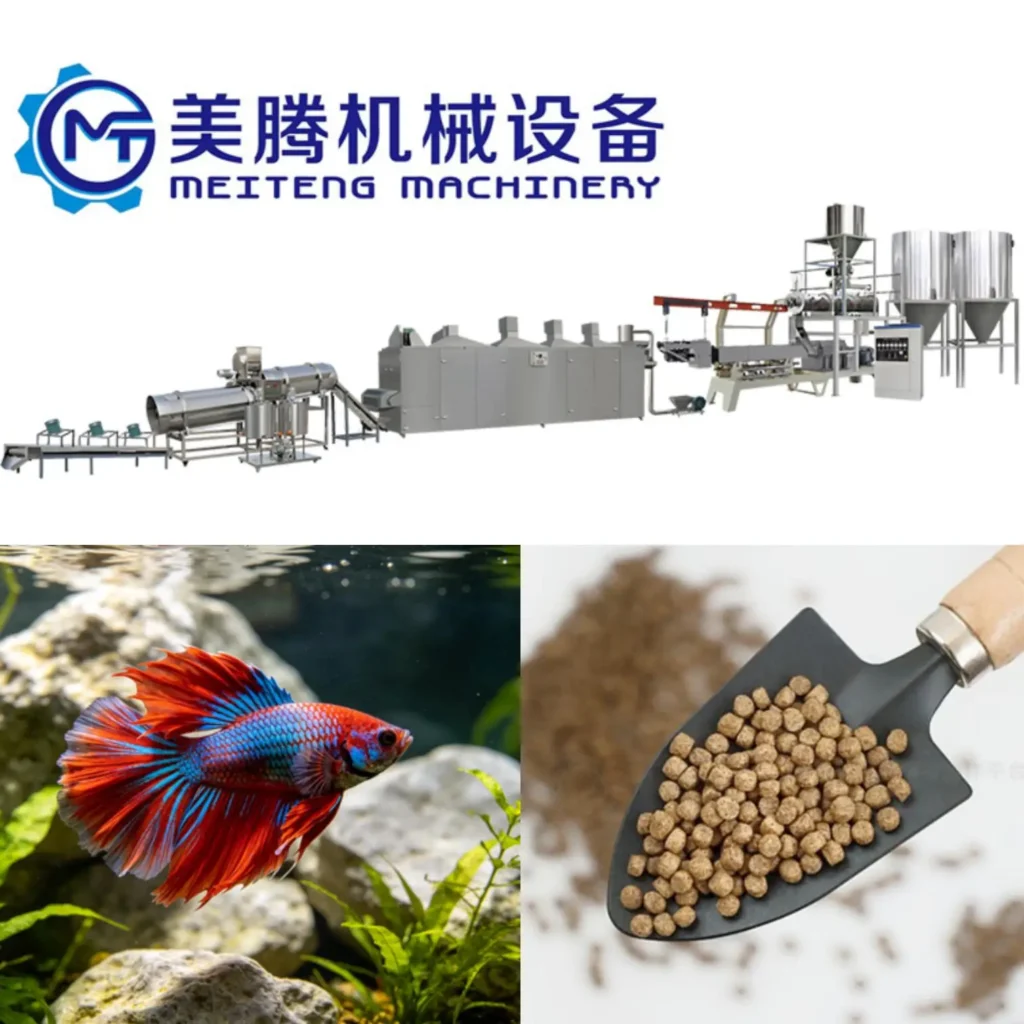
Screw and Die Matched to Your Raw Material — every twin-screw configuration in this fish feed extrusion line is specified after trial runs on the buyer’s actual formulation, not copied from a generic catalog.
Technical Specifications
| Parameter | Value |
|---|---|
| Product Type | Twin-Screw Fish Feed Extrusion Line |
| Output Capacity | 1.0–1.2 t/h (basis not stated in source — confirm raw material formulation, moisture content and pellet size) |
| Extruder Type | Twin-screw |
| Construction Material | 304 stainless steel (food-grade contact parts) |
| Target Species | Trout, salmon, catfish and other aquaculture species |
| Control System | Available with PLC or MCC control (destination requirements to be confirmed) |
| Voltage & Frequency | Configurable to destination market requirements |
| Screw Configuration & Die Design | Matched to buyer’s raw material and pellet specification |
| Line Stations | Configurable: batching, mixing, extrusion, drying, coating, cooling, packing (scope to be confirmed) |
| Certification | CE and ISO declarations available upon request |
Application Suitability
| Application | Material or Output |
|---|---|
| Floating pellet production for trout and salmon | High-protein fish meal, wheat flour, starch blends at controlled moisture |
| Sinking pellet production for catfish | Soybean meal, corn flour, vitamin and mineral premix |
| Mid-to-high volume feed mill expansion | Formulations with alternative protein or starch sources requiring screw re-specification |
| Multi-species feed manufacturing on a single line | Variable formulations with differing starch gelatinisation requirements |
Why Pellet Floatability Fails Before the Line Even Ships
A floating pellet that sinks, or a sinking pellet that fractures, is almost always a screw and die mismatch — not an operator error.
When I first started working on the assembly floor, I watched a batch of aquatic feed leave the factory with a standard screw build. The buyer ran it on a high-protein formulation, and the pellets sank when they should have floated. The extruder itself was fine; the configuration simply was not designed for that raw material [NEED_CITE: starch gelatinisation thresholds at varying protein ratios in aquatic feed extrusion]. On this fish feed extrusion line, the screw combination and die geometry are selected based on the buyer’s specific formulation, moisture content and target pellet diameter — so float-or-sink behaviour is verified before the machines leave the testing workshop.
Barrel Temperature Zones and Starch Gelatinisation Control
Twin-screw extrusion relies on precise thermal input across multiple barrel zones to achieve consistent starch gelatinisation. In fish feed production, the gelatinisation degree directly determines pellet durability in water and the nutritional availability of the feed. The barrel on this fish feed extrusion line features independently controlled heating zones, allowing the temperature profile to be shaped around the specific starch-to-protein ratio in the formulation. Too little heat and the starch remains ungelatinised, producing fragile pellets that disintegrate before the fish can consume them. Too much heat and the protein denatures unevenly, altering the pellet density and compromising floatability.
Moisture, Shear and the Float-vs-Sink Equation
Whether a pellet floats or sinks is governed by its internal expansion structure, which is a function of moisture content at the die face, the shear energy imparted by the screw elements and the pressure differential as the melt exits the die. For floating trout or salmon pellets, higher expansion is needed — achieved through specific screw element sequencing that builds sufficient shear and a die design that controls the rate of pressure release. Sinking catfish pellets require the opposite: lower expansion, denser structure, and a different screw profile [NEED_CITE: expansion ratio and pellet density relationship in twin-screw aquatic feed extrusion]. The screw configuration record for each line documents the exact element arrangement and die geometry selected for the buyer’s formulation, rather than relying on a default build.
What the Specification Sheet Means for Your Production
The twin-screw design is chosen over single-screw for aquatic feed because it handles a wider range of raw material particle sizes and fat contents, which vary significantly across fish species formulations. The 304 stainless steel contact surfaces prevent corrosion from the high-moisture, high-salt conditions typical of fish feed production — a material choice that matters when the extruder runs six days a week in a humid processing environment. The available PLC or MCC control system maintains consistent barrel temperatures and screw speed across production runs, reducing batch-to-batch variation in pellet density. Because voltage and frequency are confirmed before production begins, the motor and heating elements are wound to match the destination market’s electrical supply, avoiding the commissioning delays that arise when a 50 Hz machine is shipped to a 60 Hz facility [NEED_CITE: voltage and frequency standards by export market].
The Hidden Cost of a Generic Screw Build
A screw configuration copied from a different product line may run, but it will not hold the target pellet specification consistently. The extruder appears to be producing acceptable feed during the first hour, then drift begins — pellets start sinking when they should float, or the surface texture becomes too rough for the coating drum to season evenly. The buyer then spends weeks adjusting moisture, barrel temperatures and screw speed in the field, burning raw material and production time [NEED_CITE: field commissioning delays caused by incorrect screw configuration in feed extrusion]. These are problems that a matched screw and die build, verified through a pre-shipment trial run, prevent entirely.
Why This Line Is Built Around Your Formulation
Every screw element sequence is specified after reviewing the buyer’s raw material data sheet and target pellet specification, not pulled from a standard library. The in-house testing workshop runs the buyer’s actual formulation through the extruder before shipment, generating a trial run report that documents pellet density, expansion ratio and floatability results. Line throughput is calculated station by station — mixing, extrusion, drying, coating, packing — so that no single station becomes a bottleneck. The 304 stainless steel contact materials are used throughout product zones, meeting food-grade requirements for aquatic feed production in regulated markets. Electrical schematics and control language are confirmed with the buyer before production starts, so the control panel speaks the operator’s language and the motor matches the local grid.
Documentation & Verification
- Screw and die configuration record matched to your aquatic feed formulation
- Trial run report on your raw material confirming pellet density and floatability before dispatch
- Line layout with capacity calculation showing throughput balance across all stations
- Electrical schematic with voltage, frequency and control language confirmed pre-production
- CE declaration of conformity and ISO certificate included with shipping documents
- Operation and maintenance manual covering screw element inspection intervals
Installation, Commissioning & Support
- Foundation load and floor space plan based on the confirmed line station configuration
- Dedicated power circuit sized to the extruder motor rating and barrel heater load
- Pre-assembled barrel sections with screw elements sequenced to your formulation on arrival
- First-run parameter logging during on-site commissioning to establish baseline settings
- Operator training covering screw speed, barrel temperature zones and moisture adjustment
- Wear parts list with screw element and die replacement schedule for your production volume
What to Share With Your Inquiry
To configure this fish feed extrusion line for your facility, the most useful starting information includes your target pellet diameter and float-or-sink requirement, the primary protein and starch sources in your formulation, and the local voltage and frequency at your plant. If you have existing upstream mixing or downstream drying equipment, noting the throughput and connection points helps match the line stations correctly. Letting us know whether you need a pre-shipment trial run on your raw material will determine the timeline for testing workshop scheduling.
Frequently Asked Questions
Q: How is the 1.0–1.2 t/h capacity verified, and what does it depend on?
A: That capacity figure depends on the raw material formulation, moisture content and pellet size being produced. A high-protein trout feed formulation behaves differently through the extruder than a corn-based catfish feed. The actual throughput is confirmed during a trial run on your specific raw material, and the result is documented in the trial run report before shipment.
Q: How are screw configuration and die design selected for my formulation?
A: The screw element sequence and die geometry are chosen based on your raw material data — protein content, starch type, fat percentage and target pellet specification. The configuration is documented in a record that travels with the machine, so replacements and adjustments can reference the original design intent rather than guesswork.
Q: What determines whether a pellet floats or sinks?
A: Floatability is governed by the pellet’s internal expansion structure, which is controlled through moisture at the die face, shear energy from the screw elements and pressure release rate at the die. Floating pellets need higher expansion; sinking pellets need a denser, lower-expansion structure. Both are achieved through specific screw and die configurations verified during the trial run.
Q: Can a trial run be done on my raw material before shipment?
A: Yes. The testing workshop runs your actual formulation through the extruder, producing pellets that are measured for density, expansion ratio and floatability. The trial run report is shared with you before the line ships, so any screw or die adjustments are made at the factory rather than during field commissioning.
Q: How is barrel temperature managed across zones for different formulations?
A: Each barrel zone has independent temperature control, allowing the profile to be shaped to your formulation’s starch gelatinisation requirements. A high-starch formulation may need a gradual temperature ramp, while a high-protein mix requires a flatter profile. The PLC or MCC control system maintains these settings consistently across production batches.