Extrusion-Specific Screw Profiling — every corn flakes extrusion production line technology configuration we ship is matched to the buyer’s corn grit particle size and starch content, not copied from a generic build.
Technical Specifications
| Parameter | Value |
|---|---|
| Product Type | Corn Flakes Production Line / Breakfast Cereal Processing Line |
| Output Capacity | up to 750 kg/hr (basis not stated in source — confirm raw material formulation, moisture content, and product format) |
| Product Range | Natural corn flakes, sugar-coated flakes, various shaped breakfast cereals |
| Control System | PLC / MCC (confirm preference and operator language) |
| Motor | Industrial-grade drive (rated power to be confirmed based on line capacity) |
| Line Layout | Customizable engineered drawings tailored to specific factory sizes |
| Voltage & Frequency | Configurable to target market (to be confirmed before production) |
| Certification Standards | CE, ISO |
| Screw Type | Single or twin screw (to be confirmed based on formulation) |
| Raw Material Compatibility | Corn grits, corn flour, multi-grain blends |
Application Suitability
| Application | Material or Output |
|---|---|
| Natural corn flakes from grits | Degerminated corn grits, standard moisture content |
| Sugar-coated breakfast flakes | Corn flour or grits with syrup coating stage |
| Multi-grain cereal formats | Blends of corn, wheat, rice, or oat flour |
| Fortified breakfast cereals | Grain base with added vitamin and mineral premix |
| Shaped puffed cereal pieces | Corn-based dough with die-cut forming |
Why Corn Flake Density Fails When the Screw Build Is Generic
A screw configuration designed for puffed snacks will produce corn flakes that shatter during toasting or sink to the bottom of the milk bowl within seconds.
The corn flakes extrusion production line technology at the heart of this process depends entirely on how well the screw profile, barrel temperature zones, and die geometry match your specific corn grit formulation. I spent five days on-site with a Middle Eastern client last year because their local corn supply carried higher fat content than our trial material. The expansion behaviour shifted completely — flakes came out uneven in thickness, some too dense to toast evenly, others too fragile to survive the coating drum. Generic builds do not account for that kind of variation, and the cost shows up after the machine is already bolted to your floor [NEED_CITE: raw material variability in cereal grain supply chains].
Starch Gelatinisation Depends on Barrel Zone Discipline
Corn flakes require a precise degree of starch gelatinisation — enough to bind the dough sheet, but not so much that the flake turns glassy after toasting. The barrel temperature profile must ramp gradually across multiple heating zones, and each zone must hold its setpoint regardless of ambient workshop conditions. When we configure the corn flakes extrusion production line technology for a new buyer, the zone-by-zone profile is documented against their specific grit moisture content and particle size distribution.
Shear, Moisture, and the Dough Window Before Flaking
The dough exiting the extruder must sit in a narrow consistency window — firm enough to hold shape through the flaking rolls, yet pliable enough to compress into a uniform sheet without cracking at the edges. Moisture injection points and screw element spacing together control that window. A configuration that works for low-fat degerminated grits will produce a sticky, unworkable dough when the fat content rises even slightly, which is why we insist on running the buyer’s actual material before any line leaves our testing workshop.
Reading the Specs That Actually Matter for Flake Quality
The L:D ratio determines how long the dough stays under heat and shear — too short and the starch never fully gelatinises, leaving a raw centre that blisters during toasting. Die geometry controls the cross-section of the extrudate rope before it enters the flaking rolls, and that cross-section directly governs final flake thickness and edge integrity. The control system, whether PLC or MCC, must maintain barrel zone setpoints within tight tolerances; even a few degrees of drift in the gelatinisation zone can shift the entire batch from crisp to brittle [NEED_CITE: starch gelatinisation temperature thresholds in corn processing]. Motor power must also be matched to the viscosity of high-starch dough, which demands more torque than a puffed snack formulation would require.
What Happens When the Line Is Assembled from Mismatched Stations
An extruder that outpaces the flaking rolls creates a backlog of cooling dough that skins over before it reaches the rolls, producing flakes with inconsistent thickness. A coating drum that cannot keep up with the toaster output means some flakes receive double the syrup while others pass through bare. These bottlenecks do not appear in a catalogue — they appear on the first production day, when throughput numbers never materialise and the buyer realises the stations were never balanced [NEED_CITE: throughput matching across cereal production line stations].
Why Engineers Choose This Line Configuration
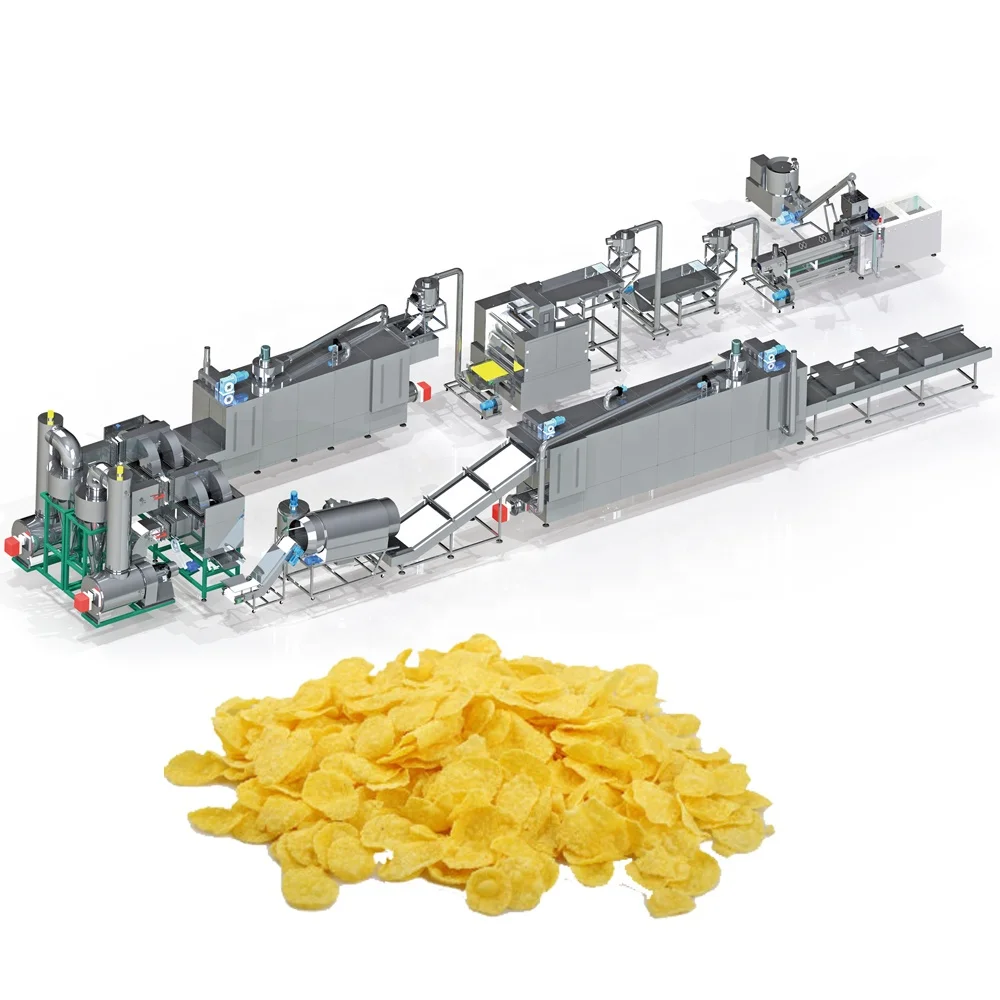
Every station on the line — from the batching system through extrusion, flaking, toasting, coating, and packing — is sized as a single integrated project, so throughput is matched end to end rather than assembled from unrelated vendors. The screw configuration and die design are specified to the buyer’s actual corn grit source and target flake thickness, not pulled from a standard library. Our in-house testing workshop runs the buyer’s raw material before shipment, generating a documented trial report that includes barrel zone temperatures, moisture readings, and flake density measurements. The same engineering team that designs the line layout handles on-site installation and commissioning, so the people who configured the screw profile are the ones watching the first production run.
Documentation & Verification
- Line layout drawing with station-by-station throughput calculation for your target capacity
- Screw and die configuration record matched to your corn grit specification
- Trial run report on your raw material with barrel zone temperature and moisture data
- Electrical schematic with confirmed voltage and frequency for your facility
- CE declaration of conformity and ISO certificate for import clearance
- Operation and maintenance manual in your operator’s language
Installation, Commissioning & Support
- Engineered foundation plan based on actual extruder and flaking roll dimensions and weight distribution
- Dedicated power circuit specification with confirmed voltage and frequency before shipment
- Pre-dispatch factory test with your corn grit formulation verified in our testing workshop
- On-site barrel zone calibration and screw speed tuning during initial commissioning runs
- Operator training on die changeover and moisture adjustment for different flake formats
- Wear parts list covering screw elements, die inserts, and flaking roll surfaces
Before You Request a Quotation
To configure the corn flakes extrusion production line technology correctly, we need your corn grit source and specification sheet — particle size distribution, fat content, and moisture level at intake. Share your target daily output, the flake formats you plan to produce, and your workshop dimensions including ceiling height. Confirm your local voltage, frequency, and preferred control language so the electrical design matches your facility from day one.
Frequently Asked Questions
Q: How does screw configuration affect corn flake density and expansion?
A: The screw element arrangement controls shear intensity and residence time inside the barrel, which directly governs how completely the starch gelatinises. Under-gelatinised dough produces dense flakes that resist toasting, while over-worked dough creates fragile flakes that break during coating. The configuration must match your specific corn grit particle size and starch content to land in the correct density window.
Q: What barrel temperature profile is needed for proper starch gelatinisation in corn flakes?
A: Corn flakes typically require a gradual temperature ramp across multiple barrel zones, holding steady at each stage to allow moisture penetration before the gelatinisation zone. The exact setpoints depend on your grit moisture content and fat level. We document the full zone-by-zone profile during the pre-shipment trial run on your actual raw material.
Q: How is die design matched to target flake shape and thickness?
A: The die opening determines the cross-section*ls. A wider opening produces thicker flakes with more bite, while a narrower opening yields thinner, crisper formats. We specify the die geometry based on your target flake dimensions and the compression ratio of your flaking rolls.
Q: What moisture range produces optimal dough consistency before the flaking stage?
A: The dough must be firm enough to hold its shape through the rolls yet pliable enough to compress without edge cracking. The target moisture range depends on your corn grit absorption characteristics and fat content. We establish the exact range during the in-house trial and record it in the configuration documentation shipped with your line.
Q: How do you run a trial on my specific corn grit formulation before line delivery?
A: Send us a representative sample of your production corn grits — typically a few hundred kilograms is sufficient. We run the full extrusion and flaking sequence in our testing workshop using the screw and die configuration specified for your line, then share the trial report including barrel temperatures, moisture data, and flake density measurements before the machine ships.