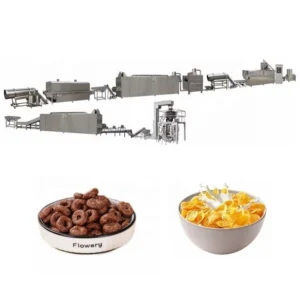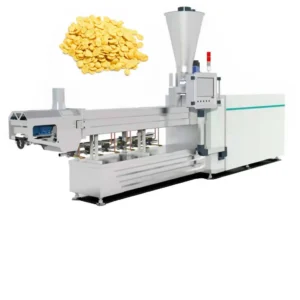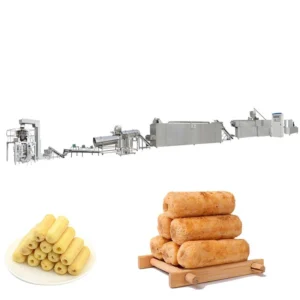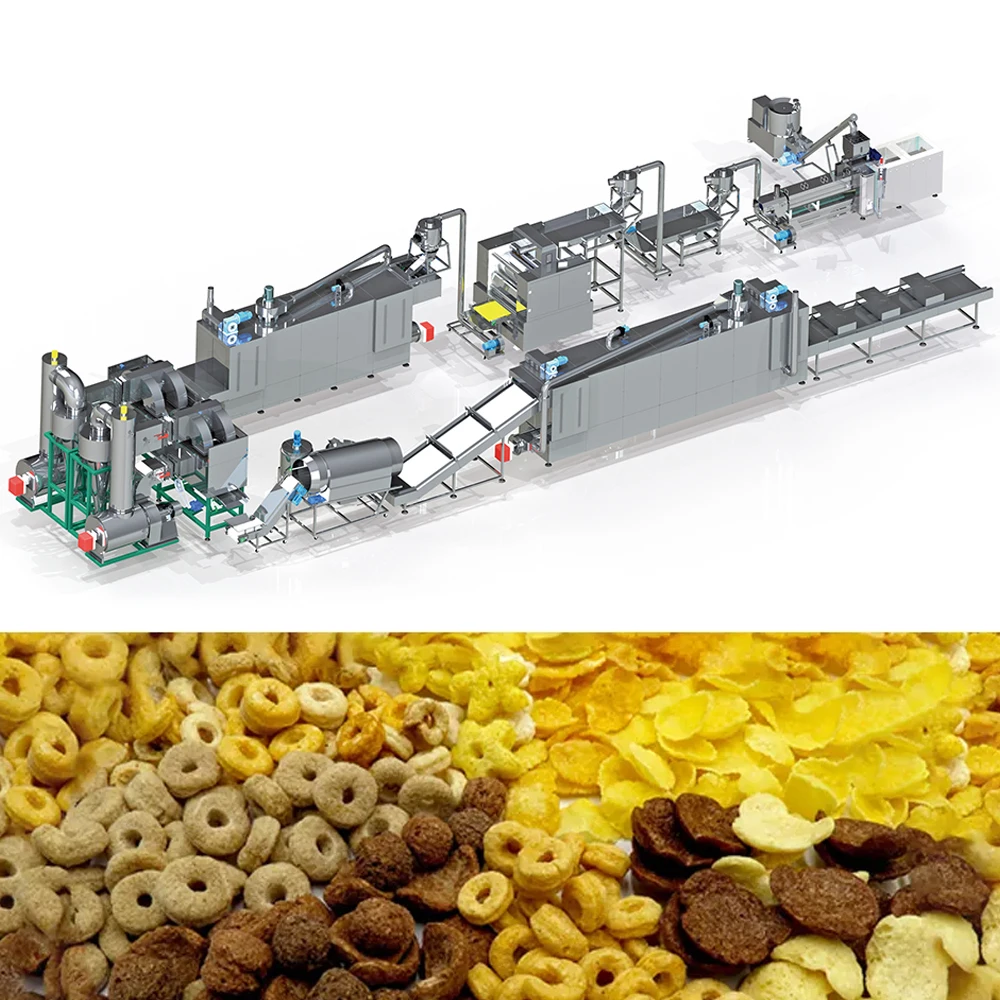
Screw Geometry Defined by Your Recipe — Every barrel zone and die land on this line is calculated against the buyer’s actual corn flour blend and target flake density, not copied from a generic build.
Technical Specifications
| Parameter | Value |
|---|---|
| Product Type | Corn Flakes Breakfast Cereal Production Line |
| Models Available | MT70 / MT85 / MT75 |
| Extruder Screw Type | Twin Screw |
| MT70 Installed Power | 160 kW |
| MT70 Power Consumption | 120 kW |
| MT70 Capacity | 150–200 kg/h (basis not stated in source) |
| MT70 Overall Dimensions | 41 × 1.5 × 2.2 m |
| MT85 Installed Power | 190 kW |
| MT85 Power Consumption | 140 kW |
| MT85 Capacity | 300–400 kg/h (basis not stated in source) |
| MT85 Overall Dimensions | 43 × 1.5 × 3.2 m |
| MT75 Installed Power | 210 kW |
| MT75 Power Consumption | 150 kW |
| MT75 Capacity | 300–500 kg/h (basis not stated in source) |
| MT75 Overall Dimensions | 45 × 1.5 × 3.5 m |
| MT-75 Extruder Capacity | 200–300 kg/h (basis not stated in source) |
| Extruder Features | Automatic lubricating and cooling function; wear-resistant screw |
| Dryer Heating Source | Gas / Electric |
| Flaking Machinery Control | PLC control system |
| Flaking Machinery Roller Drive | Double motors for separate roller driving; hydraulic system for double rollers |
| Flaking Machinery Temperature Control | Infrared sensor for even temperature pipe control |
| Roasting Oven Type | Hot air roasting oven |
| Roasting Oven Components | Vibrating pan, high-temperature spraying tubes, conciliation burner combustion chamber, two circulating fans, cyclone dust removal device |
| Coating System Components | Double tumble for sugar melting, elevator, coating drum, spraying nozzle |
| Control System | PLC and MCC |
| Line Stations | Mixing → Extrusion → Flaking → Drying → Hot Air Roasting → Sugar Coating → Seasoning |
| Standards | CE, ISO |
| Warranty | 24 months, lifetime service |
Application Suitability
| Application | Material or Output |
|---|---|
| Classic corn flakes | Corn grits or corn flour, plain or sugar-coated |
| Chocolate breakfast cereal | Corn base with cocoa coating, Chocapic-type formats |
| Fortified breakfast cereal | Grain blends with added vitamin and mineral premix |
| Various shaped cereal snacks | Alternative grain formulations using shared line equipment |
What a Generic Screw Configuration Costs You Downstream
A corn flakes extrusion technology setup copied from a standard template produces pellets with the wrong expansion ratio, and that error compounds through every station that follows.
I have watched a line where the die geometry was never adjusted for the buyer’s local corn variety. The pellets came out of the flaking rolls too dense, so they never blistered properly in the roasting oven. The client ended up with flakes that sank in milk and broke apart in the bowl — a texture problem the market rejected immediately. The extruder ran fine mechanically; the product was simply wrong. That outcome traces back to one decision: treating the corn flakes production line screw configuration as an afterthought instead of the foundation. [NEED_CITE: starch gelatinisation requirements for corn-based extrusion]
How Screw Profile and Barrel Zones Shape the Pellet
The twin-screw extruder on this line allows modular screw element arrangement — mixing, kneading, and conveying sections can be sequenced to match the starch behaviour of a specific corn flour blend. Barrel zones are individually heated and monitored, so the temperature profile can be ramped to hit the exact gelatinisation window needed for corn starch. When the moisture content and shear history are correct at the die face, the pellet exits with uniform density and a consistent internal structure that the flaking rolls can compress evenly.
Moisture, Shear, and the Expansion Window
Corn flakes require a narrow expansion range — too much puff and the flake shatters during roasting; too little and it stays hard and chewy. The moisture injected during mixing, combined with the shear energy from the screw elements, determines where the pellet sits in that window. This is where corn flakes extrusion technology separates a controlled process from guesswork. The PLC system logs barrel temperatures, screw speed, and feed rate so that every batch can be replicated once the correct parameters are established during the trial phase. [NEED_CITE: extrusion moisture and shear interaction in cereal processing]
Reading the Numbers That Actually Matter
The MT70, MT85, and MT75 platforms span different throughput ranges, but installed power and overall dimensions tell only part of the story. The MT-75 extruder references a twin-screw configuration with automatic lubricating and cooling, which matters for continuous runs where bearing heat can drift screw clearances out of tolerance. The flaking machinery uses separate motor drives on each roller with a hydraulic gap system — this means the gap between the rollers stays constant even as wear occurs, maintaining uniform flake thickness across the full roller width. The hot air roasting oven uses a conciliation burner with two circulating fans and a cyclone dust removal device, giving precise control over surface blistering without scorching the flake interior. These are the specifications that determine whether the line produces a sellable product, not just whether it runs.
The Bottleneck Nobody Planned For
Matching extruder output to flaking roll capacity is the obvious step. The failure point I see more often is the drying and roasting stages. A dryer that cannot remove moisture fast enough forces the entire front end to slow down, and a roasting oven with insufficient residence time produces flakes that look done on the surface but retain internal moisture — leading to sogginess within hours of packaging. These imbalances are invisible on a quotation that lists each machine at its nominal rating. [NEED_CITE: throughput balancing across cereal production line stations]
Why Engineers Specify This Line
The screw and die configuration is documented to the buyer’s raw material before production starts, not borrowed from a previous project. Every corn flakes production line screw configuration record includes the specific element arrangement, die land length, and barrel temperature profile used during the trial. The in-house testing workshop runs the buyer’s actual corn flour blend so that expansion ratio, pellet density, and flake texture are verified before the equipment ships. Throughput is calculated across every station — extruder, flaking rolls, dryer, roasting oven, coating drum — as a single system, so no section waits on another. Electrical schematics confirm voltage, frequency, and PLC control language for the buyer’s target market before fabrication begins. The line arrives as a coordinated system from mixing through packing, not a collection of standalone machines from separate vendors.
Documentation & Verification
- Screw and die configuration record matched to your corn flour blend and target flake density
- Trial run report on your raw material covering expansion ratio, pellet density, and moisture readings
- Line layout with capacity calculation confirming balanced throughput at every station
- Electrical schematic with voltage, frequency, and PLC language confirmed for your market
- CE declaration of conformity and ISO certificate for customs and regulatory clearance
- Operation and maintenance manual with wear parts list in English
Installation, Commissioning & Support
- Foundation plan accounts for the full line footprint up to 45 × 1.5 × 3.5 m across all stations
- Dedicated power circuits sized for installed loads up to 210 kW on the MT75 platform
- Equipment ships in sectional modules for container loading and on-site reassembly
- Commissioning includes first-run parameter setting on extruder barrel zones and flaking roll gap
- Operator training covers PLC interface navigation, screw element changeover, and roasting oven tuning
- Wear parts list covers screws, dies, and roller surfaces with reorder specifications
What to Include in Your Inquiry
To move from a general enquiry to a usable line proposal, we need your corn flour specification — including particle size, moisture content, and any vitamin or mineral premix you plan to add. Confirm your local voltage and frequency, the PLC control language your operators require, and the daily output target so we can size each station without guesswork. If you have an existing mixer upstream or a packaging system downstream, share those details so the integration points are defined before fabrication.
Frequently Asked Questions
Q: How is the screw configuration and die design matched to my specific corn flour blend and target flake density?
A: We start with your raw material data — particle size, moisture, starch content, and any additives. The screw element sequence and die geometry are then calculated to hit the gelatinisation and expansion targets your flake requires. A trial run in our testing workshop confirms the result before the line is built.
Q: Can a trial run be performed on my raw material before shipment?
A: Yes. Our in-house testing workshop runs your actual corn flour through the extruder, flaking rolls, and a sample roasting cycle. The trial report documents expansion ratio, pellet density, moisture readings at each stage, and final flake texture so you can verify the product before the line ships.
Q: How is throughput balanced across extrusion, flaking, drying, roasting, and coating stations?
A: Each station is sized against the real output of the preceding one, not against its own nameplate rating. The capacity calculation covers residence time in the dryer and roasting oven, flaking roll pass rate, and coating drum cycle so that no section bottlenecks another during continuous production.
Q: What barrel temperature profile and moisture settings are used for corn flakes compared to other cereal formats?
A: Corn flakes require a specific gelatinisation window that differs from, say, puffed rice or multigrain loops. The barrel zone temperatures and moisture injection points are set during the trial run and recorded in the configuration document, giving you a repeatable baseline for every production batch.
Q: How are voltage, frequency, and PLC control language confirmed before production starts?
A: We request your site electrical specification and operator language preference during the proposal stage. The electrical schematic and PLC program are then built to those requirements and verified during the factory test, so the line powers up correctly on arrival without rewiring or reprogramming delays.