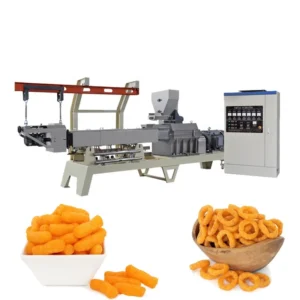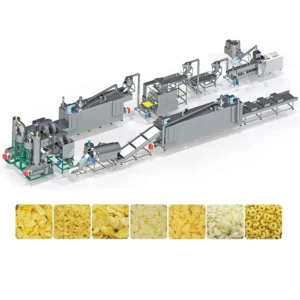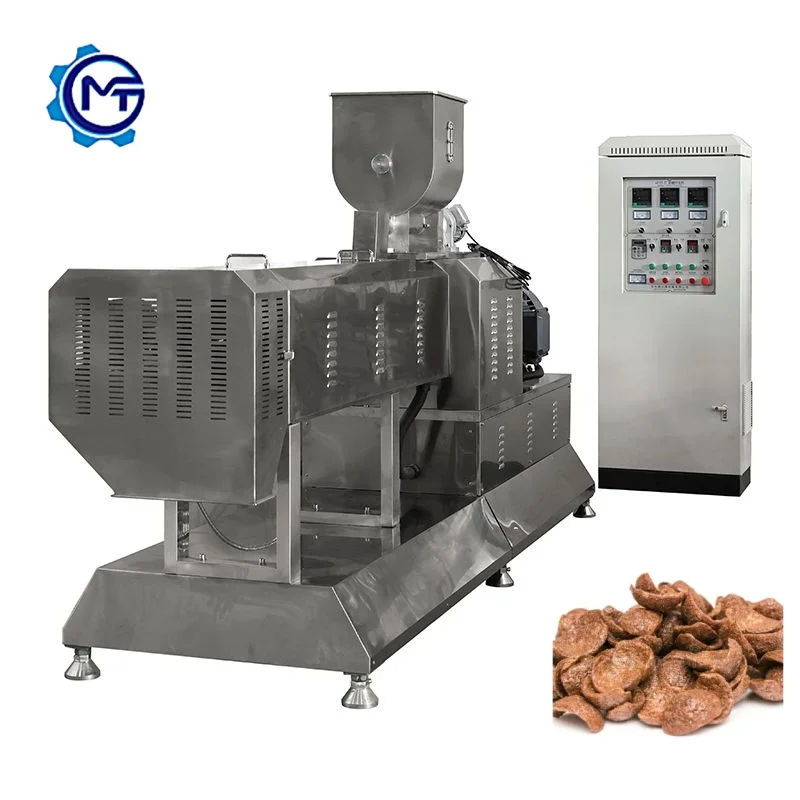
In-house testing workshop — trial runs on the buyer’s actual corn, oat, or wheat formulation verify expansion, density, and flake surface blistering before the extrusion line is finalized for shipment.
Technical Specifications
| Parameter | Value |
|---|---|
| Product Type | Twin Screw Extruder Corn Flakes Production Line |
| Models Available | MT70, MT75, MT85 |
| Screw Type | Twin Screw |
| Line Stations (Natural) | Mixing → Extruding → Flaking → Drying → Hot Air Roasting → Cooling → Packing |
| Line Stations (Sugar-Coated) | Mixing → Extruding → Flaking → Drying → Hot Air Roasting → Sugar Spraying → Sugar Coating → Drying → Cooling → Packing |
| Raw Materials | Corn, rice, wheat, oat, barley powder |
| MT70 Installed Power | 160 kW |
| MT70 Power Consumption | 120 kW |
| MT70 Output Capacity | 150–200 kg/h (basis not stated in source — confirm raw material and moisture content) |
| MT70 Overall Dimensions | 41 × 1.5 × 2.2 m |
| MT75 Installed Power | 210 kW |
| MT75 Power Consumption | 150 kW |
| MT75 Output Capacity | 300–500 kg/h (basis not stated in source — confirm raw material and moisture content) |
| MT75 Overall Dimensions | 45 × 1.5 × 3.5 m |
| MT85 Installed Power | 190 kW |
| MT85 Power Consumption | 140 kW |
| MT85 Output Capacity | 300–400 kg/h (basis not stated in source — confirm raw material and moisture content) |
| MT85 Overall Dimensions | 43 × 1.5 × 3.2 m |
| Extruder Working Principle | Feeding, extruding, cutting, heating, gearing, controlling systems |
| Extruder Key Features | Automatic lubricating, cooling function, wear-resistant screw technology |
| Dryer Heating Source | Gas or Electric (configurable) |
| Flaking Machinery Control | PLC control system |
| Flaking Machinery Drive | Hydraulic system for double rollers; double motors for separate roller driving |
| Flaking Temperature Control | Infrared sensor for even temperature pipe control |
| Hot Air Roasting Oven | Vibrating pan, high-temperature spraying tubes, conciliation burner combustion chamber, two separate circulating fans, cyclone dust removal |
| Coating System | Double tumble for sugar melting, elevator, coating drum, spraying nozzle |
| Control System | PLC |
| Final Product Shapes | Ball, tube, stick, ring, fruit loop, star, wheel, flower, heart (adjustable via extruder mould) |
| Standards | CE, ISO |
Application Suitability
| Application | Material or Output |
|---|---|
| Natural corn flakes production | Corn powder, corn grits |
| Sugar-coated breakfast cereals | Corn, rice, wheat base with sugar syrup coating |
| Multi-grain flake formats | Oat, barley, wheat, rice blends |
| Shaped cereal snacks | Ball, ring, star, wheel, heart, fruit loop forms from corn or rice base |
| Fortified breakfast cereal lines | Grain blends with added micronutrient premix |
What Grain Particle Size Means for Your Corn Flakes Extrusion Output
A line rated on one corn grit specification can underperform significantly on a coarser or higher-moisture flour blend.
I planned a corn flakes line for a Middle East buyer several years ago. The capacity figure in the contract was based on a standard refined corn grit, but their local supplier delivered a noticeably coarser flour with inconsistent moisture. The extruder barrel could not gelatinize the starch evenly, expansion dropped, and throughput fell well short of the nameplate figure. The lesson was costly and avoidable. Today, before any corn flakes extrusion production line technology configuration is locked in, I insist on running the buyer’s actual raw material through the testing workshop to confirm what the screws, barrel zones, and die can actually deliver [NEED_CITE: raw material variability impact on extrusion throughput].
Screw Configuration and Barrel Temperature Zones
The twin-screw extruder in this line uses a modular screw arrangement where element pitch, kneading block angle, and reverse-flight sections are selected to match the starch gelatinization window of the target grain. Corn requires a different barrel temperature profile from oat or wheat because its starch granules swell and rupture at distinct thresholds. The automatic lubricating and cooling function on the MT75 extruder maintains stable barrel conditions across long runs, preventing localized overheating that would scorch the dough and compromise flake surface quality. This level of control is central to how corn flakes extrusion production line technology achieves consistent flake density from batch to batch.
Die Geometry and Flake Expansion Control
The die plate at the extruder discharge determines the cross-section of the extrudate rope before it enters the flaking rolls. A round die with a specific land length produces a cylindrical rope that, when flattened between hydraulic double rollers, yields the familiar oval flake shape with uniform edges. Switching to a star or ring die opens the line to shaped cereal formats without changing downstream equipment. Infrared temperature monitoring on the flaking machinery ensures the rope arrives at the nip point within the correct thermal window, which directly governs how cleanly the rollers compress the material and how well the surface blisters during subsequent roasting [NEED_CITE: die land length and extrudate expansion relationship].
Reading the Power and Capacity Figures
The MT75 draws 210 kW installed and consumes approximately 150 kW during steady-state operation across its 45-meter line footprint. Output capacity figures for each model are published ranges, but those numbers assume a specific raw material grade and moisture level — values that shift when a buyer sources corn locally in a different region. The MT70 and MT85 follow the same principle: installed power and dimensions scale with throughput envelope, yet actual output must be validated on the buyer’s formulation. This is why the testing workshop trial is non-negotiable. The PLC control system logs barrel temperatures, screw speed, and moisture dosing throughout the trial, producing a data set that anchors the production recipe before the line leaves the factory.
The Cost of Skipping the Raw Material Trial
Buyers who skip the trial run often discover problems only after the extruder is bolted to their factory floor. The screw configuration optimized for one corn variety may produce dense, under-expanded pellets with another, forcing the roasting oven to work longer and consume more energy to achieve acceptable crispness. The flaking rolls, set for a specific rope diameter and moisture content, may tear rather than compress the extrudate, generating excessive fines that the cyclone dust removal system must handle. Every downstream station — dryer, roaster, coating drum — was sized for a throughput and product geometry that no longer matches reality [NEED_CITE: extrusion line bottleneck causes in breakfast cereal production]. These mismatches are far more expensive to correct on-site than to resolve during a pre-shipment trial.
Why Source This Line from Meiteng
The entire production sequence from batching through packing is supplied as one integrated system, so throughput at the flaking rolls, dryer, and roasting oven is matched to the extruder output rather than assembled from independent vendors. Screw configuration and die design are specified against the buyer’s actual raw material formulation, documented in a configuration record that travels with the machine. The in-house testing workshop allows trial runs on the buyer’s corn, oat, or wheat blend before shipment, generating a report that confirms expansion ratio, flake density, and surface quality targets. Twin-screw extrusion expertise spans corn flakes, multi-grain cereals, and shaped snack formats, meaning the same engineering team handles recipe development and mechanical design. Pre-sales consultation extends through on-site installation, commissioning, and operator training to ensure the PLC recipes developed during trials transfer cleanly to daily production.
Documentation & Verification
- Line layout and capacity calculation matched to your corn or oat blend and target flake density
- Screw and die configuration record documenting element arrangement for your specific raw material
- Trial run report on your actual grain formulation covering expansion, moisture, and texture data
- Electrical schematic with voltage and frequency confirmed for your facility before production starts
- Factory test record with PLC-logged barrel temperatures and screw speeds from the pre-shipment run
- CE declaration of conformity and ISO certificate included with shipping documentation
Installation, Commissioning & Support
- Line footprint up to 45 × 1.5 × 3.5 m requires level concrete flooring with anchor points at extruder and flaking stations
- MT75 requires dedicated 210 kW supply; voltage and frequency confirmed before electrical panel assembly
- Extruder, flaking rolls, and roasting oven ship in sections for reassembly and alignment on-site
- First production run replicates trial workshop PLC recipes, with barrel zones and screw speed fine-tuned locally
- Operators trained on die changeover procedures for switching between flake, ring, and star formats
- Wear-resistant screws and hydraulic roller seals listed in spare parts schedule with replacement intervals
Before You Request a Quote
To configure the right extrusion platform, share your primary grain type and particle size distribution, the target flake thickness and bowl-life expectation, and whether sugar coating is part of the product range. Provide your facility voltage and frequency, available floor length and ceiling height, and any existing upstream milling or downstream packing equipment the line must integrate with. If your raw material source is already fixed, sending a sample for the testing workshop trial is the fastest path to a validated capacity figure.
Frequently Asked Questions
Q: How is screw configuration tuned for different cereal grains like corn, rice, or oat?
A: Each grain has a distinct starch gelatinization temperature and moisture absorption rate. The screw element arrangement — kneading block angles, reverse-flight sections, and conveying pitch — is adjusted to match that profile. Barrel temperature zones are then set to maintain the dough within the correct viscosity window for consistent expansion at the die.
Q: What determines whether corn flakes achieve correct density and surface blistering?
A: Flake density is governed by extrudate expansion at the die, compression ratio at the flaking rolls, and roasting temperature profile. Surface blistering depends on residual moisture and oven air velocity. All three parameters are logged during the pre-shipment trial run on the buyer’s actual grain to confirm targets are met before dispatch.
Q: Can the line produce multiple cereal shapes beyond standard flakes?
A: Yes. The extruder die plate is interchangeable, and the line supports ball, tube, ring, star, wheel, flower, and heart formats. Die changeover involves swapping the die insert and adjusting the cutting system timing. Downstream flaking rolls are bypassed for shaped products, with the dryer and roasting oven handling the extrudate directly.
Q: How is throughput matched between extruder, flaker, dryer, and roasting oven?
A: Each station is sized during the layout phase based on the extruder output confirmed in the trial run. The hydraulic flaking rolls, dryer belt length, and roasting oven residence time are calculated so no single station creates a bottleneck. This matched-throughput approach is documented in the line capacity calculation provided with the quotation.